



































Jamaat Walkout as President’s Speech Sparks Protests in Parliament




On the very first day of the first session of the 13th National Parliament, the main opposition party, Bangladesh Jamaat-e-Islami, staged a walkout from the House after rejecting the address of President Mohammed Shahabuddin. However, despite the walkout, the party continued to broadcast the President’s speech live to its followers through its verified Facebook page.
Opposition Leader and Ameer of Jamaat-e-Islami, Shafiqur Rahman, said during a live broadcast that the President was “guilty of three offences.” He said, “This President is guilty for three reasons. We cannot listen to his speech in this great Parliament. First, he was an accomplice in all the killings. Second, on 5 August 2024, he addressed the nation and said that the then fascist Prime Minister had resigned and that he had accepted it. But later he denied it, thereby proving himself a liar before the nation.”
As a third reason, the Jamaat Ameer said the President had personally signed an ordinance stating that there would be two ballots in the election and that those elected as Members of Parliament would also serve as members of the Reform and Amendment Council. The same individual would administer both oaths on the same day.
He said that although opposition members had taken the two oaths, the ruling party had not done so. According to him, the President’s first responsibility was to convene the session of the Reform Council within 30 days of issuing the ordinance, but he did not do so. He added that 70 percent of people voted “Yes” in the referendum, and by failing to act, the President had insulted those 70 percent of voters.
Earlier on Thursday (12 March), Speaker Hafiz Uddin Ahmed invited the President to deliver his speech in Parliament in accordance with parliamentary procedures. At that time, opposition MPs from Jamaat-e-Islami stood up in protest, holding placards bearing slogans such as “No betrayal over July” and “Stop betrayal with July.” The Speaker called on everyone to remain calm.
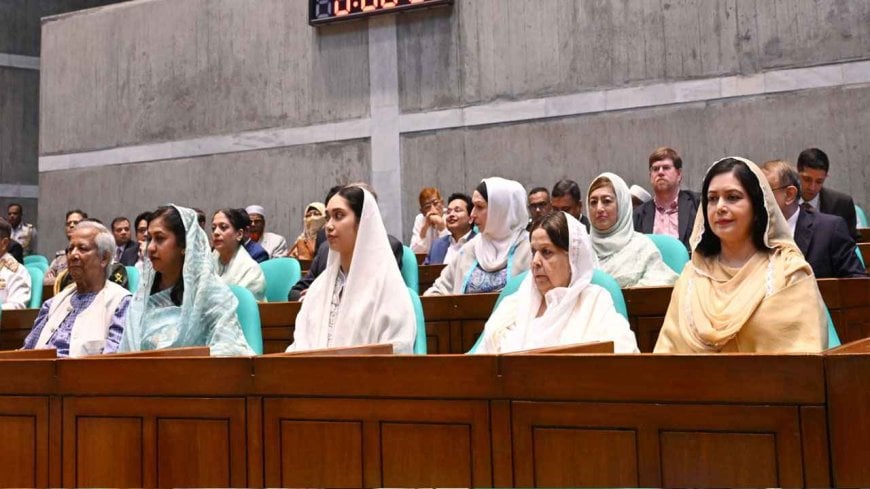
Meanwhile, in the visitors’ gallery of Parliament were seen former Chief Adviser of the recently concluded interim government Muhammad Yunus, Army Chief Waker-Uz-Zaman, Prime Minister Tarique Rahman’s wife Zubaida Rahman, his daughter Zaima Rahman, as well as the chiefs of the Navy and Air Force.
Amid protests, shouting, and commotion, the President entered the parliamentary chamber and took his seat beside the Speaker. Opposition MPs from Jamaat-e-Islami continued their protests in the House. However, when the national flag was raised and the national anthem was played, opposition MPs led by Jamaat stood up from their seats and stopped shouting.
The commotion resumed immediately afterward, as the President began his speech. During the address, the Prime Minister and MPs from the BNP were seen thumping their desks. Although the Speaker repeatedly requested the opposition MPs to listen to the President’s speech, they eventually staged a walkout.
In his address, the President informed the nation that the current number of voters in the country stands at approximately 127.7 million. In the recently held national election, more than 1.5 million expatriate voters registered for the first time through the “Postal Ballot App,” which he described as a commendable initiative by the Election Commission.
The President said that during the fascist regime, public confidence in the constitutional institution of the Election Commission had declined significantly. However, through the 13th national election, public trust in the Election Commission has been restored. He added that the government would ensure that future electoral processes maintain that confidence.
He further stated that the government would ensure that the Election Commission and other constitutional institutions are able to operate independently in accordance with the law.
The President also said that a new democratic Bangladesh free from subservience and fascism had emerged through the blood of thousands of martyrs. In the history of Bangladesh’s democracy, the mass uprising of students and citizens in July–August 2024 was a significant event. Through the collective movement of students, farmers, workers, teachers, journalists, intellectuals, expatriates, and pro-democracy political parties, the then fascist government fell on 5 August 2024.
He noted that in June 2001, the Bangladesh Awami League left office after making Bangladesh a champion in corruption. In October 2001, the government led by Khaleda Zia took strong measures against corruption and enacted the Anti-Corruption Commission Act, 2004 to prevent corruption, enabling Bangladesh to shed the stigma of being the world’s corruption champion.
Mohammed Shahabuddin further said that the quota reform movement eventually turned into an anti-fascist movement. The collective movement of people from all walks of life ultimately led to the fall of the then fascist government on 5 August 2024 and paved the way for a new democratic Bangladesh free from subservience and fascism.
Following the opposition walkout, newly elected Speaker Major (Retd.) Hafiz Uddin Ahmed (Bir Bikrom) adjourned the session until 11:00 am on Sunday (15 March). The second working day of the 13th Parliament will begin at 11:00 am on that day.
DBTech/DPMBT/MUM/OR









