





































Government Moves to Launch National Ambulance Pool and Emergency Service Network
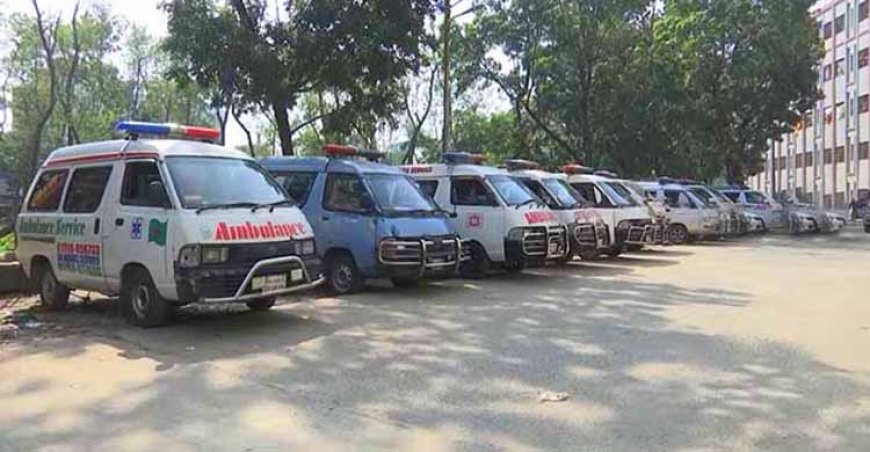



The government has taken an initiative to establish a National Ambulance Pool and Emergency Service Network to address long-standing challenges in Bangladesh’s ambulance sector, including the unavailability of ambulances during emergencies, excessive fare charges, broker syndicates, and poor coordination. According to the Health Services Division, preliminary planning for the project has already begun.
Officials concerned said that private ambulances will be brought under a centralized digital platform, enabling citizens to request ambulances quickly through a mobile application or call center. The proposed system is expected to operate in a manner similar to ride-sharing platforms such as Uber. Work is also underway on fare regulation, real-time vehicle tracking, and the development of an integrated emergency response network.
Sources at the Health Services Division said that an initial allocation of BDT 30 crore has been recommended for the initiative in the 2026–27 fiscal year. The proposal includes developing operational guidelines, defining service coverage, creating a maintenance framework, introducing an ambulance tracking system, and strengthening the existing health helpline 16263. A pilot project is expected to be launched first in Dhaka.
Notably, the formation of a National Ambulance Pool was included in the healthcare section of the election manifesto of the ruling Bangladesh Nationalist Party (BNP). The manifesto pledged to introduce technology-driven emergency healthcare services to ensure that no life is lost due to the inability to obtain an ambulance on time.
In line with that commitment, an initial meeting was held on May 23 under the chairmanship of Additional Secretary (Hospitals) Md. Khorshed Alam at the Health Services Division. Discussions focused on bringing private ambulances under a unified network and determining an appropriate centralized management structure.
Reliable sources within the division noted that although many ambulances are available across the country, the lack of centralized coordination often prevents emergency patients from receiving timely services. In many cases, ambulances remain idle in one area while patients elsewhere face long delays. To address this issue, the government plans to use an app- or call center-based system to identify and dispatch the nearest available ambulance. An MIS-based platform will also be introduced to facilitate faster coordination among patients, hospitals, and ambulance operators.
Speaking on the initiative, Md. Khorshed Alam, Additional Secretary of the Hospital Wing of the Health Services Division, said that the National Ambulance Pool remains in the planning stage. He explained that authorities are considering an app-based or call center-driven service through which ambulances can be summoned as easily as ride-sharing vehicles. Efforts will also focus on regulating fares, implementing tracking systems, and ensuring service quality.
The Health Services Division further stated that once the national network becomes operational, the government may introduce fixed fare structures based on distance traveled. Discussions have also been held on establishing a centralized call center modeled after Bangladesh’s national emergency service, National Emergency Service 999. In the next phase, broader consultations will be held involving the Bangladesh Road Transport Authority (BRTA), police, public and private hospitals, ambulance owners, and drivers.
However, stakeholders acknowledge that syndicates operating within the largely unregulated private ambulance sector may pose a significant challenge to the implementation of the new system. Despite these obstacles, the government remains optimistic about building an effective, technology-enabled emergency healthcare network in the public interest.
DBTech/JNO/EK/ORBRTA









