





































Policy Push Urged to Finance Digital Devices for Students, Boost Economy



To make digital devices accessible for students, a coordinated policy involving multiple government ministries, educational institutions, banks and financial institutions, and corporate entities is essential, speakers said. They believe that formulating a dedicated policy for financing digital devices could contribute several thousand crore taka to the national economy.
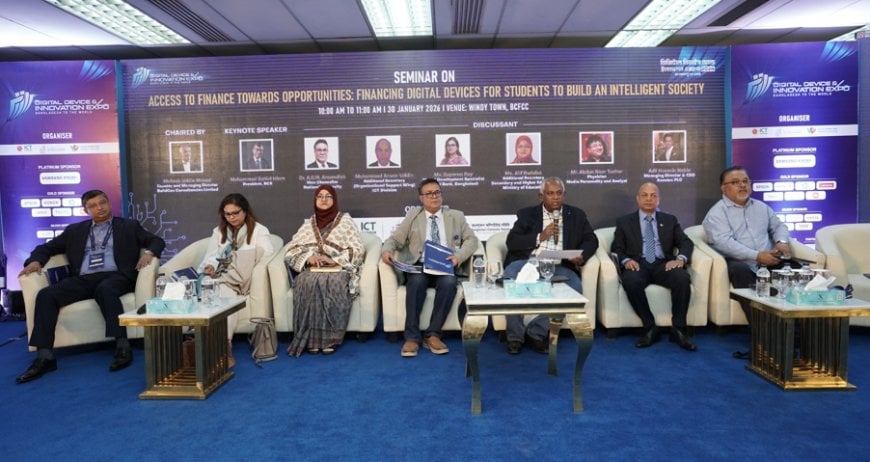
These views were expressed at a seminar titled “Access to Finance Towards Opportunities: Financing Digital Devices for Students to Build an Intelligent Society”, held on Friday morning, January 30, at the Bangladesh-China Friendship Conference Center in Agargaon as part of the Digital Device and Innovation Expo 2026.
The keynote paper, titled “Stalled Dreams Must Be Revived,” was presented by Mohammad Zahirul Islam, President of the Bangladesh Computer Samity (BCS).
In his presentation, Zahirul Islam stressed the need to significantly increase device usage in the country by making digital devices more accessible. He said that smart device penetration must reach at least 80 percent; otherwise, Bangladesh would face major obstacles on its path to progress.
He emphasized the importance of providing easy-term loans for students to purchase digital devices and called on Bangladesh Bank, the government, and commercial banks to introduce low-interest—or in some cases, interest-free—financing schemes for students. Drawing a parallel with agricultural loans, he underscored the necessity of a separate policy framework dedicated to digital device loans aimed at enhancing student skills.
The seminar was chaired by Mahtab Uddin Ahmed, Founder and Managing Director of Buildcon Consultancy Limited.
Among the panelists were Dr. ASM Amanullah, Vice-Chancellor of the National University; Mohammad Anwar Uddin, Additional Secretary (Organizational Support Wing), ICT Division; Suparna Roy, Digital Development Specialist at the World Bank; Alif Rudaba, Additional Secretary of the Secondary and Higher Secondary Education Division, Ministry of Education; physician, media personality and analyst Abdun Noor Tushar; and Adil Hossain Nobel, Managing Director and CEO of Accetech PLC.
Mahtab Uddin Ahmed said the biggest challenge in financing digital devices for students is credibility. “In many cases, loans are given even when repayment is uncertain, yet questions are rarely raised. But when it comes to students, the issue becomes controversial. That is why a clear and structured policy is needed,” he said.
National University Vice-Chancellor Dr. ASM Amanullah highlighted structural weaknesses in the country’s education system, noting that although the National University is the world’s second-largest university and produces nearly one million graduates annually, only about 10 percent are absorbed into the industrial sector. This lack of industry–academia linkage, he said, creates employability and credibility gaps. He added that most students lack access to essential devices, and with proper tools, they could generate several thousand crore taka in earnings each year.
Additional Secretary Alif Rudaba pointed out that while the government is working on course financing initiatives, there is currently no dedicated mechanism for device financing for students. She explained that most government projects are short-term and closely linked to loan recovery, making device financing more complex.
World Bank specialist Suparna Roy said global experience shows that effective risk management is crucial in device financing. She emphasized the importance of digital identity for students, data-sharing mechanisms between educational institutions, banks, and other entities, and integration with mobile financial services (MFS) to ensure easier tracking and repayment. She also noted that subsidy-based models could be explored, as practiced by the World Bank.
ICT Division Additional Secretary Mohammad Anwar Uddin said that improving youth skills could enable foreign income generation without overseas migration. With internet access now available in almost every upazila and village, the key question is ensuring accessibility. He suggested that device policy and financing initiatives should begin at the secondary education level to bring young people into the mainstream.
Axentech PLC MD and CEO Adil Hossain Nobel said that even corporate-sector financing is not always fully recoverable, making student financing even more complex. Banks, he noted, may be reluctant to finance students directly, underscoring the need for a new and innovative financing model.
Physician and analyst Abdun Noor Tushar said that while there is widespread interest in providing digital device loans for students, it must be done through a robust policy framework. He noted that rising global prices of chips, memory, and RAM are already impacting the domestic hardware market, while software companies are increasingly controlling hardware ecosystems. Therefore, he said, a national device policy is urgently needed.
He further emphasized that students receiving device loans must be provided with skill-development training and that proper monitoring mechanisms should be in place to ensure positive usage. Any policy adopted by the government, he added, must be long-term and focus on boosting local device manufacturing to move toward self-reliance.
DBTech/EHM/EK/OR









