






































Tech and Digital Devices Seen as Key to Diversifying Bangladesh’s Export Basket



Bangladesh remains heavily dependent on the ready-made garment (RMG) sector for exports, with more than 80 percent of the country’s annual global exports coming from garments. Despite this dominance, Bangladesh still lacks its own global apparel brand. In this context, sector stakeholders believe that technology and technology-based products offer the most viable pathway for export diversification.
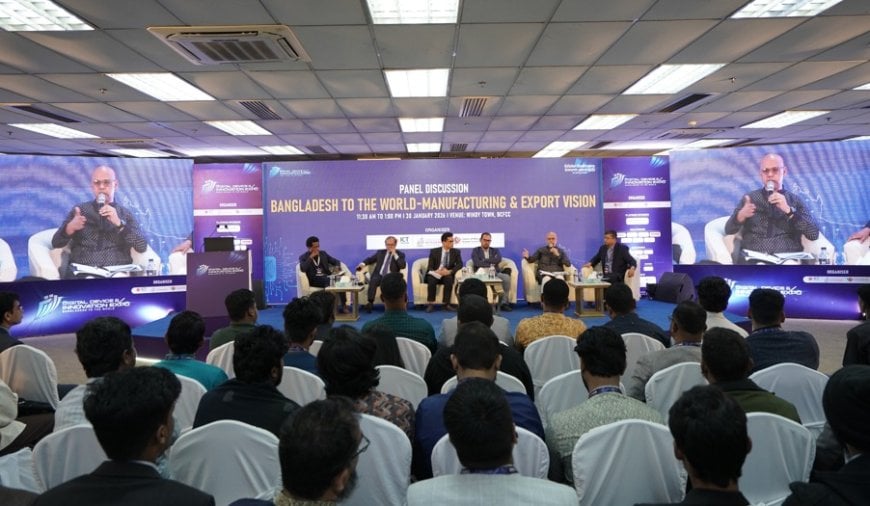
These views were shared during a panel discussion titled “From Bangladesh to the World: Dreams of Manufacturing and Export”, held on Friday, January 30, at the Bangladesh-China Friendship Conference Center in Agargaon as part of the Digital Device and Innovation Expo 2026.
Moderated by Mohammad Zahirul Islam, President of the Bangladesh Computer Samity (BCS), the panel featured Mohammad Hasan Arif, Secretary General and Chief Executive Officer of the Export Promotion Bureau (EPB); Nur Alam, Executive Director of RFL Electronics; Abdur Rauf, Executive Director of the Global Business Division at Walton Digi-Tech Industries; Ziauddin Chowdhury, Country Manager of Xiaomi Bangladesh; and Ubah Thomas Ubah, Senior Specialist at the World Bank.
Prior to the panel discussion, the keynote paper was presented by BCS President Mohammad Zahirul Islam, who spoke on Bangladesh’s export products and services as well as the production and management capabilities of local enterprises.
In his presentation, Zahirul Islam noted that Bangladesh has now entered the USD 50 billion export bracket, with the overwhelming majority coming from the garment sector, while exports from other sectors remain insignificant. He identified technology and digital devices as potential new export frontiers.
To achieve this, he emphasized the need for structured planning—short-term (0–3 years), medium-term (3–6 years), and long-term (7–10 years). With such a roadmap, he said, Bangladesh could realize major export ambitions beyond RMG.
He also highlighted the importance of increasing research and development (R&D) budgets and urged stakeholders to identify and overcome Bangladesh’s existing limitations to unlock export potential.
Speaking during the discussion, EPB Secretary General and CEO Mohammad Hasan Arif said that with 80 percent of exports concentrated in RMG—primarily destined for the European Union and partially the United States—Bangladesh faces significant market risk. He stressed the need to rethink export market diversification.
He revealed that the EPB plans to organize an upcoming trade fair showcasing Bangladesh’s exportable products, with information technology being prominently featured. The aim, he said, is to enhance global visibility of Bangladeshi products and expand export markets.
World Bank Senior Specialist Ubah Thomas Ubah said Bangladesh needs to advance under multiple strategic agendas, requiring joint efforts from both government and private sector stakeholders. He described Bangladesh as a large and export-capable technology market with significant talent, emphasizing the need to connect this talent with global markets.
He also underscored financing as a critical issue, calling for financial openness aligned with government policy in the private sector. If addressed properly, he said, Bangladesh could even produce global “unicorn” companies.
RFL Electronics Executive Director Nur Alam spoke about the domestic electronics market, noting that Bangladesh remains heavily dependent on imported components. He said high dollar exchange rates, taxes, and rising electricity and gas prices have created major challenges in controlling product costs and offering affordable pricing.
Walton Digi-Tech Industries Global Business Division Executive Director Abdur Rauf said Walton operates South Asia’s largest electronics manufacturing facility outside China and has already adopted robotic systems in production. He noted that Walton develops its own software and maintains strict control over export products.
However, he said export barriers remain significant, citing technical challenges such as voltage differences—220 volts in Bangladesh versus 110 volts in the United States—which create compliance hurdles. Overcoming such barriers, he emphasized, is essential for successful export expansion.
Xiaomi Bangladesh Country Manager Ziauddin Chowdhury focused on foreign direct investment (FDI), noting that Xiaomi has established a smartphone manufacturing facility in Bangladesh. He stressed the importance of having the right electronics policy, pointing out that the global smartphone market is projected to reach USD 1 trillion in the coming years.
“If Bangladesh can capture even five percent of that market, it could amount to a USD 50 billion opportunity,” he said. He added that Bangladesh must develop strong brands, as infrastructure is already in place, but effective policy support is now critical to exporting electronics and smartphones from the country.
DBTech/IHM/EK/OR









