






























CREST Launched at BRAC University to Advance Bangladesh’s Semiconductor Ambitions
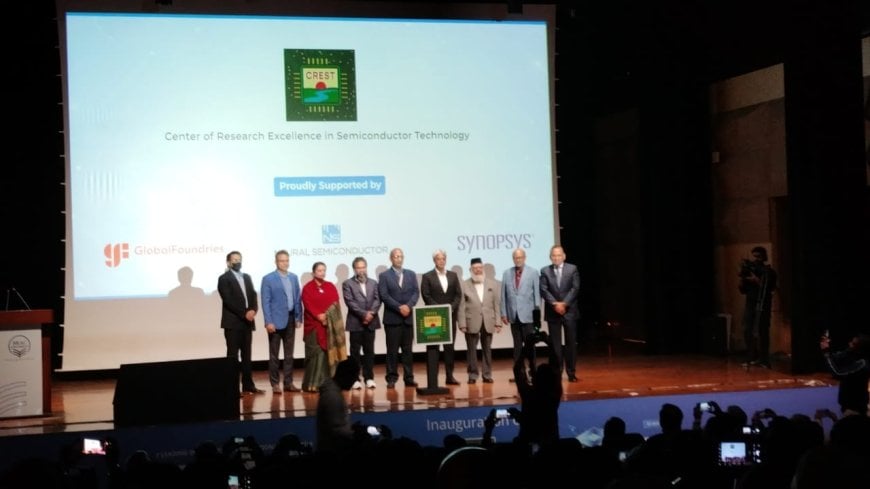



With the vision of emerging as an innovative nation, BRAC University has formally launched the Centre of Research Excellence in Semiconductor Technology (CREST). The research and development hub aims to lay the foundation for Bangladesh’s credible participation in the global semiconductor ecosystem and to establish a “Made in Bangladesh” semiconductor industry, targeting at least 1 percent of the USD 15 trillion deep-tech market.
The initiative is positioned as a national framework to integrate Biotechnology, Electronics, Artificial Intelligence (AI), and Robotics (BEAR), officials said at the inauguration ceremony.
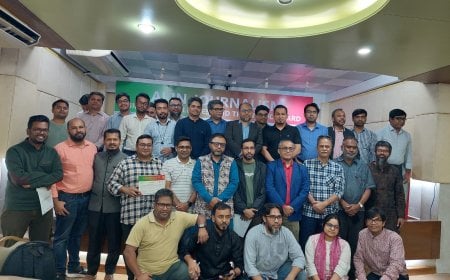
Under the Silicon River Ecosystem, the CREST logo was unveiled on Monday, December 29, at BRAC University’s campus in Badda, Dhaka. At the same event, nine researchers from nine universities received CREST fellowships for semiconductor research, while 15 winners of the BEAR Summit were awarded checks.
The first batch of CREST Fellows includes Md. Shazol Al Mamun (BUET), Akif Hamid (UIU), K. M. Mehedi Hasan (EWU), Md. Sharif Uddin (UAP), Ishmam Hossain (NSU), Priyanka Das (BRAC University), Junayed Jalil (BUET), Md. Khalid Hossain (BUET), Afsana Anjum Akhi (University of Dhaka), and Sheikh Tariful Islam (BUET). A total of BDT 1.187 million was distributed among the fellows.
Through CREST, Bangladesh reaffirmed its commitment to transforming from a technology consumer into a technology innovator by pursuing excellence in AI-centric chip design, VLSI systems, robotics, materials science, semiconductor packaging and testing, and future hardware platforms.
Earlier, Professor Muhammad Mustafa Hussain of the Department of Electrical and Computer Engineering at Purdue University, USA, the architect of the Silicon River Vision and the CREST initiative, presented the detailed roadmap of the project. He announced that an additional BDT 128,000 in research grants would be awarded soon following a formal agreement with UAP.
He expressed optimism that, with adequate government policy support, 8,000 non-resident Bangladeshi professionals working across the global semiconductor sector could help elevate the industry to new heights. Under the fellowship programme, eight postgraduate and two undergraduate students will conduct year-long research across nine advanced semiconductor domains under faculty supervision.
Speakers at the event included BRAC University Vice-Chancellor Professor Dr. Syed Ferhat Anwar, Secretary of the Ministry of Science and Technology Md. Anwar Hossain, President of the Bangladesh Semiconductor Industry Association (BSIA) and Managing Director of Neural Semiconductor Limited M. A. Jabbar, and Dean of the Faculty of Engineering at the University of Dhaka Professor Upama Kabir.
Distinguished representatives from the government, universities, industry, armed forces, and Bangladeshi diaspora experts were also present.
In special video messages, Dr. Mahbub Rashed, Vice President of GlobalFoundries, emphasised the importance of a coordinated national vision, strong university–industry collaboration, and long-term investment in research talent. Similar video messages were delivered by Harish Balan, Director at Synopsys, and Major General Nasim Parvez, Commandant of the Military Institute of Science and Technology (MIST).
In his welcome address, Dr. Syed Ferhat Anwar reiterated BRAC University’s commitment to advancing modern research, fostering innovation-driven human capital, and implementing national priorities in science and technology.
Calling for collective progress, Science and Technology Secretary Md. Anwar Hossain urged stakeholders to move forward together to transform Bangladesh into a knowledge-based industrial economy through research-driven technological advancement and innovation-led economic transformation.
BSIA President M. A. Jabbar highlighted the importance of strengthening domestic capabilities, promoting industry–academia collaboration, and building an export-oriented semiconductor industry.
In his concluding remarks, Professor Upama Kabir underscored the need for sustained collaboration, mentorship, and institutional commitment to nurture the next generation of researchers and innovators, reaffirming the University of Dhaka’s active role as a fellowship partner and nationwide training centre.
DBTech/CMO/EK/OR