




































Fake Feeds Flood Social Media After Sharif Osman Hadi Shooting, Says FactWatch



Social media platforms have been inundated with fake photo cards, fabricated comments, and AI-generated images and videos circulated under the names of well-known local and international news outlets, according to fact-checking organisation FactWatch. The misinformation campaign centres on the shooting of Sharif Osman Hadi, spokesperson of Inqilab Mancha and a prospective independent candidate for the Dhaka-8 constituency.
FactWatch said that following the shooting of Sharif Osman Hadi in Dhaka’s Bijoynagar area on Friday, December 12, numerous misleading contents began spreading on Facebook, including fake photo cards and AI-generated visuals falsely attributed to mainstream media outlets.
In its monitoring, FactWatch identified a fake photo card circulated using the name and logo of private broadcaster RTV, claiming—citing the Dhaka Metropolitan Police (DMP) Commissioner—that the attackers were linked to Jamaat-Shibir politics. Verification showed that RTV had not published any such content on its verified social media platforms or website.
Instead, FactWatch found that RTV had published a different photo card on December 13 using the same image, with the headline: “Police have identified those who shot Hadi: DMP Commissioner.” On the same day, the DMP’s verified Facebook page also flagged the earlier viral card as fake.
Citing the fake photo card, BNP Senior Joint Secretary General Advocate Ruhul Kabir Rizvi made remarks at a programme in Nayapaltan. He later expressed regret, calling it an “unintentional mistake.”
A similar fake photo card was also circulated using the name and logo of Daily Kalbela, claiming Jamaat-Shibir involvement in the attack. FactWatch said no such report or photo card appeared on Kalbela’s verified Facebook page or website.
However, an authentic Kalbela photo card posted on December 12 titled “Doctors update on Osman Hadi’s latest condition” was found to have been manipulated by altering its headline to spread false claims.
Several fake photo cards were also circulated using the name and logo of BBC Bangla, with claims such as: “Shibir attack to remove Hadi for nominating Shadik Kayem” and “Shishir Monir secured bail twice for Hadi’s attacker earlier.”
FactWatch confirmed that no such reports exist on BBC Bangla’s verified platforms. Additionally, the fonts used in the fake cards did not match BBC Bangla’s authentic design, confirming the content as fabricated.
Another fake photo card used the name and logo of the daily Amar Desh, claiming that phone records of the attacker included the number of Sadiq Qayem. On December 13, Amar Desh publicly stated on its Facebook page that the card was fake and that misinformation was being spread in its name.
FactWatch also flagged misleading content originating from a website named “Rukhe Darao BD.” The domain was registered on November 3 and contains very limited content. Analysis suggests the site operates as a propaganda outlet, the organisation said.
On the day of the attack, digital investigative outlet The Descent analysed an image of a masked suspect. Subsequently, a photo of an unmasked individual was circulated on Facebook, claiming he was Hadi’s friend’s younger brother and that the image was taken from CCTV footage.
FactWatch’s verification found the image to be AI-generated, confirmed by multiple AI image detection tools.
A video claiming that Hadi’s attacker had been arrested while fleeing to Sylhet by the Paharia Express train also circulated on Facebook. FactWatch said the six-second clip was AI-generated, noting visual anomalies such as an unnatural hand restraining the suspect without any visible person attached—an indicator commonly seen in AI-generated content.
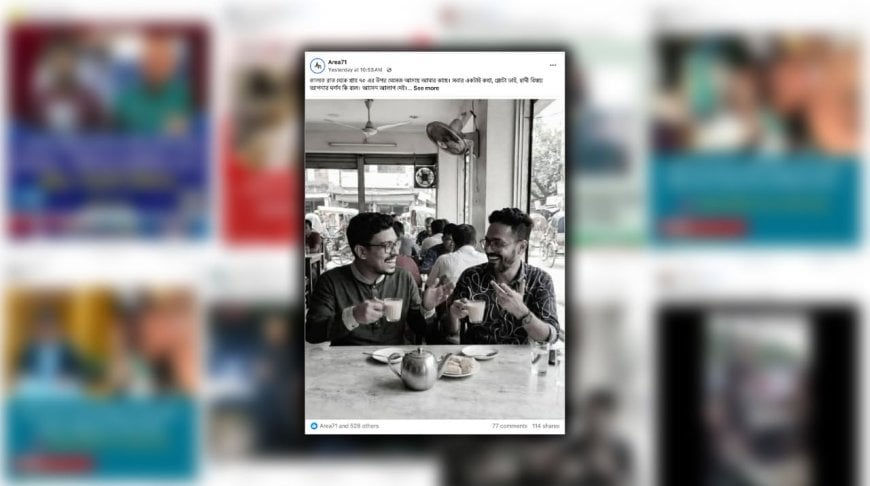
Another rumour involved an image showing DUCSU VP Shadik Kayem allegedly having tea with suspect Faisal Karim Masud. FactWatch confirmed that this image was also entirely AI-generated and not a real photograph.
FactWatch said it continues to work against the spread of rumours, misinformation, and misleading content in Bangladesh. The organisation is an independent fact-checking body approved by the University of Liberal Arts Bangladesh and operated by the Center for Critical and Qualitative Studies (CQS).
Amid a recent surge in fake videos and disinformation on social media, FactWatch said it remains committed to verifying claims, presenting facts, and countering rumours through regular monitoring and public awareness efforts.
DBTech/FactWatch/MUM/OR









