





































BIGF Builds Digital Trust Through Dialogue




The three-day Bangladesh Internet Governance Forum (BIGF) concluded at the International Mother Language Institute in Dhaka with workshops and policy discussions, reaffirming its commitment to fostering digital governance in the Global South.
On the final day, Saturday, November 1, Saif Ahmad, Head of the ICT Department of Daily Jugantor, presented the keynote paper titled “Media and Digital Trust: The Challenge of Sustaining Public Confidence in the Age of Misinformation.”
In his paper, he elaborated on how the media can play a crucial role in maintaining public trust, countering misinformation, and ensuring online credibility in the digital era.
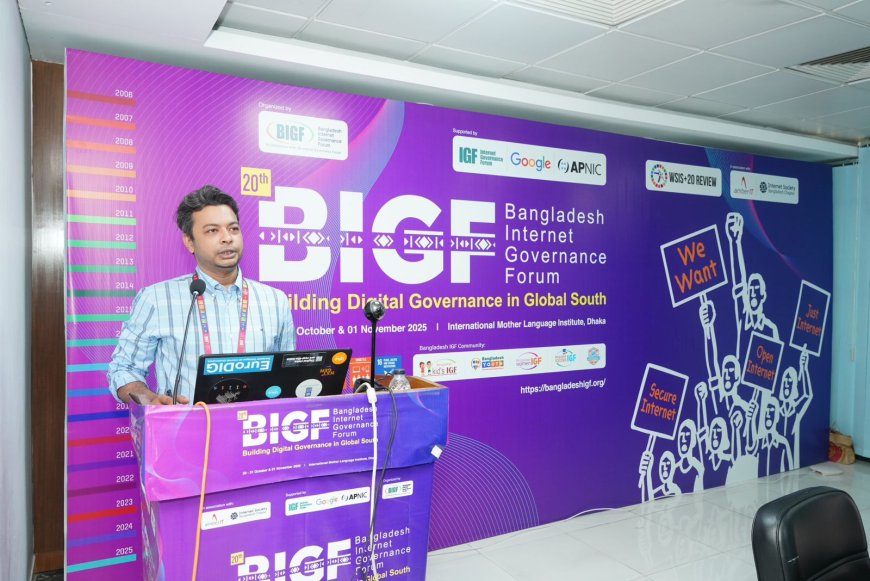
“We are living in a time where there is no shortage of information, but a severe shortage of trust,” said Saif Ahmad. “The line between truth and falsehood has become blurred. Yet journalists are still fighting for the truth — that is our greatest strength.”
He further emphasized, “Digital trust must be rebuilt collectively. Journalists must speak the truth, technology companies must ensure transparency, governments should encourage independent fact-checking instead of control, and the public must stay aware. Conscious citizens are the strongest defense against fake news.”
“Fake information divides us, but courageous truth unites us. Let us all work together to restore that trust,” he added.
The session, moderated by Hasan Zakir, Assistant Editor of Daily Samakal and President of the Center for Technology Journalism, featured panelists Jahid Hossain Khan, Researcher at Jonon Television, and Mohammad Yamin, Fact-Check Editor (Bangla) at AFP.
The session’s chief guest was Manzur Mohammad Shahriar, Deputy Secretary of the Information and Communication Technology Division.
In his address, he remarked, “While the flow of information is faster in the digital era, the risks of misinformation have also increased. Journalists now play the most vital role in maintaining public confidence. The media is not just a source of information, but also a symbol of truth, ethics, and responsibility.”
He further added, “No information should be disseminated online without proper verification. Responsible journalism alone can sustain digital trust and social stability.” Shahriar expressed hope that initiatives like BIGF 2025 would open new horizons for building a truthful, trust-based, and responsible digital society.
Discussing the keynote paper, researcher Jahid Hossain Khan said, “Ordinary internet users need to be aware. Journalists should undergo regular training to produce and promote quality content and credible information. Continuous research and skill development among journalists can further strengthen public confidence in the media.”
AFP Fact-Check Editor (Bangla) Mohammad Yamin highlighted strategies to debunk misinformation, saying, “When users encounter flashy, sensational, or emotional posts, they should view them critically. Only after confirming from reliable sources should such content be shared.”
BIGF Secretary General Mohammad Abdul Haque Anu stated that the forum has played a vital role in facilitating multi-stakeholder dialogue and policy development on internet governance in Bangladesh. The 20th edition of the forum featured nine panel discussions over three days, including a special workshop for children and adolescents.
Representatives from government, private sector, technical communities, academia, civil society, youth, and the media participated in the three-day event.









