






































Postal Ballot Breakthrough: App for Expatriate Voting to Launch in November
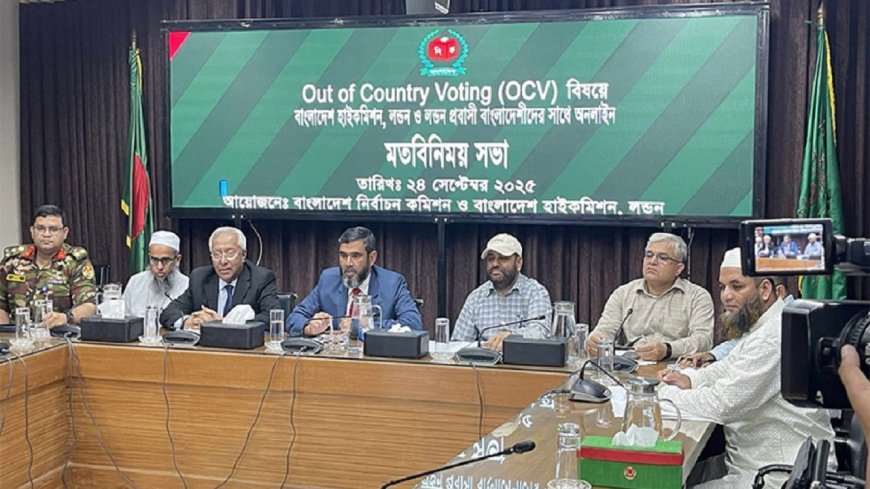



The Election Commission (EC) of Bangladesh has announced that an app named Postal Vote BD will be launched in the third week of November to facilitate expatriate voting. Election Commissioner Brigadier General (Retd.) Abul Fazal Md. Sanaullah revealed the plan on Wednesday, September 24, after a consultative meeting at the EC with the Bangladesh High Commission in London and expatriate Bangladeshis regarding out-of-country voting.
Speaking to the media, Sanaullah said, “We are developing an app for out-of-country voting registration so that votes can be cast from abroad. The app will be launched in November. We are aiming for the second or third week of November.”
He explained that after prolonged discussions, the EC has adopted a hybrid solution for expatriate voting. Interested voters will first have to complete voter registration, followed by separate registration for out-of-country voting via the new app. Symbol-marked ballot papers will then be sent in advance to registered expatriates. “Each region will be given 7 to 10 days for registration, with a possible extension of 3 to 7 more days if required. Prior circulars will notify voters from which region they can register and when,” he added.
The commissioner pointed out that of the six widely used global methods of expatriate voting, in-person voting and postal ballots are the most common. Bangladesh had proposed postal ballots, proxy voting, and online voting. However, online voting was deemed unfeasible for now, and proxy voting was excluded due to lack of political consensus.
Sanaullah noted that the app will be presented to expatriates once it is ready. “The app will be briefly demonstrated through screen sharing. We are working on it with proper circulation so that in the third week of November it can be officially launched. Postal ballots do pose challenges regarding confidentiality, and awareness must be raised so that secrecy is not compromised,” he said.
He further cautioned that if any candidate’s nomination is canceled by court order at the last moment before elections, all expatriate votes for that constituency will also be canceled.
Reflecting on the history, he said structural limitations delayed the implementation of expatriate voting despite the provision being introduced after initial discussions in London in 2008. Time constraints had prevented ballots from being sent and returned. “This time, a new hybrid solution has been taken up. Interested voters will register online, and symbol-marked ballots will be sent in advance,” he explained.
On the registration process, he reiterated, “The work will proceed in two stages. First is voter registration—those already with NID cards are included in the electoral roll. Then, they must register separately for out-of-country voting through the new app, which will be launched in the third week of November. Each region will have 7–10 days for registration, with an additional 3–7 days if necessary.”
Optimistically, the commissioner stated, “Inshallah, this time expatriate Bangladeshis will cast their votes through postal ballots.”
Drawing from international experience, he observed, “Globally, the registration rate for postal ballots is only 2.7 percent, with actual vote collection rates below 30 percent. Still, Bangladeshis abroad are more interested than others. Based on the experiences of India, Pakistan, Sri Lanka, and Malaysia, our expectations must remain modest, but we will not fail.”
Nonetheless, Sanaullah acknowledged several limitations, such as safeguarding ballot secrecy, the risk of vote cancellations due to court orders, and the approximately 24 percent failure rate of postal ballot delivery worldwide.
Even so, he expressed confidence that expatriate Bangladeshis would show greater enthusiasm compared to global averages, ensuring that the initiative does not falter.









