






































Rooftop Revolution Rises in Renewable Roadmap




Bangladesh Sustainable and Renewable Energy Association (BSREA) has set an ambitious target of installing 3,000 megawatts of rooftop solar power by December this year. To support the effort, the Bangladesh Power Development Board (BPDB) announced plans to introduce cluster-based franchises in Dhaka, Chattogram, and other divisional cities, while the government is preparing a set of incentive programs to accelerate solar expansion.
These announcements came during a discussion titled “Solar Rooftop Finance Unveiling: Towards a Sustainable Energy Future,” held on Tuesday, September 2, at The Westin, Dhaka. Participants highlighted both opportunities and challenges in the sector, with investors citing banks’ complex and highly conditional financing processes as the biggest barrier to scaling rooftop solar power.
Representatives from Mutual Trust Bank, Jamuna Bank, City Bank, and other financial institutions also shared negative investment experiences in the field.
Speakers stressed that IDCOL has already demonstrated success in off-grid solar and large projects. They argued that if commercial banks and non-bank financial institutions (NBFIs) introduced new financial products such as leasing, project financing, pay-as-you-save models, and green bonds, investment risks would be reduced and sustainable profitability ensured. Without such initiatives, they warned, the goal of generating 30 percent of electricity from renewable sources by 2040 would remain out of reach.
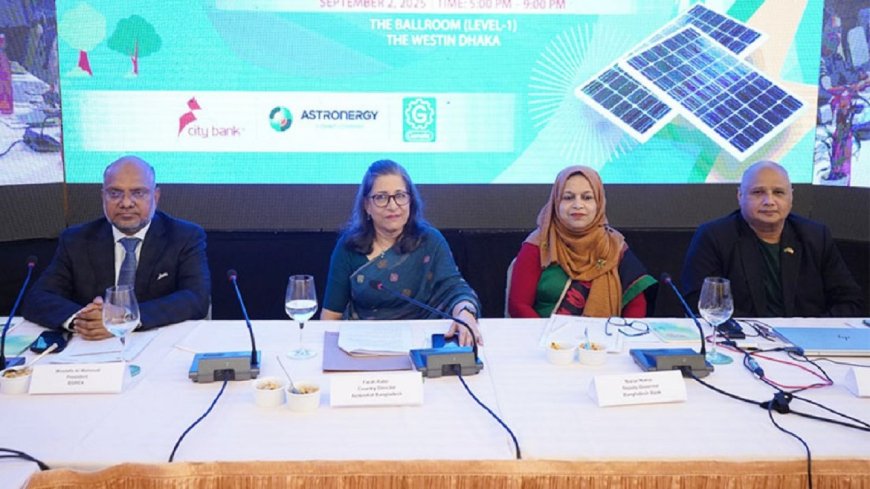
The seminar, jointly organized by BSREA and ActionAid Bangladesh, brought together stakeholders from the Power Division, SREDA, IDCOL, power distribution companies, commercial banks, NBFIs, and renewable energy businesses. ActionAid Bangladesh Country Director Farah Kabir moderated the event, while former Bangladesh Bank Director Khondker Morshed Millat presented the keynote paper.
Bangladesh Bank Deputy Governor Nurun Nahar announced at the seminar, “Since 2008, Bangladesh Bank has been involved in solar plant financing. Rooftop solar is now essential for our country. Policies mandating 20 percent solar power in EPZs, EZs, and other economic zones are being introduced. New guidelines for commercial banks and financial institutions are on the way. BPDB will launch cluster-based franchises in all divisional cities, and an escrow system will be implemented to ensure payment security.” She also noted ongoing efforts to launch solar projects on unused railway land under the PPP model.
Alamgir Morshed, CEO of IDCOL, pointed out that while the cost of rooftop solar has declined due to technological improvements, entrepreneurs remain largely unaware of the updated figures. “IDCOL will remain at the forefront of financing. If banks step in, blended investment will become possible. The current cost has come down to 30–35 taka per watt, compared to over 100 taka a decade ago. The private sector now needs to take the lead,” he said.
BSREA President Mostafa Al Mahmud reiterated, “Our target is to install 3,000 megawatts of rooftop solar by December 2025. Despite strong potential, financing remains the biggest challenge, along with bureaucratic delays. Net metering approvals are particularly time-consuming. At present, only 5.6 percent of our electricity comes from renewable energy, far less than our neighboring countries.”
A representative from IDLC Finance added, “In the past two to three years, our investment experience has been positive. We have invested in projects totaling around 80 megawatts. What is needed now is awareness. After gas, rooftop solar is the second most affordable source of electricity.”
Speakers further emphasized that for rooftop solar to succeed, the Power Division and SREDA must make policies more transparent and private-sector friendly, while utility companies must simplify grid connections and net metering. Development partners were urged to provide risk guarantees and share global models. With coordinated efforts from all stakeholders, rooftop solar could emerge as the new frontier of renewable energy in Bangladesh.









