





































Favoritism over Fairness? Allegations of Nepotism in BMU Faculty Recruitment
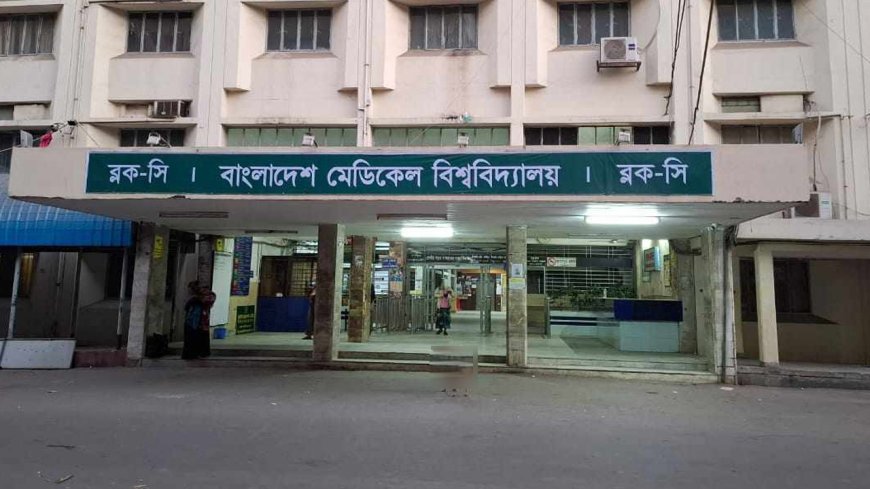



The Bangladesh Medical University (BMU), formerly known as Bangabandhu Sheikh Mujib Medical University, now stands accused of favoring connections over merit in its latest recruitment process for the Department of Biochemistry and Molecular Biology. Despite its rebranding following the recent uprising, the university’s hiring practices reportedly continue to follow an old and questionable script.
Controversy surrounds the appointment of Dr. Miliva Mozaffar, wife of former Bogura Medical College Chhatra Dal president and central leader of Doctors’ Association of Bangladesh (DAB), Dr. Mohammad Tipu Sultan. Allegations claim that recruitment rules were violated to ensure her eligibility, raising serious questions about transparency.
On Sunday, June 2, Dr. Miliva was summoned before a committee led by BMU Registrar and DAB leader Dr. Nazrul Islam to respond to allegations. When asked about the session’s outcome, Dr. Nazrul told this reporter, “She was called to respond to the allegations raised against her. She gave her explanation.” He refused to disclose further, stating, “That’s not something I will tell you. We will inform you officially in writing.”
Regarding the irregularities, he said, “Due to a lack of qualified candidates, the conditions for recruitment were relaxed. In the future, appointments will follow the previous guidelines. If any irregularities are found in this process, we may cancel it and issue a new circular. But I can assure you that the recruitment will be based on transparency.”
Investigations reveal that on December 12, 2024, BMU's 94th Syndicate meeting controversially relaxed the mandatory teaching experience requirement for professor and associate professor positions—but only for the Departments of Biochemistry and Molecular Biology, and Pharmacology. Traditionally, such positions required prior teaching experience within BMU or its affiliated postgraduate institutions.
This decision sparked criticism, especially since numerous qualified candidates already met the original requirements. Observers alleged that the criteria were specifically relaxed to accommodate preferred candidates from private institutions.
On February 6, 2025, BMU announced four faculty positions—two for professors and two for associate professors. However, during the 96th Syndicate meeting on May 31, four candidates were approved despite not meeting the stated criteria: Prof. Dr. Nasrin Chowdhury (Apollo Imperial Hospital, Chattogram), Prof. Dr. Rezwanul Haque (Delta Medical College, Dhaka), Dr. Zeba Un Nahar (Gazi Medical College, Khulna), and Dr. Miliva Mozaffar (Medical College for Women and Hospital, Dhaka)—all from non-affiliated private institutions.
The appointments have raised further concerns. Prof. Nasrin Chowdhury reportedly has no citations listed in her Google Scholar or ResearchGate profiles and lacks the required number of indexed research publications, raising doubts about her academic credentials. She is also known to be close to former department chair Prof. Mozammel Haque.
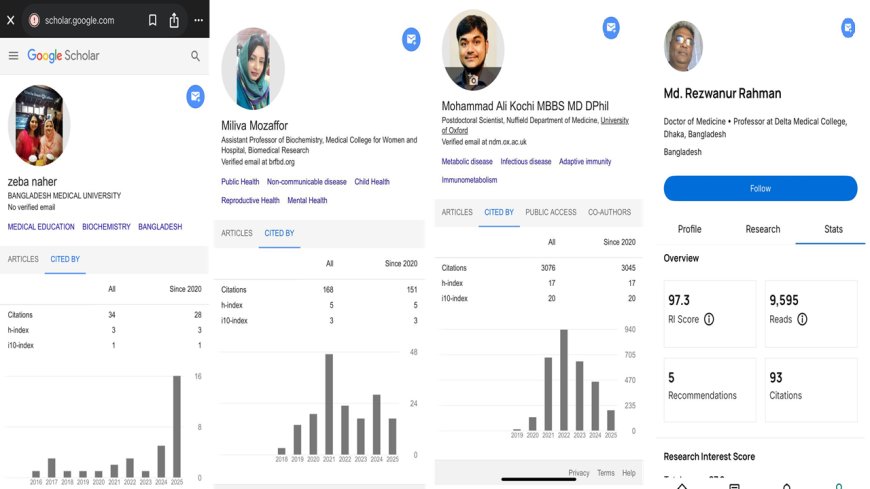
Similarly, Prof. Rezwanul Haque, with only 93 citations and an h-index of 5, has no teaching experience in any postgraduate medical institution. Dr. Zeba Un Nahar, newly appointed as associate professor, has 34 citations and an h-index of 3—relatively low compared to other applicants. Her husband is a leader of the Jamaat-affiliated doctor’s group NDF and a known associate of the current Vice Chancellor.
Dr. Miliva, meanwhile, claimed to have been working as assistant professor since 2017, though institutional records show she was promoted to that position only on February 17, 2022. Her citation count stands at 168 with an h-index of 5. Critics argue she provided false information regarding her experience and strategically presented her acting role as a permanent position—violating both university and civil service regulations. As a result, her appointment has been put on hold and referred to the Academic Council for review.
In contrast, highly qualified candidates such as Dr. Mohammad Ali, an Oxford University DPhil and former assistant professor at BMU, were excluded from the final list. Dr. Ali has over 3,112 citations, an h-index of 17, and an i10-index of 20, with publications in top-tier journals like Nature, Science, Cell, and The Lancet. Despite being the only PhD-holder among applicants—a credential valued under BMU’s recruitment policy—he was not selected.
Recruitment board members included BMU Vice Chancellor Dr. M. Shahinul Alam, Pro-VC Dr. Muhammad Abul Kalam, Registrar Prof. Nazrul Islam, former departmental chair Prof. Mozammel Haque, and current chair Dr. Nayla Atik Khan. According to sources, a shortlist on May 27 included Dr. Zeba Un Nahar, Dr. Mohammad Ali, and Dr. Miliva. But the May 31 Syndicate meeting approved only Zeba and Miliva, leaving out the more qualified Dr. Ali. The appointed faculty began joining in late June, except for Dr. Miliva, whose appointment remains pending due to mounting criticism.
Observers have labeled the process as biased and politically driven, accusing BMU of compromising merit and violating policies to serve powerful interest groups. Medical professionals and academic stakeholders are now demanding a transparent investigation and appropriate action against those responsible for undermining the integrity of one of the country’s leading medical universities.
“The recruitment must be scrutinized and any irregularities addressed,” said a senior academic. “Administrative action is essential—not just against those who misrepresented their credentials, but also those who enabled such favoritism.”









