





































Bridging Barriers: Bangladesh Launches Tech Solutions for Persons with Disabilities
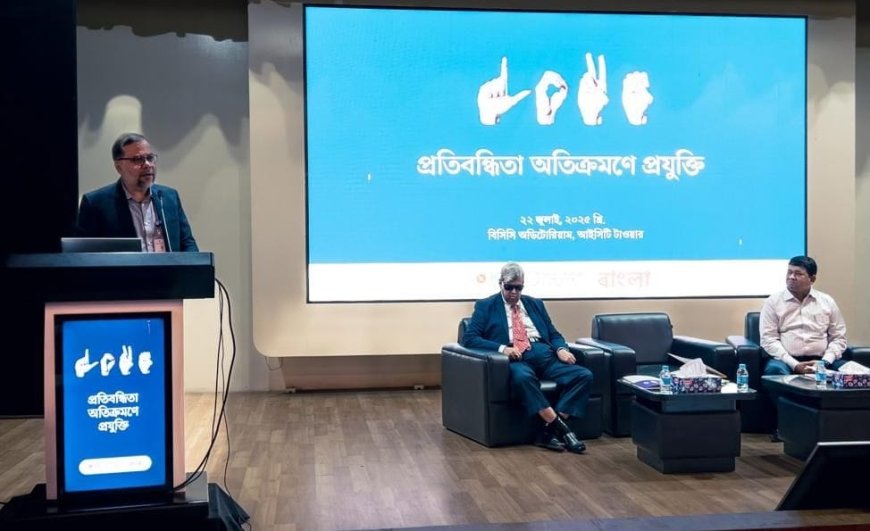



To empower individuals with speech, hearing, and visual impairments, the Information and Communication Technology (ICT) Division of the Government of Bangladesh has announced a suite of new software tools based on the Bangla language. On Tuesday, July 22, a dataset for Bangla Sign Language was officially launched during a workshop titled “Technology to Overcome Disability” held in Agargaon, Dhaka. The dataset is now available for public use online.
In addition to the sign language dataset, several assistive technologies—such as a Bangla screen reader, Braille converter, and sign language digitization software—will soon be publicly released. These efforts are part of a broader initiative by the ICT Division's Bangladesh Computer Council under the project “Enrichment of Bangla Language in Information Technology through Research and Development.”
ICT Division Secretary Shish Haider Chowdhury, who was present as the chief guest, emphasized the importance of accessibility in establishing technological equity. “Accessibility is a fundamental issue in ensuring technological parity,” he said. “Our aim should not be to ignore disabilities, but rather to overcome them through innovation. The government and academia must work together to transform this project into a fully functional industry. The upcoming screen reader, Braille converter, and sign language software in Bangla will play a vital role in achieving this goal.”
He also highlighted that technology must go beyond digital access and serve as a medium for inclusion, empowerment, and skill development.
Speaking as a special guest, Mansur Ahmed Chowdhury, founding trustee of Transparency International Bangladesh (TIB) and Impact Foundation Bangladesh, shared his personal experience of losing his vision at the age of seven. “I strongly believe that providing event-related information in Braille for the visually impaired is a necessity,” he said, stressing the urgency of making the software tools publicly available as soon as possible.
The workshop featured a concept paper that emphasized the importance of user-centric design in the context of human-computer interaction. The paper also provided an update on the progress of technologies such as Bangla Sign Language Recognition Systems, Text-to-Sign Puppets, Bangla Text-to-Braille converters, the screen reader “Alo,” and TTS-based audiobooks.
Project Director Md. Mahbub Karim stated, “Creating equal opportunities for Bangla-speaking persons through technology is a core objective of this project.” He added that initiatives are also underway to digitize indigenous languages, develop sign language software, and create Braille applications for the visually impaired—tools that will significantly ease communication and digital access for stakeholders.
Workshop participants provided feedback and shared experiences related to the developing software. Arafat Sultana Lata and Ariful Islam served as sign language interpreters during the event.









