





































TIB Reports Nearly Tk 30 Billion in Irregularities Across Six Solar Projects Over 15 Years
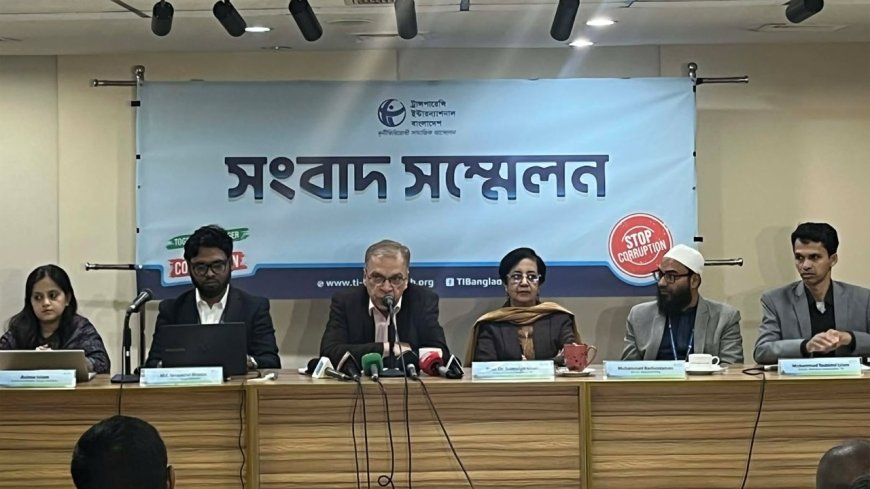



Transparency International Bangladesh (TIB) has alleged that irregularities amounting to nearly Tk 30 billion occurred in six solar power projects over the last 15 years. The findings were disclosed on Wednesday (December 24) at a press briefing held at TIB’s office in Dhanmondi, Dhaka.
The findings were presented through a research report titled “Electricity Generation from Renewable Energy in Bangladesh: Governance Challenges and Ways Forward” by TIB officials Newazul Mowla and Ashna Islam.
Speaking at the press conference, TIB Executive Director Dr Iftekharuzzaman said Bangladesh’s power sector master plan suffers from policy inconsistencies and visible corruption. He noted that inadequate prioritisation of renewable energy, excessive dependence on fossil fuels, and a lack of transparency in project implementation pose major obstacles to long-term development. If the current situation persists, achieving the country’s renewable energy targets by 2050 will be extremely difficult, he warned.
Dr Iftekharuzzaman pointed out that Bangladesh currently relies on fossil fuels for around 95 percent of its energy needs, while renewable energy accounts for just over 4 percent—demonstrating persistent neglect of the renewable sector.
Highlighting irregularities within the Bangladesh Power Development Board (BPDB), the report said excessive project cost estimates were identified across six categories related to government and IPP-based solar projects.
According to BPDB estimates, the average cost of producing one megawatt of solar power should be around Tk 80 million. However, the six projects under review showed an average excess cost of Tk 138 million per megawatt—more than one and a half times higher. As a result, Tk 29.27 billion was spent beyond actual requirements.
Overall, while the six projects should have cost Tk 40.43 billion, actual expenditure stood at Tk 69.70 billion, the report said.
The study further noted that in some cases, government solar projects were built on government-owned land—eliminating land acquisition or leasing costs—yet per-megawatt installation costs were shown as high as Tk 148 million, significantly higher than comparable projects elsewhere in the country.
TIB also found corruption worth Tk 2.49 billion in land purchases and compensation payments across five power sector projects included in the study.
Only 3.3 percent of foreign investment in the power sector has been directed toward renewable energy, the report said, adding that letters of intent (LOIs) for renewable projects backed by foreign investors were cancelled amid procedural ambiguities. Compared to fossil fuels, renewable energy projects receive far fewer tax incentives, customs exemptions, VAT waivers, and insurance benefits.
Addressing the investment gap, TIB researchers said Bangladesh would require up to USD 980 million (Tk 115.64 billion) annually until 2030, and up to USD 1.46 billion (Tk 172.80 billion) per year from 2030 to 2041, to meet renewable energy goals. However, the government lacks a clear and time-bound financing plan.
They also noted that the interim government cancelled LOIs for 31 unsolicited renewable energy projects with a combined capacity of 3,287 MW, involving billions of dollars in foreign investment. Of these, 15 projects had already incurred non-refundable investments, including land purchases and tax payments.
Four projects involved direct foreign ownership, with two fully owned by foreign companies—raising concerns about investor confidence. Although tenders were later floated for 55 renewable energy project packages, 22 received only a single bid and 13 received none, indicating reduced foreign investor participation due to the absence of state guarantees.
TIB further observed that despite a dedicated renewable energy scheme under Bangladesh Bank’s green financing initiative, its practical utilisation remains minimal due to lengthy and complex application processes.
The report highlighted that although there is potential to install around 500 MW of floating solar power using the infrastructure of the country’s only hydropower plant, bureaucratic hurdles and investment shortages have prevented implementation.
International financiers such as the Asian Development Bank (ADB) and the World Bank are increasingly favouring private-sector renewable projects over government-led initiatives, limiting the public sector’s role. Despite this shift, the government has yet to introduce attractive incentive packages to encourage IPP-based renewable investments.
TIB concluded that the Renewable Energy Policy 2025 lacks a concrete financial roadmap necessary to achieve its stated targets.
DBTech/SK/EK/OR









