








































Customs Conundrum: Calls for Complete Automation at Chattogram Customs House



Despite introducing e-auction (online bidding) in 2020, Chattogram Custom House was forced to roll back the system and revert to a hybrid of manual and semi-automated processes. Business leaders allege that this half-hearted approach has created severe harassment for traders, while automation has not advanced even “an inch” over the past two decades.
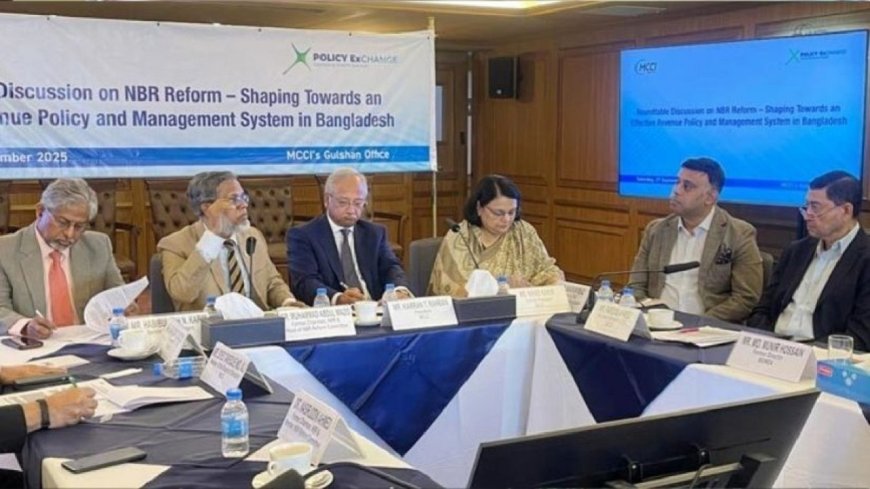
The grievances were aired at a roundtable discussion on National Board of Revenue (NBR) reform, organized jointly by the Metropolitan Chamber of Commerce and Industry (MCCI) and Policy Exchange Bangladesh on Saturday (September 27) at MCCI’s office in Gulshan’s Police Plaza. The session was inaugurated with an opening statement from MCCI President Kamran T. Rahman.
Former NBR Chairman and current member of the NBR Reform Committee, Mohammad Abdul Majid, attended as the chief guest. The discussion was moderated by former MCCI President Nihad Kabir, with top executives from various business enterprises present.
A.M. Mahbub Chowdhury, Vice-President of the Chattogram Metropolitan Chamber, said, “The largest revenue collection point is the Chattogram Custom House. Former NBR member Farid Uddin was commissioner there 20 years ago. Whatever automation progress he made at that time, that is where it stopped. Since then, it has not advanced an inch. Even the green channel for garments, which was promised, has not moved forward.”
Mahbub criticized the half-automated system, stating, “The biggest problem at Chattogram Customs is that half of its functions are automated and the other half manual. Businesspeople have been repeatedly urging: make it either fully automated or fully manual.”
Citing an example, he explained, “In the customs house, two or three branches share a single computer operator, and nearly 20 people queue up for service in front of him. In some places, computers exist but no printers are available. As a result, half the day is wasted in one line. If it were manual, we could simply collect the required signature on a sheet and leave.”
Mahbub also remarked, “The revenue board has reformed policies and revenue management. But we still don’t understand their effectiveness. The reforms need more publicity, as hardly one percent of the population is even aware of them.”
Echoing the concerns, NBR Reform Committee member and former NBR member Md. Farid Uddin said the government had not implemented the committee’s core recommendation of dissolving NBR and dividing it into a Revenue Policy Division and a Revenue Management Division. He said, “Our recommendation was that the policy-making committee must include mandatory representation from the private sector. Moreover, any policy undertaken should remain in effect for at least five years.”
He cautioned, “The recommendations we made have not been properly reflected in practice. If NBR is divided out of malice or faulty decisions, it will create a disastrous situation for the nation.”
Committee member and former NBR Chairman Mohammad Abdul Majid added, “Proper implementation of recommendations is essentially a matter of political commitment. Otherwise, reforms will remain only on paper.”
Mohammad Hatem, President of the Bangladesh Knitwear Manufacturers and Exporters Association (BKMEA), argued, “If automation happens, all problems can be solved. But automation cannot be limited to NBR alone—it must also extend to related institutions.”
Former MCCI President Nihad Kabir said, “We have been talking about NBR reform for a long time. At times, it has felt like crying in the wilderness. Policymakers cannot collect revenue themselves. The NBR reform committee is doing good work, and if their report is implemented, the revenue sector will change.”
Snehasis Barua, Director of SMAC Advisory Services Limited, observed that taxpayers should be able to pay VAT and taxes in a single office. This, he said, would reduce government expenditure and make revenue collection easier, as businesses now have to knock on the doors of multiple offices.
Enamul Haque Khan, Senior Vice-President of the Bangladesh Garment Manufacturers and Exporters Association (BGMEA), added, “Simply splitting NBR into two will not solve everything. NBR and its affiliate bodies must be freed from corruption. Revenue policies related to income tax, customs, and VAT should be long-term—at least five years. Moreover, in enacting or amending laws, SROs, rules, and notifications, stakeholders’ opinions must be taken into account.”









