





































Telecom Talk Targets Disaster-Time Readiness
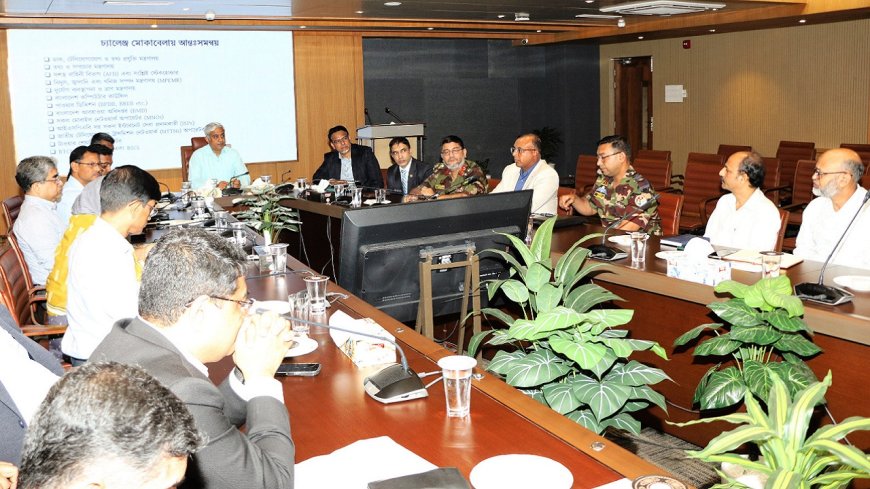



A stakeholder meeting on disaster-time telecom infrastructure preparedness was held at the Bangladesh Telecommunication Regulatory Commission (BTRC) headquarters on Tuesday, July 15. Representatives from government and private agencies, including telecom service providers, attended the session to discuss critical issues and recommend sustainable policy strategies for disaster response.
At the exchange, Brigadier General Shafiul Azam Parvez, Director General of the Engineering and Operations Division at BTRC, outlined key challenges faced during disasters. These included power outages, network downtimes, damage to optical fiber and microwave links, call drops, broadband and tower disruptions, technician inaccessibility in remote areas, fuel shortages for backup generators, and the limited use of amateur radio and alternative communication systems.
Telecom operators and representatives of the Nationwide Telecommunication Transmission Network (NTTN) emphasized their reliance on the Power Development Board (PDB) and the Rural Electrification Board for uninterrupted services. They stressed the need for prior coordination with these entities to ensure electricity readiness before disasters and proposed reducing the duration of power blackouts during emergencies. They also called for the formation of an effective committee and for officially declaring telecom services as essential during disasters.
A representative of Bangladesh Satellite Company noted that transporting telecom equipment during disasters remains a significant challenge. They proposed the installation of VSAT equipment in vulnerable regions and recommended using government disaster-risk maps to pre-position generators, solar panels, and satellite units to ensure connectivity.
Tower company representatives raised concerns about the absence of permanent generators and shelter facilities for workers in high-risk sites. They urged BTRC to formulate a policy mandating permanent generator installations in designated tower locations and suggested categorizing regions using a red-yellow-green scale to prioritize support based on risk levels.
The Rural Electrification Board representative pointed out that power lines in rural areas are often surrounded by trees, which necessitates preemptive disconnection during alerts. He added that work is underway to redesign power poles in coastal regions to be more disaster-resistant and to ensure proper inspection at each step of power transmission during emergencies.
The Director of the Department of Disaster Management pledged to incorporate stakeholder recommendations into a five-year disaster management action plan.
In his concluding remarks, Brigadier General (Retd.) Iqbal Ahmed, Commissioner of the Engineering and Operations Division at BTRC, emphasized the varying network infrastructure capacities across operators and called on each entity to strengthen their systems. He recommended categorizing disaster-related challenges for phased action and stressed the importance of inter-agency information sharing and integrating telecom into all disaster response frameworks.
He expressed optimism that through continued meetings and collaboration, a sustainable and effective disaster-time telecom policy can be drafted.
Also present at the meeting were BTRC Spectrum Division Commissioner Mahmud Hossain, senior BTRC officials, representatives from the Armed Forces Division, Department of Disaster Management, Power Development Board, Bangladesh Satellite Company Ltd., Bangladesh Submarine Cable Company Ltd., Meteorological Department, mobile network operators, NTTN operators, tower sharing companies, international terrestrial cable operators, the Internet Service Providers Association of Bangladesh, and the Amateur Radio Association of Bangladesh.









