






































Triple Zero Target: Rizwana Urges Muslim World to Embrace Social Responsibility
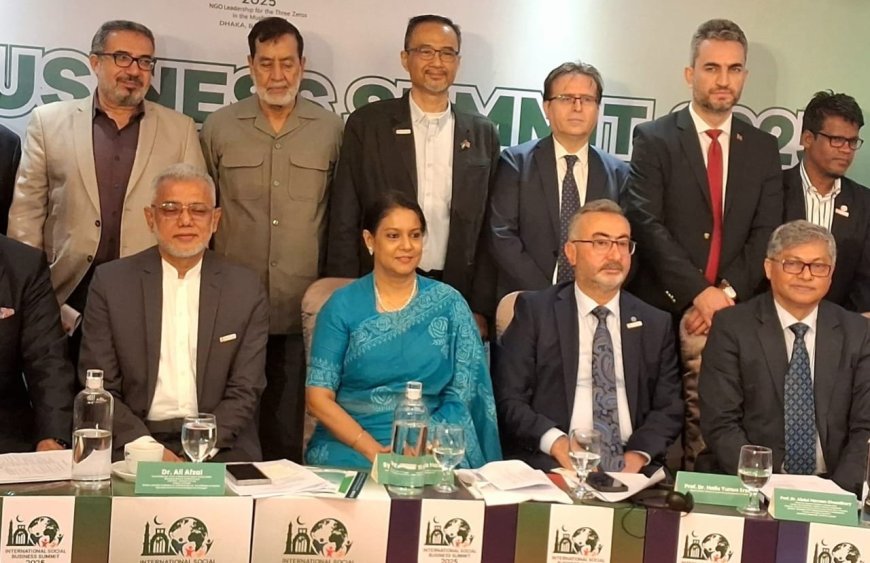



Syeda Rizwana Hasan, Adviser to Bangladesh's Ministry of Environment, Forest and Climate Change and the Ministry of Water Resources, has called upon leaders of the Muslim world to take an active stand toward achieving the goals of zero net carbon emissions, zero poverty, and zero unemployment—collectively referred to as the “Triple Zero” agenda. She emphasized the importance of sincere social responsibility and the adoption of genuine social business models in realizing these ambitious goals.
She made the call while addressing the International Social Business Summit (ISBS) 2025: NGO Leadership for Achieving the Three Zeros in the Muslim World, held on Saturday, July 5, at Hotel Bengal Blueberry in Gulshan, Dhaka.
Distinguished attendees at the event included Professor Dr. Halis Yunus Ersoz, Deputy Minister of Youth and Sports of Turkey; Professor Dr. Abdul Hannan Chowdhury, Chairman of Grameen Bank and Vice Chancellor of North South University; Yup Akmal, Secretary General of UNIW and Chairman of Fuzul Savings Finance Inc.; S. M. Rasheduzzaman, Chairman of SAWAB and member of UNIW’s High Advisory Board; Dr. M. Abdul Aziz, representative of IIIT Bangladesh and Director General of BIIT; and Dr. Ali Afzal, UNIW Council Member and Managing Director of Krishibid Group.
Addressing the audience, Rizwana Hasan said, “To achieve zero poverty, zero unemployment, and zero net carbon emissions, we must cultivate a genuine sense of social responsibility.” She urged leaders across the Muslim world to adopt authentic social business models to tackle poverty, joblessness, and environmental degradation.
She added, “We speak of values, but fail to practice them—that’s the root of the problem. Real transformation begins only when moral ideals are put into action.” Referring to the harmful impact of modern capitalism, she warned, “If we do not revise our economic models now, many countries will submerge under water and entire civilizations may vanish by the end of this century.” She stressed the need to re-evaluate our consumer culture, saying, “We must learn to distinguish between need and excess. And we must stop waging wars—forever.”
Referring to Islamic teachings, she said, “Islam does not merely call for preaching but mandates effective action. It stands against inequality and teaches us to earn ethically and spend for the welfare of others without inflicting suffering in the name of profit.” Expressing disappointment, she said, “The Muslim world fails to speak in one voice during humanitarian crises. Why do Muslim states remain silent when innocent Palestinians are being killed? Brotherhood means nothing without moral courage.”
She also cited zakat—a key pillar of Islamic economic practice—as a tested and effective model. “In modern tax systems, we pay taxes expecting the state to support the poor. But in reality, that money is often spent on large-scale projects that don’t benefit marginalized communities,” she observed. Calling for a renewed sense of human solidarity, she concluded, “The path to humanity lies in embracing diversity, not hatred. We must speak with empathy and recognize the value of all communities.”









