

































Government Plans Major Tax Incentives to Accelerate Solar Power Expansion



The government is preparing a comprehensive package of tax incentives to significantly boost the production and use of renewable energy in Bangladesh, with a particular focus on solar power. The initiative is expected to be incorporated into the national budget for the 2026–27 fiscal year, and an official notification may be issued soon.
According to reliable sources within the tax wing of the National Board of Revenue (NBR), companies engaged in establishing and supplying solar power plants will receive a full income tax exemption on earnings generated from such operations until June 30, 2035. The proposed incentive is scheduled to take effect from July 1, 2026.
Conditions for Tax Exemption
NBR sources said that eligible companies will be required to meet several conditions to qualify for the tax holiday.
Among the key requirements are:
- Solar power plants must be established through the company’s own financing and management.
- Each project must obtain mandatory approval from the relevant authority in accordance with the Net Metering Guidelines 2025.
- Companies must comply with all provisions of the Income Tax Act 2023.
- Electricity generated by the plants must be supplied to users under a valid Power Purchase Agreement (PPA).
- Any surplus electricity must be fed into the national grid through the net-metering system.
- Applicable withholding taxes must continue to be deducted and deposited into the government treasury.
Additional Incentives for Solar Power Users
The proposed policy also includes benefits for industrial and commercial entities consuming solar electricity.
Under the plan, businesses using electricity generated by solar power plants will be allowed to claim a tax rebate equivalent to 5 percent of their total electricity payments. The amount can be directly adjusted against their payable income tax liabilities.
Industry stakeholders believe the measure will encourage wider adoption of solar installations across the business sector.
High Import Duties Seen as a Major Barrier
Analysis of NBR data from fiscal years 2022–23 through 2024–25 shows that despite substantial import duties, annual government revenue from solar-energy-related equipment ranges between approximately Tk 5.5 crore and Tk 16.5 crore—less than Tk 20 crore in total annual revenue.
Sector experts argue that the relatively small revenue contribution does not justify the heavy tax burden currently imposed on renewable energy equipment.
At present, most solar power components are subject to combined duties and taxes ranging from 25 percent to nearly 90 percent.
According to applicable HS codes:
- Solar PV modules face a tax burden of 26.90 percent.
- Photovoltaic cells are taxed at 25.75 percent.
- Solar inverters carry a 28.73 percent tax rate.
- DC cables, aluminum mounting structures, and battery packs are subject to 58.40 percent taxation.
- Monitoring units and circuit boards face taxes ranging from 31 to 37 percent.
- PV DG controllers or hybrid controllers bear the highest tax burden at 89.08 percent.
Growing Momentum in Solar Projects
Bangladesh has recently witnessed increased investment in solar energy infrastructure.
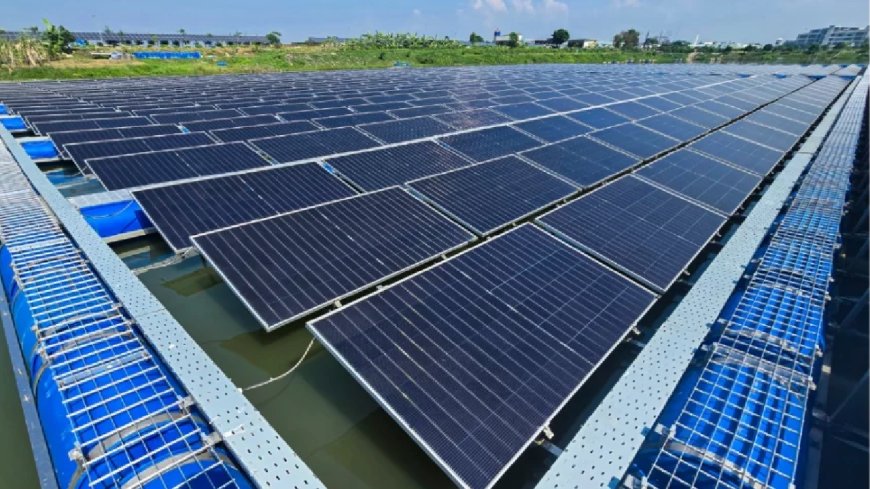
A notable example is a 1-megawatt floating solar project installed on a water body at the Walton headquarters in Chandra, Gazipur. The project has been claimed as the largest privately developed solar power plant of its kind in the country.
Earlier, a 2.3-megawatt solar power project in Bulanpur, Chapainawabganj, incorporated a 0.8-megawatt floating solar installation on a water reservoir.
Sources indicate that technology companies and telecommunications operators are also exploring similar renewable-energy initiatives to reduce operational costs and enhance sustainability.
Expected Economic and Environmental Benefits
Entrepreneurs and industry stakeholders believe that tax exemptions and rebates on solar equipment and power generation will significantly accelerate renewable energy adoption across Bangladesh.
They argue that the incentives could:
- Increase domestic solar power generation capacity.
- Reduce dependence on imported fossil fuels.
- Lower energy costs for industrial and residential consumers.
- Create new employment opportunities.
- Attract substantial local and foreign investment.
- Support the country's transition toward a greener and more sustainable energy future.
DBTech/DPO/MUIM/OR