





































BNP Manifesto Promises Regional Hubs in E-Commerce and Aviation
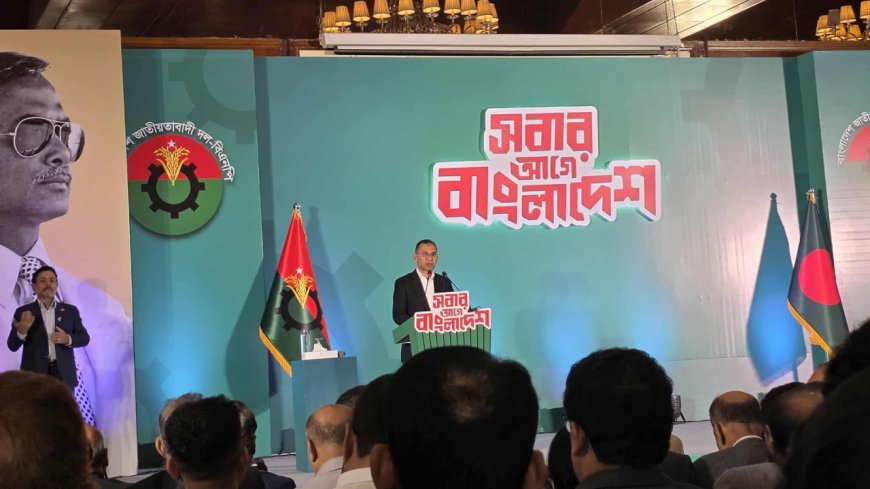



The Bangladesh Nationalist Party (BNP) has unveiled its election manifesto for the 13th National Parliamentary Election, expressing a firm commitment to building a self-reliant Bangladesh. The manifesto was formally announced by BNP Chairperson Tarique Rahman on Friday, February 6, at 3:30 pm, at Hotel Sonargaon in Dhaka.
In his address, Tarique Rahman pledged to govern the country impartially by prioritising merit over political identity. Among the nine key pledges outlined in the manifesto, special emphasis has been placed on strengthening the digital economy and global connectivity. These include the introduction of an international payment system such as PayPal, the establishment of a regional e-commerce hub, and expanded exports of ‘Made in Bangladesh’ products.
The manifesto also promises to upgrade Dhaka, Chattogram, and Sylhet international airports into fully integrated logistics and passenger hubs. As part of this initiative, BNP plans to launch a National Logistics Digital Platform to enable integrated cargo tracking, booking, and route planning. In the agricultural sector, the party has pledged to bring farmers’ land data under a centralised data processing system and extend benefits through an expanded Agriculture Card framework.
Reiterating its commitment to transforming Bangladesh into a regional hub for exports and e-commerce, the manifesto outlines comprehensive plans to secure the future of young people. These include job creation, enhancement of technical and language skills, startup and entrepreneurship support, integration with global e-commerce platforms, and ensuring merit-based recruitment in government services. BNP has also pledged to issue Agriculture Cards to all categories of farmers, expand app-based agricultural services, and waive agricultural loans of up to BDT 10,000 for farmers.
Unveiled under the slogan “Bangladesh First” and guided by the principle “Work to Build the Nation”, the manifesto places strong emphasis on education reform. It commits to establishing a joyful and skill-oriented education system, formulating a values-based education policy, prioritising primary education, providing technology support for teachers and students, and introducing a mid-day meal programme in primary schools.
The manifesto has been structured into five core sections, with a focus on state reform and democratic reconstruction. Tarique Rahman pledged to implement the July Charter, in alignment with BNP’s 31-point reform agenda, at the outset of governance. The manifesto includes 35 specific commitments, such as reinstating a neutral caretaker government system during elections, forming a bicameral parliament, fixing term limits for the Prime Minister, and ensuring full independence of the judiciary.
According to the proposal, these reforms will be implemented based on the ‘July National Charter’ signed on October 17, 2025, alongside BNP’s 31-point agenda. The manifesto also emphasises restoring the constitutional provision of “absolute trust and faith in Almighty Allah” and reinstating the caretaker government system abolished during what the party describes as a fascist regime.
In addition, BNP has outlined an ambitious plan to transform Bangladesh into one of the leading aviation hubs of South and Southeast Asia by 2034. This includes developing a nationwide air connectivity grid, initially linking divisional cities and gradually extending to district towns through the construction of small airports and airstrips.
The manifesto declaration event was presided over by BNP Secretary General Mirza Fakhrul Islam Alamgir, while the programme was conducted by Nazrul Islam Khan, a standing committee member of the party and chairman of its election steering committee.
The manifesto has been formulated by integrating the 19-point programme of BNP founder and martyred President Ziaur Rahman, Vision-2030 of former Prime Minister Khaleda Zia, Tarique Rahman’s 31-point state reform agenda, and the July National Charter. The document also pledges to create new export sectors beyond the garment industry, aiming to diversify and strengthen the national economy.
DBTech/IH/MUM/OR









