





































“Freedom on the Net 2025” Report Shows 5 Step Advancement
Bangladesh’s Bettering Bandwidth Freedom
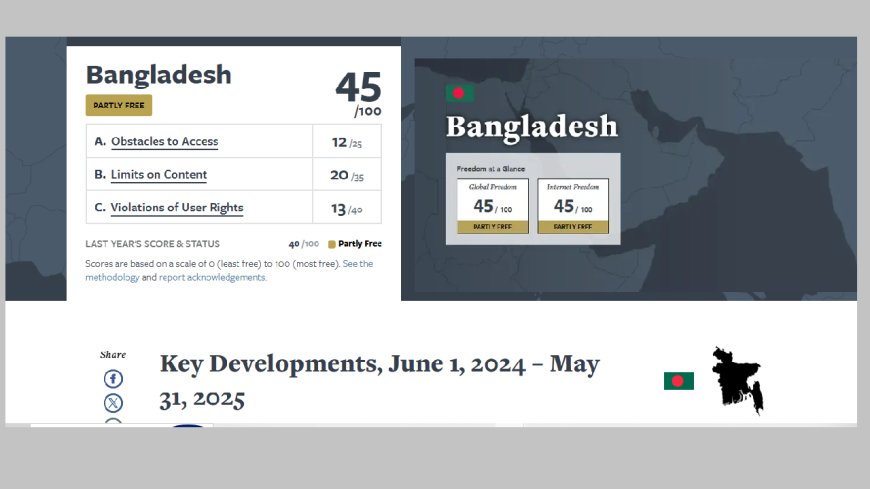



Internet freedom continues to decline worldwide. However, Bangladesh has advanced five points within the “Partly Free” category following the July mass uprising last year. According to the Washington-based research organisation Freedom House and its newly published Freedom on the Net 2025 report, online freedom conditions worsened in 28 of the 72 assessed countries, while 17—including Bangladesh—experienced overall improvement. Bangladesh’s score has increased from 40 to 45 out of 100.
Freedom House evaluates countries across three major categories: Obstacles to Access, Limits on Content, and Violations of User Rights. Bangladesh scored 12 out of 25 in Obstacles to Access, 20 out of 35 in Content Limitations, and 13 out of 40 in User Rights Violations.
The report notes a decline in arbitrary shutdowns and improvements in policy transparency by the BTRC. However, infrastructural limitations and the lack of affordable internet remain key challenges. Some website blocking persists, but transparency around content restrictions has improved. Self-censorship in political contexts has declined, although concerns remain regarding propaganda and disinformation.
According to the analysis, Bangladesh witnessed this progress between 1 June 2024 and 31 May 2025. Despite the improvements, the country remains in the “Partly Free” category.
In the Asia-Pacific region, Indonesia (48), India (51), and Sri Lanka (53) rank ahead of Bangladesh. Yet, Bangladesh’s progress has been termed a “significant positive development” in a year when global internet freedom continued to deteriorate.
The report observes that the student-civil uprising, political turbulence, and the subsequent change in government in June 2024 reshaped Bangladesh’s digital rights environment. After Nobel Laureate Professor Muhammad Yunus assumed leadership of the interim government in August, reforms in digital regulations, shutdowns, and surveillance practices were initiated. As noted in the report, BTRC Chairman Emdad-ul-Bari’s commitment that “internet access will be considered a human right and unreasonable shutdowns will no longer be tolerated” played a crucial role in easing access barriers. Additionally, under the supervision of Chief Adviser’s Special Assistant Faiz Ahmad Taiyeb, the government abolished the controversial Cyber Security Act (CSA) and issued the Cyber Security Ordinance (CSO) in May 2025, which brought limited relief.
Freedom House’s 13 November Freedom on the Net 2025 report has drawn international attention for Bangladesh’s notable rise from 40 to 45—the country’s highest score in seven years—bringing it closer to India (51) and Sri Lanka (53).
The assessment also highlights contrasting global developments. Kenya witnessed the steepest decline after internet shutdowns and mass arrests during tax-related protests. Bangladesh, too, faced extended shutdowns during the student-led demonstrations against the former Awami League government. However, the eventual fall of that administration and installation of the interim government brought policy reforms and the end of repressive digital practices. The current government has annulled the previous restrictive cyber law and introduced a new ordinance, though concerns remain regarding content removal, criminal penalties for online expression, and surveillance-related provisions.
Freedom House acknowledges improvements in protections against online harassment, greater transparency in appeals and complaints processes, and strengthened procedural safeguards. However, the broad “cyber terrorism” clause, expanded surveillance authority, and continued risks of censorship still pose significant threats.
Positive developments highlighted in the report include the recognition of internet access as a basic right, increased political openness following student movements, absence of major cyberattacks or massive data leaks, and a somewhat safer environment for media and civil society. Nevertheless, legal ambiguities, surveillance risks, censorship vulnerabilities, and the digital divide remain major challenges. Bangladesh must make further progress before achieving a fully free and secure digital environment.
Following the publication of the report on DigiBanglaTech.news, the Ministry of Posts, Telecommunications and Information Technology issued a statement. Signed by the Ministry’s Public Relations Officer Muhammad Jasim Uddin, the statement attributes the improvement in Bangladesh’s score to several initiatives undertaken after Chief Adviser’s Special Assistant (in charge of the Ministry) Faiz Ahmad Taiyeb assumed office. These include the new telecom ordinance, fundamental reforms in surveillance structures, the Personal Data Protection Ordinance, and the National Data Management Ordinance. A World Bank delegation has already noted that these ordinances meet global standards. Bangladesh’s progress reflects its commitment to ensuring an open and secure digital future. With improved internet governance, digital transformation, simplified telecom licensing, enhanced citizen services, and strengthened interoperability, Bangladesh is expected to surpass a score of 50 soon.
DBTech/IH/OR









