





































Spinning Sector Struggles: Gas Prices, Policy Gaps, and Indian Yarn Threaten Survival



Bangladesh’s spinning industry has long been grappling with multifaceted challenges. Stakeholders have warned that without addressing issues such as rising gas prices, the influx of foreign yarn, and policy inconsistencies, the sector may face a severe downturn.
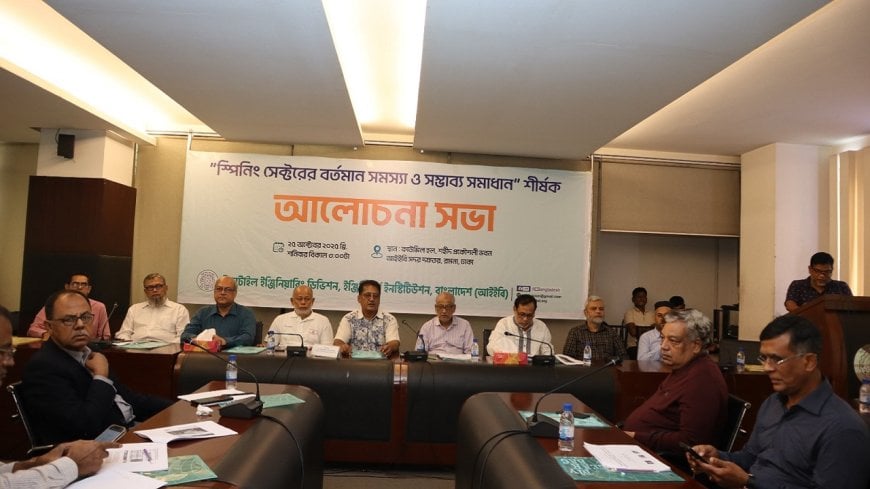
These concerns were voiced on Saturday, October 25, at a discussion titled “Current Challenges and Possible Solutions for the Spinning Sector” held at the council hall of the Institution of Engineers, Bangladesh (IEB) headquarters in Ramna, Dhaka. The event was organized by the IEB’s Textile Engineering Division.
The session was presided over by Engineer Mohiuddin Ahmed Selim, Chairman of the Textile Engineering Division, while the Acting President of IEB, Engineer Khan Manjur Morshed, attended as the chief guest.
He stated, “The major problems in the spinning sector are the influx of Indian yarn and the increase in gas prices. Mill owners want restrictions on Indian yarn imports, but garment manufacturers oppose it. Representatives from all sectors must sit together to resolve this conflict.”
Engineer Md. Abul Kalam Azad, Director of Armada Spinning Mills Ltd., presented the keynote paper, saying, “Industrial revolutions worldwide have been driven by the harmony of technology and policy. Yet Bangladesh is lagging in competitiveness. India is capturing our market by exporting yarn duty-free and selling below production cost — a clear case of dumping that requires immediate government intervention.”
Engineer Nasiruddin Mia, Director of One Composite Ltd., said, “We are now selling shirts for $1.20, but the production cost is $1.55. This gap is unsustainable. The government must act swiftly with policy measures and reinstate incentives.”
Engineer Mahbub Milton, Executive Director of Masco Group, remarked, “Competition will always exist. We need to reduce costs, particularly in utilities and transportation, and strengthen our internal capabilities.”
Engineer Jamil Tipu, former Executive Director of Akij Group, noted, “State-controlled spinning mills collapsed after independence due to inefficient management. The Indian dumping policy continues to threaten this sector. With rising gas prices, production costs have soared — we must now explore alternative energy like solar power.”
Engineer Enamul Haque, Director of Bengal NFK Ltd., said, “Rising bank interest rates are putting more pressure on the industry. Loans now carry over 13% interest. Solar systems could generate up to 45% of our electricity, but if loans were available before setup, production costs would decline significantly.”
Engineer Ahsanul Russell, Chairman of Rah Spinning Mills Ltd., commented, “Gas and power instability remain the biggest obstacles. Power outages during production cause huge losses. If the government resolves utility issues, overall costs will fall sharply.”
Md. Afzal Hossain, Chairman of Lablu-Babul Composite Mills, added, “We have invested in backward linkage, but the unrestricted entry of foreign yarn has put our investment at risk. The government must act immediately.”
Mosharraf Hossain, Chairman of Mosharraf Group, remarked, “The government raised gas prices without consulting the industry. Now, cheap Indian yarn is flooding the market, pushing local mills to the brink of closure.”
Other speakers included Engineer Md. Azhar Ali, CEO of Salma Group; Engineer Ehsanul Karim Kayser, Convener of ITET; and several others.
Among the distinguished attendees were Dr. Julhas Uddin, Vice-Chancellor of Bangladesh Textile University; Dr. Ayub Nabi Khan, Pro-Vice Chancellor of BGMEA University; Engineer Sheikh Al Amin and Engineer Niaz Uddin Bhuiyan, Vice Presidents of IEB; Engineer Sabbir Ahmed Osmani, Acting Honorary General Secretary; and Engineer ATM Shamsuddin Khan, President of the Textile Engineers Forum, among other notable engineers.
The vote of thanks was delivered by Engineer Md. Saidur Rahman, Vice Chairman of the Textile Engineering Division, while the event was moderated by Engineer Sumayel Md. Mallik.









