






































Talent Gap, Trade Trouble



Bangladesh has opened a new horizon of economic progress by achieving stable GDP growth of over 6% in the past decade. However, the greatest challenge in its transition from an agriculture-based to an industry-driven economy lies in the acute shortage of skilled human resources. In high-growth sectors such as textiles, IT, finance, and pharmaceuticals, the lack of skilled local professionals has made Bangladesh increasingly dependent on foreign workers—currently, nearly half a million expatriates are employed in mid- and senior-level positions.
A recent study led by Dr. Tanvir Abir of Daffodil International University revealed that despite the large number of university graduates, industries are facing serious deficits in technical expertise, leadership, and problem-solving skills.
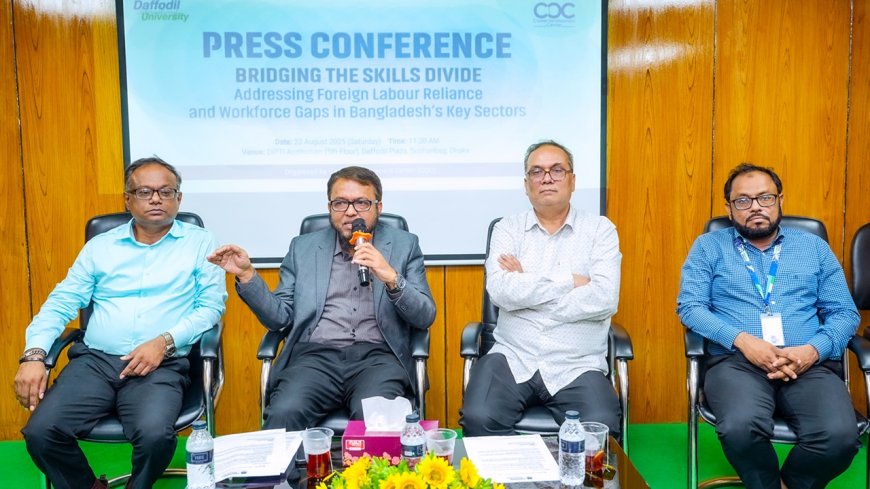
These findings were disclosed at a press conference held on Saturday, August 23, at the Daffodil Prasar Deepti Auditorium in Dhanmondi, Dhaka, under the title “Bridging the Skills Gap: Addressing Foreign Labor Dependence and Workforce Deficiency in Bangladesh’s Key Sectors.” The keynote paper was presented by Dr. Tanvir Abir, the head of the research team.
Speakers at the event included Dr. Nadir Bin Ali, Registrar of Daffodil International University; Professor Dr. Syed Mizanur Rahman, Director of External Affairs; and Mohammad Monzurul Haque Khan, Director of the Career Development Center, among others.
Key Features of the Study
-
Sectoral Analysis: The skills gap was clearly identified in textiles, IT, finance, and pharmaceuticals.
-
Foreign vs. Local Workers: Employers often prefer expatriates due to their superior technical expertise and adaptability.
-
Training Needs: Hands-on training, stronger industry-academia collaboration, and curriculum modernization were deemed urgent.
-
Graduate Employability: Local graduates scored an average of 2.72 out of 4—below industry expectations.
-
Policy Recommendations: A national skills development framework, gender equality, and incentives to retain local talent.
Impact on the Economy
-
Reducing Foreign Labor Dependence: Lowering billions of dollars in annual remittance outflows while boosting productivity.
-
Job Creation: Enhancing local skills will open up higher-value employment opportunities.
-
Global Competitiveness: Aligning education with industry demand can accelerate exports and attract investment.
-
Social Equity: Increasing women’s participation in the workforce will unlock new possibilities in the labor market.
Limitations and Future Directions
While the study is limited to the Bangladeshi context, the researchers proposed expanding it to include multinational comparative analyses to gain a global perspective. They stressed the importance of identifying future-oriented skill demands in fields such as artificial intelligence, data science, blockchain, green energy, and cybersecurity.
Need for Funding
According to the research team, without sufficient investment in developing local talent and training infrastructure, the skills gap cannot be bridged. Such investment, they argued, will not only sustain the economy but also enhance Bangladesh’s global competitiveness many times over.
Ultimately, the study provides policymakers, academics, and industry leaders with a practical roadmap through which Bangladesh can advance toward a self-reliant economy powered by skilled human capital.









