





































Yunus Urges Rooftop Revolution for Renewable Energy
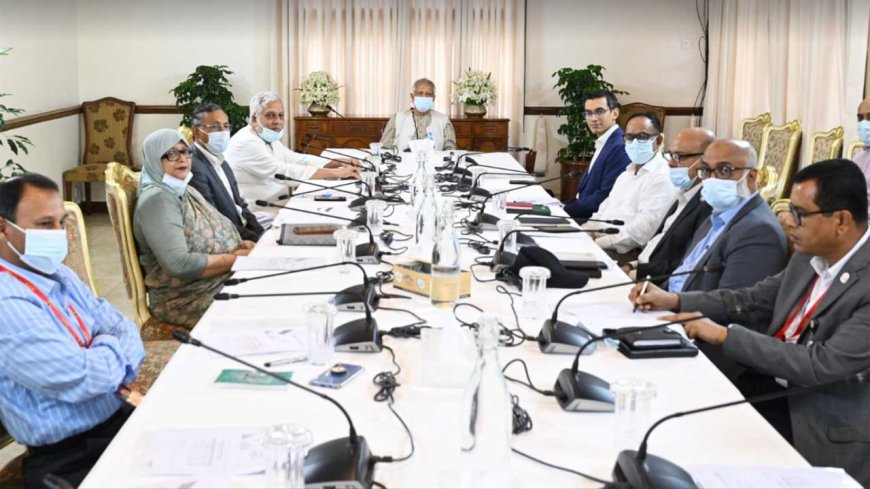



Chief Advisor Professor Dr. Muhammad Yunus has directed authorities to initiate solar power generation by installing rooftop solar panels on all government buildings across the country. The directive was issued during a meeting titled “National Rooftop Solar Program,” held on June 26 (Thursday) at the state guest house Jamuna.
The information was shared through a press statement from the Chief Advisor’s Press Wing.
Officials attending the meeting cited the 2024 report by the International Renewable Energy Agency (IRENA), which revealed that Bangladesh lags far behind its neighboring countries in achieving its solar energy targets. While India generates 24 percent, Pakistan 17.16 percent, and Sri Lanka 39.7 percent of their total electricity demand from solar energy, Bangladesh produces only 5.6 percent.
According to the Renewable Energy Policy 2025, Bangladesh aims to generate 20 percent of its electricity from renewable sources by 2030 and 30 percent by 2040. As part of this effort, tender processes have already commenced for 55 land-based solar power plants with a combined capacity of 5,238 megawatts. However, officials mentioned that full implementation may take until 2028.
In this context, the Chief Advisor directed the formulation of a fast-track, implementable “National Rooftop Solar Program.” As part of this initiative, he instructed relevant bodies to take necessary measures to install rooftop solar systems on all government buildings, schools, colleges, madrasas, and public hospitals.
He stated, “Consider whether the installation of solar panels on government buildings can be carried out through private initiatives. Those who install the systems will maintain and operate them efficiently out of their own business interest. The government will only provide the rooftop space; the rest will be managed by them.”
“We must learn from the experiences of institutions that have already installed rooftop solar. We need to understand the challenges they faced and address those issues,” he added.
Under this program, public schools, colleges, and madrasas will not be required to pay electricity bills, and they will also receive rental income for the use of their rooftops for solar energy production.
The meeting was also attended by Energy, Power, and Mineral Resources Advisor Faozul Kabir Khan, Executive Chairman of the Bangladesh Investment Development Authority (BIDA) Chowdhury Ashiq Mahmud Bin Harun, and senior officials from the ministries of Power, Energy and Mineral Resources, and Secondary and Mass Education.









