





































Telecom Troubles and Digital Disconnects: BTRC Chairman Flags Industry Fractures
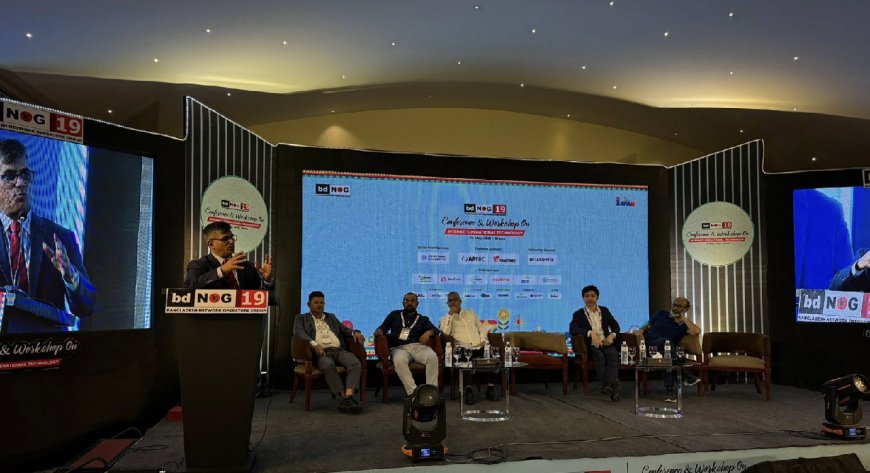



The Chairman of the Bangladesh Telecommunication Regulatory Commission (BTRC), Engineer Md. Emdadul Bari, has drawn attention to a series of structural disconnects within the country's telecom sector, stating that a critical disjunction occurred between the government and regulatory authorities around 2010. He remarked, “There is also a funny disconnect—that is Information and Communication Technology. Today, you cannot separate communication and information technology. Yet in 2011, we created an ICT ministry. We soon realized ICT cannot be separated from telecom. For the last 10 years, telecom and ICT have been two sides of the same coin. This is what’s holding back our industry’s growth.”
The BTRC chief further stated, “But even worse has been the disconnect between the telecom industry and the people.”
Explaining how this distance evolved, he said the initial telecom business revolved around copper-wire phones, with network operations focused solely on connectivity. SMS emerged as a by-product of voice services. Eventually, the country’s telecom industry advanced in tandem with the vision of building an inclusive society. However, in the race to expand connectivity, the industry lost sight of what people would actually do with that connectivity. “If we continue this way, this sector will not progress,” he warned.
“That’s why we must now move from connectivity to digital transformation and services,” Bari added. Citing the decline of CD/DVD businesses in the wake of services like Spotify, he urged caution: “The world is moving toward open networks. Business will no longer be vertical—it will expand horizontally. We don’t know where cloud computing and artificial intelligence will take network topology and service communication. No one will remain in the same place tomorrow. We must drive our own transformation.”
He traced a history of missed opportunities and segmentation in the sector. “When fixed telecom and mobile companies began fighting over network sharing, we had our second big disconnect. Similarly, in the last mile, there was a disconnect between NTTNs and ISPs—which still persists. Another classic example is the early stage of mobile financial services, which were originally considered just another form of connectivity. Once it was clear that it was actually a financial service, the sector evolved separately, and that disconnect remained.”
The BTRC chairman urged telecom businesses to focus on digital services that align with consumer needs, instead of competing over network ownership. “When everyone was focused on connectivity, voice and internet got disconnected. Meanwhile, a revolution happened unnoticed—the rise of digital services. We missed it,” he said. “At a time when we needed awareness around digital service providers and content creators, we pushed them away. Then came voice and OTT, which led to the world’s biggest disconnect. Now we are all scrambling to become digital service providers.”
Bari also pointed out the disconnect between television and internet services. “Once, these were two separate technologies, regulated by two different authorities. Homes had both TV and telephone, but we never realized they were fundamentally the same. Then ISPs built networks and the internet protocol emerged. Now, broadcast services are using both telephone and internet—but there remains a significant disconnect.”
He emphasized that the BTRC is working to bring these fragmented elements into a unified service ecosystem. “We are restructuring license categories in such a way that one does not overlap with another. Everyone should be able to connect through a single business model because connectivity is no longer just about connection.”
The BTRC Chairman made these remarks during the closing ceremony of the 19th BDNOG Conference held on Saturday at a hotel in Gulshan, Dhaka. The event was presided over by BDNOG President Nadir Bin Ali and attended by ISPAB President Mohammad Aminul Hakim, APNIC Secretary General Zia Rang Low, APNIC Executive Council Member Suman Ahmed Sabir, Bahon CTO Rashed Amin Bidyut, and ISPAB General Secretary Nazmul Karim Bhuiyan.









