




































AI-Driven Hajj: How Saudi Arabia Is Digitally Transforming the Pilgrimage Experience



Modern technology and artificial intelligence (AI) are no longer confined to everyday life alone; they have now brought an unprecedented transformation to the management of the holy Hajj pilgrimage. To ensure the safe, organized, and efficient management of millions of pilgrims arriving annually from around the world, Saudi Arabia is extensively deploying artificial intelligence, real-time data analytics, smart devices, and augmented reality (AR) technologies. This fusion of technology and faith is making the Hajj experience significantly smoother and more spiritually enriching for pilgrims worldwide.
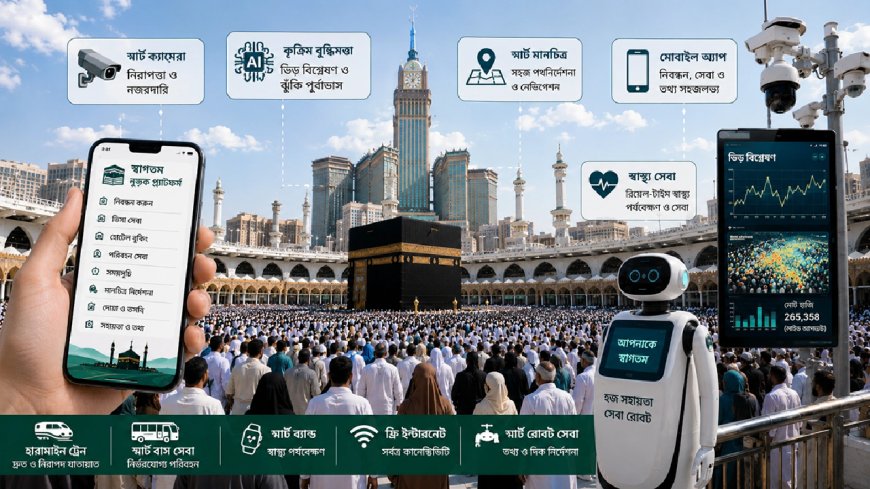
Once upon a time, Hajj registration, visa processing, and travel planning were highly complex and time-consuming tasks. Saudi Arabia’s Ministry of Hajj and Umrah has now digitized the entire process. Its newly introduced Nusuk app has become the central driving force of Hajj management. Through this single platform, pilgrims can access e-visas, hotel bookings, transportation services, prayers, and all essential guidelines in one place. In addition, the Tawakkalna app securely stores pilgrims’ digital identities, including visas, passports, and health insurance information, significantly reducing the risks associated with losing paper documents.
One of the greatest challenges during Hajj is managing the movement of millions of people. In the past, overcrowding often led to tragic incidents. This year, however, Saudi authorities are using AI-based smart monitoring systems. Thousands of smart cameras and sensors installed at holy sites analyze crowd movement patterns in real time. Whenever excessive crowd density begins to build up, the AI system instantly alerts authorities before the situation escalates.
To further modernize Hajj management for 2026, Saudi Arabia’s Umm Al-Qura University-affiliated startup Al-Amad has introduced a new AI-powered mobility platform titled “Routes of the Holy Sites.” Using real-time data analysis, the platform can predict potential traffic congestion and overcrowding in advance, enabling authorities to take rapid action to ensure smooth pilgrim movement.
Technology has also made life easier for pilgrims on a personal level. Previously, language barriers, navigation difficulties, and understanding Hajj rituals created considerable anxiety among pilgrims. Now, online classes, video lectures, and mobile apps allow pilgrims to learn every stage of Hajj from home. Through augmented reality (AR) technology, pilgrims can virtually explore the Kaaba, Mina, Arafat, and Jamarat before physically arriving there.
Even pilgrims unfamiliar with Arabic can now easily communicate with hospitals, shopkeepers, and authorities using AI-powered translation tools on smartphones. GPS navigation and offline map downloads have also significantly reduced the fear of getting lost in the massive crowds.
Healthcare services have also undergone digital transformation through the Sehhaty app, which enables pilgrims to consult doctors via video calls. Smart bracelets are being used to protect elderly pilgrims by monitoring heart rate, body temperature, and blood pressure, while instantly sending alerts to control centers during emergencies.
Meanwhile, AI-powered multilingual robots deployed at the Two Holy Mosques are answering pilgrims’ questions, distributing Zamzam water, and providing religious books and guidance.
Despite these technological blessings, concerns remain regarding the misuse of digital tools during such a sacred act of worship. Many pilgrims are becoming overly engaged in smartphone use, selfies, live streaming, and social media activities during Hajj. However, Hajj is fundamentally an act of humility and devotion to Allah rather than self-promotion or public display. Therefore, ensuring the responsible use of technology while preserving the spiritual essence of worship remains a major challenge.
Overall, Saudi Arabia’s digital transformation is not only making Hajj safer and more organized but is also presenting the world with a remarkable model of sustainable and efficiently managed human gathering.
DBTech/NA/EK/OR









