In an effort to improve service quality for a single operator without disrupting services for customers of others, the country’s leading mobile operator Grameenphone was denied 850 MHz spectrum in the EGSM band a year ago. At the time, amid objections from rival operators, the Bangladesh Telecommunication Regulatory Commission (BTRC) made it clear that its core objective in spectrum allocation was to ensure competitive balance and equal opportunity.
Against this backdrop, BTRC announced the auction of spectrum in the 700 MHz band on January 14. Known as a low-band frequency, the 700 MHz band is highly effective in providing wider coverage at lower cost, particularly in rural and remote areas. As a result, mobile operators often refer to it as a “golden spectrum.”
Auction framework and pricing
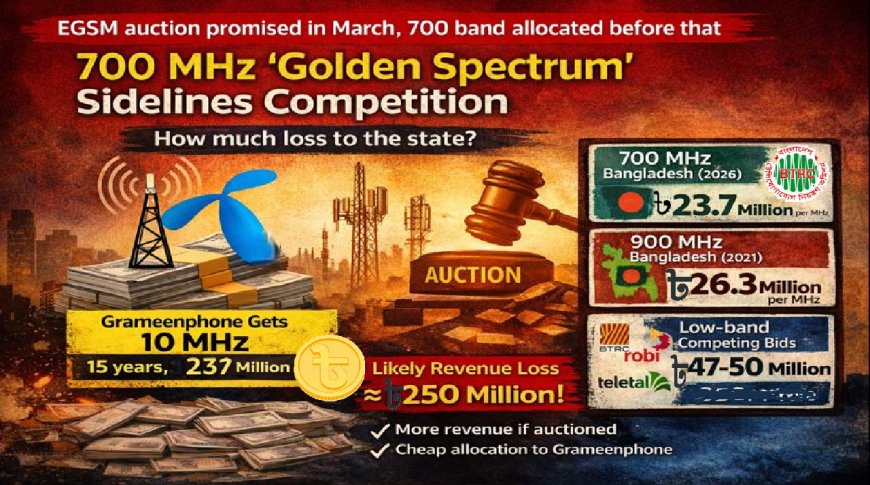
Although the 700 MHz band contains a total of 45 MHz of spectrum, 20 MHz remains tied up in legal complications. Consequently, only 25 MHz was put up for auction. BTRC initially set the reserve price at BDT 263 crore per MHz. After adding 7.5 percent VAT, the total base price per MHz stood at BDT 284 crore.
This pricing triggered objections from operators, who argued that fixing the same price as the 900 MHz band—set 28 years ago—was unreasonable given changes in technology and market realities. In response to these concerns, BTRC later reduced the base price to BDT 237 crore per MHz.
Operators step back
Despite the revised pricing, state-owned Teletalk and Banglalink did not participate in the auction. Eventually, Robi Axiata also withdrew its application. This left Grameenphone as the sole bidder.
Under BTRC’s amended auction guidelines, a single bidder is eligible to acquire a maximum of 10 MHz of spectrum. As competitive bidding failed to materialize, the Commission decided to proceed with direct allocation.
‘Not an auction, but a tailored allocation’
The decision immediately drew criticism. Allegations surfaced that, by allocating spectrum under revised rules instead of holding an auction, the regulator had protected the commercial interests of a single company, resulting in a potential revenue loss of around BDT 2,500 crore for the state.
Critics questioned how the 700 MHz band could be allocated at a price comparable to the 900 MHz band sold in 2021, despite years of inflation and a sharp rise in smartphone usage and data demand. They also pointed out that similar spectrum in neighboring India fetched around BDT 470 crore per MHz, suggesting that Bangladesh’s national resource had been handed over at nearly half the value.
Grameenphone’s explanation
Commenting on the allocation of 10 MHz of 700 MHz spectrum for 15 years at a total cost of BDT 2,370 crore, Grameenphone Chief Corporate Affairs Officer Tanvir Mohammad said the spectrum would enhance network coverage in underserved and indoor areas, improve efficiency and resilience, and strengthen the company’s capacity to deliver secure digital services to more than 85.6 million subscribers.
Questions over the MD’s remarks
The allocation also reignited debate over comments made by Grameenphone Managing Director Yasir Azman during media interactions on January 6. He had said investor appetite for Bangladesh was “very, very low,” citing this as a major concern not only for Grameenphone but for other operators as well.
This prompted questions about how Grameenphone could proceed with fresh investment without an auction when other operators had opted out. Was this not contradictory to the MD’s statement?
Responding, Grameenphone Head of Communications Sharifuddin Ahmed Chowdhury said the remarks referred to investor reluctance due to tax burdens and long-standing financial disputes. He added that the newly acquired spectrum would further strengthen the operator’s ability to provide secure and innovative digital services to its more than 85.6 million customers.
Did Robi fall behind by staying out?
Explaining Robi Axiata’s decision, its Chief Corporate Affairs Officer and Company Secretary Shahid Alam said the 700 MHz band was strategically important for future network expansion. However, after reviewing network priorities, implementation plans, and market realities, the timing of the auction did not align with the company’s immediate operational needs.
Addressing concerns about whether Robi might lag behind in rural expansion without the 700 MHz band, he noted that low-band frequencies also include the 900 MHz band. Robi has held the largest share of 900 MHz spectrum since 2016, enabling extensive 4G rollout in rural and remote areas. Moreover, around 65 percent of smartphones support the 900 MHz band, compared to only 35 percent supporting 700 MHz, meaning most Robi users already benefit from low-band coverage.
Banglalink’s position
Banglalink Chief Corporate Affairs Officer Taimur Rahman said the operator had been keen on the 700 MHz band but found the proposed price and allocation method misaligned with market realities. At current price levels, he said, the band was viable only for financially stronger operators, limiting participation by smaller players.
He added that Banglalink had formally applied to BTRC for spectrum in the EGSM band, which would help improve network coverage and competitiveness, expressing hope for swift regulatory action.
BTRC’s explanation and March assurance
BTRC Commissioner and Spectrum Management Committee Convener Mahmud Hossain said the single-bidder cap was reduced to 10 MHz to encourage competitive bidding, and prices were lowered in response to operator demands. However, when other operators chose not to participate, allocation proceeded under the revised guidelines.
Addressing allegations of haste before the election or bias toward a former employer, he said the guidelines had been amended twice prior to the auction, explicitly allowing single-bidder allocation. The decision, he stressed, was collective, fully documented, and followed legal procedures, with written confirmation from BTRC’s legal counsel and the Additional Attorney General that there were no legal barriers.
He added that the recommendation would be placed before the Commission meeting on January 28. Upon approval, Grameenphone would receive the spectrum for 15 years, payable in 10 installments.
Mahmud Hossain also assured that preparations were underway to hold an EGSM band auction by March, aiming to ensure fairness for all operators.
DBTech/IH/MU/OR