





























































































































India-Origin False Narratives on Bangladesh Intensify
Evidence of Disinformation Found in 140 Reports Published by 73 Indian Media Outlets




The spread of disinformation originating from India and centered on Bangladesh is increasing at an alarming rate. Compared to the previous year, the volume of such false content rose by nearly five percent. In 2025 alone, fact-checking organization Rumor Scanner identified evidence of at least 155 instances of disinformation about Bangladesh circulated across Indian media outlets and social media platforms. These figures highlight not only the scale of the problem but also a clear pattern of sustained growth. Even more concerning is the active role played by India’s mainstream media in disseminating these misleading narratives. Over the past year, 73 Indian news outlets published a total of 140 reports across 38 incidents containing false or misleading information involving Bangladesh.
Surge at the Start of the Year
For several years now, Indian social media accounts, pages, and mainstream media outlets have been consistently spreading disinformation involving Bangladesh. This trend continued unabated in 2025. The highest concentration of false content appeared at the beginning of the year, with 34 instances identified in January alone—the highest monthly total recorded in a single month last year. Although the numbers declined somewhat in subsequent months, the flow did not stop. May recorded the lowest count, with four instances, yet overall, Rumor Scanner observed that Indian accounts and media outlets were involved in spreading an average of at least 13 pieces of disinformation per month throughout the year.
X Remains the Epicenter
The microblogging platform X (formerly Twitter) continues to be the primary medium for spreading India-origin disinformation about Bangladesh. Of the 155 false claims identified last year, 126—nearly 81 percent—were circulated through various X accounts.
Beyond X, Indian accounts and pages also spread 54 instances of disinformation on Facebook during the same period. Other platforms implicated include YouTube, Instagram, Threads, and TikTok. Indian mainstream media outlets were directly involved in at least 38 disinformation incidents.
These data points clearly show that digital platforms have become the dominant channels for spreading India-origin disinformation about Bangladesh, with X playing the most influential role. When more than 80 percent of identified false narratives are disseminated via a single platform in just one year, it signals not merely a statistical anomaly but a structural trend—suggesting coordinated efforts to construct and amplify specific narratives.
Most troubling is the participation of mainstream Indian media. Disinformation originating from recognized news outlets tends to carry greater credibility among the public and can directly influence opinion formation.
Unchecked Communal Disinformation
Of the 155 instances of disinformation identified by Rumor Scanner in 2025, 91 were communal in nature—amounting to nearly 58 percent of the total. X again emerged as the primary vehicle for such content, with at least 85 communal disinformation posts traced to Indian accounts on the platform last year.
Indian mainstream media also played a role in this communal disinformation campaign. Evidence shows that in at least 10 incidents, Indian news outlets published communal falsehoods involving Bangladesh. Media organizations such as NDTV, The Times of India, Zee News, World Is One News, India Today, Hindustan Times, News18, TV9, ABP, and Mirror Now were among those that disseminated misleading content.
These statistics underscore deeper concerns—not only about the volume of disinformation but also its nature and intent. The majority of identified false narratives were capable of directly inciting religious division. This points to a pattern in which a significant portion of India-origin disinformation targeting Bangladesh is deliberately crafted and circulated to inflame communal tensions.
Bangladesh-Related Disinformation Across 73 Indian Media Outlets
Analyzing fact-checks published in 2025 on false information circulated by Indian media, Rumor Scanner identified 38 incidents involving Bangladesh across reports published by 73 Indian news outlets. The number of misleading reports per outlet ranged from as many as ten to as few as one. In total, 140 reports across these 73 outlets were found to contain verifiably false information.
Topping the list was the Indian satellite television channel Aaj Tak Bangla, which aired false information in 10 out of 32 incidents—placing it first in the ranking. In 2024, the channel had ranked fourth.
On July 9 last year, scrap trader Lal Chand, also known as Sohag, was brutally murdered in Dhaka’s Mitford area. In the aftermath, at least 27 Indian media outlets falsely claimed that Sohag was a Hindu—an assertion that was entirely untrue. This incident received the highest level of coverage by Indian media for a single false claim last year. Additionally, Rumor Scanner found that 16 Indian outlets spread disinformation in December surrounding a James concert in Faridpur, while in June, 12 outlets propagated false claims regarding the revocation of freedom fighter status of Sheikh Mujibur Rahman and four national leaders and their reclassification as associate freedom fighters.
It should be noted that this list does not represent the full extent of disinformation spread by Indian media. It is based solely on fact-checkable claims that came under Rumor Scanner’s scrutiny. Disinformation that escaped fact-checking could make the actual situation even more severe.
Muslims Misrepresented as Hindus
Among the most common patterns of fake news and communal propaganda against Bangladesh last year was the misrepresentation of Muslim victims of attacks or assaults as Hindus to fuel communal narratives. Rumor Scanner identified at least 33 such cases in 2025. Another recurring tactic involved presenting old incidents as recent communal attacks in Bangladesh—eight such cases were documented. In at least six instances, scripted or fictional content created for entertainment was falsely presented as real. Five cases involved incidents that actually occurred in India but were falsely claimed to have taken place in Bangladesh.
Alongside social media platforms, Indian mainstream media outlets were also actively involved in spreading disinformation on various internal issues within Bangladesh during this period.
A Subcontinental Problem—and Bangladesh as a Testing Ground?
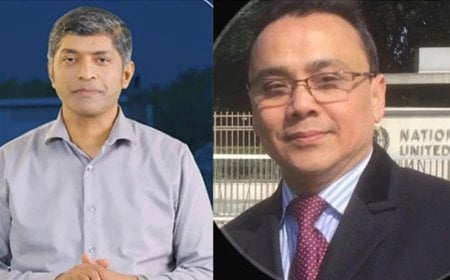
The steady rise in India-origin disinformation prompted Rumor Scanner to speak with Indian journalist Orko Bhattacharya. He warned that the impact of such misinformation is severely damaging relations between the peoples of India and Bangladesh. “A completely false perception of one country is being created in the minds of people of another,” he said, adding that intense hatred and animosity are being generated and amplified through social media.
Associate Professor Rajib Nandi of the Department of Communication and Journalism at the University of Chittagong believes Bangladesh also bears responsibility. Speaking to Rumor Scanner, he said that the unchecked rise in mob violence, recurring communal attacks, and the lack of firm and credible responses at the state level are providing Indian media with raw material for exaggeration. Weak governance, failures in law enforcement, and the absence of clear political positions against violence have further complicated the situation.
Nandi warned that unless Bangladesh’s governance structure takes a clear, firm, and ethical stand against violence, exaggerated and distorted narratives in neighboring countries’ media will continue to be reproduced.
According to this media researcher, these disinformation campaigns are no longer merely journalistic errors; they have become strategic tools for shaping public opinion and political narratives about a neighboring state.
Bhattacharya, who has long spoken out on the issue, believes that communal problems rooted in the subcontinent affect both countries. “Communal violence has existed in Bangladesh—during the Awami League era as well. We saw Nasirnagar, Ramu, and the bloody Sharadiya incidents of 2021. The problem persists today, just as minorities remain vulnerable in India. This is not the curse of any one country—it is the curse of the entire subcontinent. But when mainstream media spreads false and exaggerated information, the issue becomes trivialized. That is dangerous,” he said.
On whether the lack of effective action at the governmental or policymaking level in either country is to blame, Bhattacharya expressed skepticism. “I don’t think governments can realistically do much without being accused of interfering with media freedom,” he noted, suggesting that fact-checking initiatives and building people-to-people communication between the two countries may offer partial remedies.
Asked whether Indian domestic politics is accelerating anti-Bangladesh narratives, Nandi said the issue cannot be described as uniformly anti-Bangladesh. “It is primarily a combination of India’s domestic vote-bank politics, identity sensitivities, and strategic political messaging.” However, he added that through visual exaggeration, dramatic language, and unverified information, Indian media is increasingly crossing ethical boundaries and constructing emotionally charged, conflict-driven narratives.
DBTech/Rumor Scanner/EK/OR