





































Environment Must Be Central to Development Planning: Rizwana Hasan
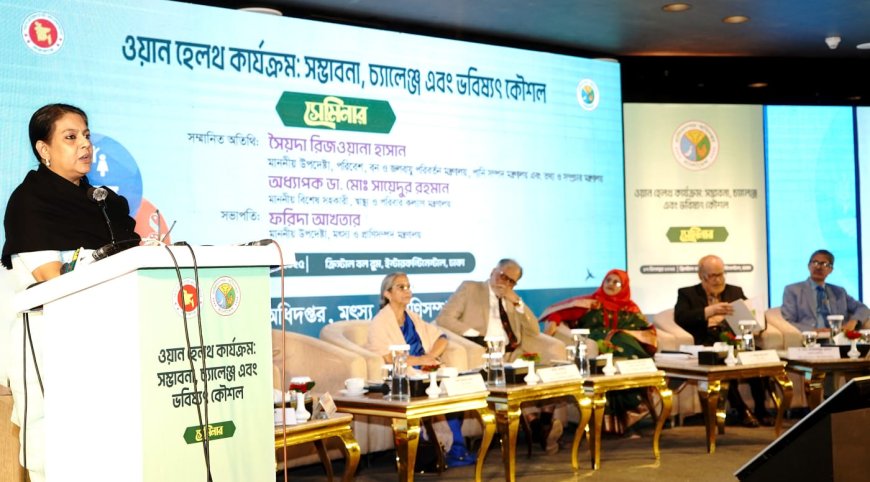



Adviser to the Ministries of Environment, Forest and Climate Change; Water Resources; and Information and Broadcasting, Syeda Rizwana Hasan has said that integrated and forward-looking decision-making is essential, with environment, biodiversity, and public health placed at the centre of development planning. She warned that when environmental destruction is carried out in the name of development, society ultimately bears the cost.
“While roads or infrastructure can be built, a Sundarbans or a river cannot be recreated,” she said, adding that climate change, pandemics, and environmental crises repeatedly remind us that every element of nature is deeply interconnected, and that humans are not owners of nature but an inseparable part of it.
She made these remarks as the chief guest at a seminar titled “One Health Initiative: Prospects, Challenges and Future Strategies,” held on Wednesday (17 December) at a hotel in the capital.
The environment adviser noted that excessive procedural complexity, lack of inter-ministerial coordination, and delays in decision-making are major obstacles to implementing the One Health initiative. To overcome these challenges, she stressed the need for effective advisory committees at national and district levels, along with clearly designated focal points in each ministry.
She further said that increasing manpower, expanding online processes, and strengthening coordination with the Planning, Public Administration, and Finance ministries could accelerate project implementation. Drawing from practical experience, she pointed out that in many cases, a significant portion of a five-year project timeline is spent solely on land acquisition, underscoring the need for transparent and effective reforms.
Syeda Rizwana Hasan described One Health not merely as a technical framework but as a social and ethical commitment. She emphasized the importance of clearly explaining to people at all levels of society why wildlife protection and nature-based development are essential, warning that no development initiative can be sustainable without strong social values. She expressed optimism that the government would work sincerely to strengthen the One Health initiative through capacity building, policy reforms, and effective coordination.
Speaking at the seminar, Farida Akhter, Adviser to the Ministry of Fisheries and Livestock, said that to safeguard public interest, the Ministries of Fisheries and Livestock; Environment, Forest and Climate Change; and Health and Family Welfare must work together in a coordinated manner.
Other speakers included Prof Dr Md Sayedur Rahman, Special Assistant to the Ministry of Health and Family Welfare; Dr Farhina Ahmed, Secretary, Ministry of Environment, Forest and Climate Change; Abu Taher Mohammad Jabbar, Secretary, Ministry of Fisheries and Livestock; Md Saidur Rahman, Secretary, Health Services Division; Dr Md Abu Sufian, Director General, Department of Livestock Services; Prof Dr Tahmina Shirin, Director, IEDCR; and Md Zahidul Kabir, Deputy Chief Conservator of Forests.
Representatives from various departments and agencies also took part in the open discussion session.
DBTech/DC/IHK/OR









