




































HERizon Fest 2025: Celebrating Women, Skills, and Employment in Dhaka
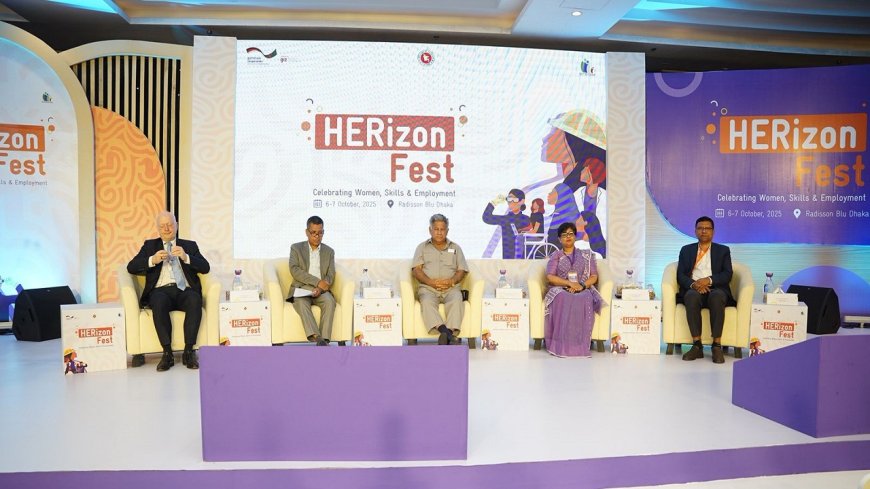



A two-day festival titled ‘HERizon Fest 2025: Celebrating Women, Skills, and Employment’ is currently underway at the Radisson Blu Hotel in Dhaka, organized by the National Skills Development Authority (NSDA) with technical support from the German development agency GIZ. The event showcases women’s empowerment through skill development and employment, and features discussions centered on inclusive and women-friendly approaches to enhancing skills in Bangladesh.
The festival includes a range of activities such as interactive discussions, workshops, and cultural programs, all designed to spotlight women’s leadership, skill-building, and inclusive employment opportunities.
The opening ceremony, held on Monday, 6 October, emphasized the importance of women’s empowerment and inclusive skill development. Speakers particularly highlighted the need for women-focused advancements in technical schools to enhance access to technology and vocational training for women.
Brigadier General (Retd.) Dr. M. Sakhawat Hossain, Advisor to the Ministry of Labour and Employment, inaugurated the festival as the chief guest. Special guests included Lutfey Siddiqi, Special Envoy for International Affairs to the Chief Adviser (with the rank of Advisor), who joined virtually, Md. Saifullah Panna, Secretary at the Office of the Chief Adviser, and Shuaib Ahmad Khan, Additional Secretary (Technical Division), Technical and Madrasa Education Division. Dr. Rudiger Lotz, Ambassador of Germany to Bangladesh, attended as Guest of Honour. The session was chaired by Dr. Nazneen Kauser Chowdhury, Executive Chairman (Secretary) of NSDA.

In his address, Dr. M. Sakhawat Hossain stated, "True empowerment of women is only possible when they are actively involved not only in training and employment but also in policy-making." He acknowledged the significant role of female workers—especially in the garments sector—in driving Bangladesh's economy and fostering social change. The advisor emphasized the need for a secure work environment, leadership development, and participation in decision-making for women, particularly calling for strengthened language and technical training for outbound female workers so they can work abroad with dignity and safety. He added, "Women’s empowerment must not be limited to policy; it must be reflected through real leadership and representation."
Special guest Lutfey Siddiqi remarked, "Women in Bangladesh are not just participants in the development journey, they are a driving force." He stressed the importance of a collaborative approach between government, private sector, and development partners to ensure equal opportunities for women in skills and employment. He added, "We hope that NSDA’s initiatives will create more flexible and supportive learning environments for women, helping overcome both social and institutional barriers."
Md. Saifullah Panna, also speaking as a special guest, highlighted NSDA’s pivotal role in employment generation, stating that if the authority operates at full capacity, it could significantly reduce unemployment. He noted, "Half of our workforce is female—they are skilled, hardworking, and resilient. Their inclusion is crucial for GDP growth, remittance inflow, and overall economic strength."
Shuaib Ahmad Khan, Additional Secretary (Technical Division), emphasized the limited participation of women in acquiring technological and vocational skills. He noted the necessity of women-focused development in technical and vocational institutions, saying that involving women as technicians would enhance GDP, remittance, and economic progress. He also pointed out that many women remain confined to informal work due to household responsibilities, calling for public-private partnerships, industry-ready training, and a shift in societal attitudes.
German Ambassador Dr. Rudiger Lotz stated, "Women’s empowerment is not just for women—it’s for everyone, and it can only be achieved through collective efforts." He added that if women are given safe and inclusive environments to thrive, the entire society and economy will benefit. He assured that Germany would continue to support Bangladesh’s initiatives in this area.
Chair of the opening session, Dr. Nazneen Kauser Chowdhury, acknowledged that women are making notable contributions to ICT, yet female participation in the labor force remains below expectations. She highlighted the transformative influence of digital technology on learning and work and mentioned that NSDA is working under the National Skills Development Policy 2022 to deliver inclusive, market-driven training for women, persons with disabilities, and other marginalized groups. She said, “Through this conference, a framework will be developed for demand-based training programs for women, ensuring safe and dignified workplaces, inclusive opportunities for disabled and marginalized women, and promoting female participation in future-oriented sectors such as the digital economy, green industry, care economy, and the creative sectors.”
Mina Masuduzzaman, NSDA member, emphasized the equal importance of women in national development, stating that women are proving their skills not only in education, health, and services but also in ICT. However, many still lack access to modern technology, technical education, and vocational training. Encouragingly, he noted, “Women are now acquiring skills in ICT, AI, and graphic design, enabling them to freelance from home.”
The first day of the event featured interactive workshops that focused on gender-sensitive capacity building, private sector involvement, and equal opportunities for disadvantaged groups, contributing to NSDA’s strategic direction for inclusive skills development.
The festival was attended by over 450 participants, including officials from the Chief Adviser’s Office and various ministries, development partners, representatives from skills training providers (STPs), academics, private sector and industry skill councils, women’s networks, youth organizations, and media professionals. International experts from Nepal, the United States, Austria, Germany, and UNICEF also shared global perspectives on inclusive technical education and future skills for women—insights that will assist NSDA in shaping strategies to increase participation of young, marginalized, and at-risk women in the labor market.









