





































'You Failed to Kill Abrar Fahad’ to be Screened Nationwide on 6th Anniversary of His Killing
“Abrar Fahad: A New Symbol of Bangladesh’s Sovereignty and Our Cultural Identity.”
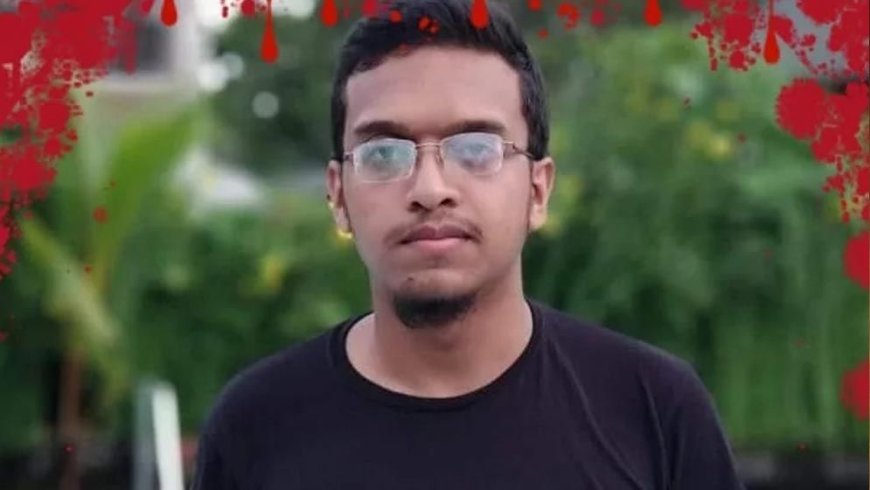



On the sixth death anniversary of Abrar Fahad, a student of Bangladesh University of Engineering and Technology (BUET) brutally killed in 2019, a special screening of the documentary "You Failed to Kill Abrar Fahad" will be held on Tuesday, 7 October, at 7:00 PM in Shilpakala Academy branches across the country, including the central venue in Dhaka. Abrar's father will be present at the Dhaka screening.
In observance of the martyrdom of Abrar Fahad—a symbol of national dignity, independent thought, and resistance—the Dhaka University Central Students' Union (DUCSU) has called for October 7 to be recognized as ‘Anti-Hegemony Day’. As part of the observance, a memorial gathering will take place at Palashi intersection at 3:00 PM, organized by the Abrar Fahad Smriti Sangsad. During this event, Abrar's father Barkat Ullah will inaugurate the "Eight Pillars Against Aggression" at the same location.
It’s worth noting that the initial installation of these eight symbolic pillars was first undertaken by the Student Rights Council on Abrar’s first death anniversary in 2020, led by Akhtar Hossain. However, they were demolished within 24 hours following a directive from Dhaka South City Corporation.
In a statement marking the occasion, DUCSU Vice President Sadiq Kayem said, “The martyrdom of Abrar Fahad is not just an incident—it symbolizes the nation’s dignity and independence. We must honour his sacrifice and nurture a generation rooted in anti-hegemonic ideals so that every citizen becomes a vigilant guardian of freedom and sovereignty.” He urged for nationwide observances to instil a vow among the youth that “we shall never bow to foreign dominance, influence, or injustice.”
The statement further described Martyr Abrar Fahad as a beacon of inspiration and a symbol of national unity, claiming that after the fascist Awami League came to power, the banned terrorist group Chhatra League resumed brutal campus killings, beginning with the murder of Shaheed Sharifuzzaman Nomani. After years of repression, abduction, and extrajudicial killings, Abrar’s death reportedly galvanized the nation against authoritarianism.
The statement added, “The regime attempted to justify killing those with dissenting views, but the martyrdom of Abrar Fahad marked the beginning of resistance against this manufactured legitimacy. The ongoing struggle against hegemonic forces defending sovereignty reached a new height with this sacrifice.” It also noted that the anti-fascist and anti-hegemonic movement culminated in the ‘July Revolution’ of 2024, through the martyrdoms of Abu Sayeed, Shanto, Muggdha, Wasim, Ali Raihan, Tahir, Riya Gop, and Nasim.
Meanwhile, the Interim Government has officially declared October 7 as a national day, commemorating the killing of Abrar Fahad. The announcement came through a post on the official Facebook page of the Chief Adviser on Monday afternoon.
The Bangladesh Shilpakala Academy, in a statement, announced that under the initiative of the Ministry of Cultural Affairs, events will be held nationwide. Special discussions on the life and work of Shaheed Abrar Fahad will be organized, focusing on the theme:
“Abrar Fahad: A New Symbol of Bangladesh’s Sovereignty and Our Cultural Identity.”
The highlight of the event will be the simultaneous nationwide screening of the documentary "You Failed to Kill Abrar Fahad", which portrays his courage and struggle.
Meanwhile, a Facebook post by Abrar Fahad, originally written on 5 October 2019, has once again gone viral ahead of his death anniversary. The post, critical of Bangladesh-India relations, has garnered over 450,000 likes and 73,000 shares within hours. The renewed attention reflects the lasting impact of his words and legacy.
In that now widely circulated post, Abrar wrote:
“After the 1947 Partition, there was no seaport in the western part of the country. The then government requested India for temporary access to the Kolkata port for six months. But our ‘big brothers’ advised us to measure our own roads. Eventually, to prevent famine, we had to open the Mongla port before its official inauguration. Ironically, today India is the one requesting access to use that same Mongla port.”
He continued:
“A few years ago, the dispute over the Kaveri River made headlines as the Kannada and Tamil people clashed over water-sharing. If one Indian state refuses to share water with another, why should we provide 150,000 cubic meters of water daily without any exchange? A few years back, citing national interest, India halted the export of coal and stone. Yet we are now preparing to supply gas to them, while our own factories remain shut due to gas shortages. Why should we light a friend’s lamp with the gas we can’t spare for ourselves?”
He concluded with a poignant quote, reflecting the irony of blind self-sacrifice:
“Perhaps it was in search of such happiness that the poet wrote — ‘Give your life, your mind, and all for the sake of others. Is there any greater joy than forgetting oneself for others?’”









