





































Rice Bran Oil Reform: Researchers, Regulators, and Industry Rally for Government Support
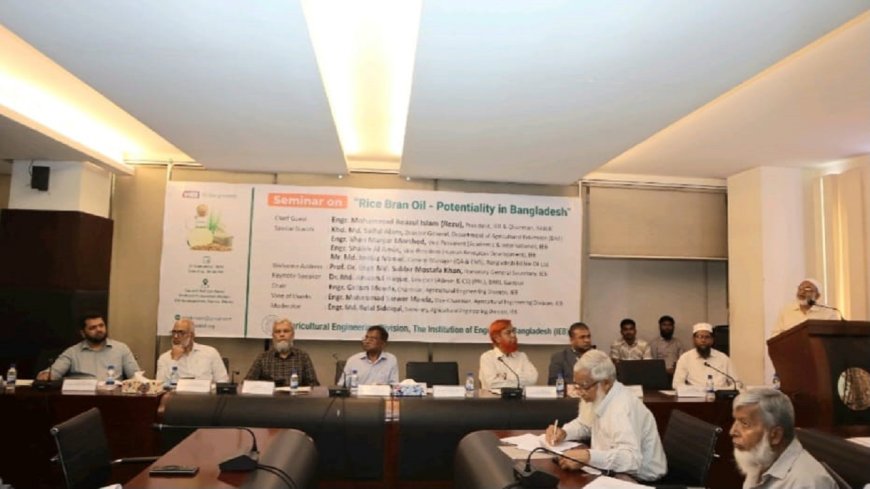



Industry stakeholders have urged government intervention to make edible oil produced from rice bran more accessible in Bangladesh, in light of both domestic and global market demands. The call came during a seminar titled “Rice Bran Oil – Potentiality in Bangladesh” organized by the Agricultural Engineering Division of the Institution of Engineers, Bangladesh (IEB) at its headquarters in Ramna, Dhaka, on Saturday, September 27.
Speaking as chief guest, Director General of the Department of Agricultural Extension (DAE), Agriculturist Md. Saiful Alam, remarked, “Rice is our principal crop. If we can harness the potential of oil produced from its husk, both the agriculture and industrial sectors will benefit. The government is giving the highest priority to agro-processing industries, and policy support will continue to advance oil production. In addition, a specialized agricultural engineering wing is being established at the DAE to strengthen food processing and mechanization.” He expressed optimism that with sustainable production systems, Bangladesh would achieve self-sufficiency in agriculture by 2050.
Special guest and IEB Vice President (HRD), Engineer Sheikh Al Amin, stated that IEB has long been working to enhance the professional skills of engineers. He noted, “Although rice bran oil is beneficial to human health, we are exporting it abroad and importing harmful oils instead. The recommendations emerging from today’s seminar will be forwarded to the respective agencies and ministries to ensure increased production and accessibility of rice bran oil.”
Mohammad Imtiaz Masud, General Manager (QA & EMS) of Bangladesh Edible Oil Limited, observed that 90 percent of rice bran oil currently produced in the country is exported to India due to limited demand in the domestic market. “As rice bran oil is comparatively more expensive than other oils, it is not affordable for all. Government intervention is needed to make it more accessible. Automation of rice bran oil mills would increase production and reduce costs. We seek government cooperation to enhance production and ensure supply,” he added.
Delivering the welcome speech, IEB Honorary General Secretary Professor Dr. Engineer Md. Sabbir Mostafa highlighted the critical role of agriculturists in an agriculture-based country like Bangladesh. He affirmed that the seminar’s recommendations would be forwarded to the relevant authorities for implementation.
The keynote paper was presented by Dr. Md. Anwarul Haque, Director (Admin & CS) of BRRI, Gazipur (PRL), who noted, “BRRI has been conducting research on rice bran for a long time. If husks are collected at the right time and processed with modern technologies, it is possible to produce oil of the highest quality. For this, the government, research institutions, and private sector must work together.”
The seminar was presided over by Engineer Golam Mawla, Chairman of IEB’s Agricultural Engineering Division, with Vice Chairman Engineer Mohammad Sarwar Mawla delivering the vote of thanks. The event was moderated by Division Secretary Engineer Md. Belal Siddiqui.
Experts concluded that greater availability of rice bran oil could significantly reduce dependence on imported edible oils, improve public health by replacing harmful alternatives, and contribute to the country’s broader goals of economic development and digital transformation in agriculture.









