





































BUET Boosts Bangladesh’s Frontier Technology Training



To bridge the “skill gap,” the Bangladesh Hi-Tech Park Authority under the ICT Division is establishing the Institute of Frontier Technology (IFT) at Bangladesh University of Engineering and Technology (BUET). Once completed under the Initial Infrastructure Construction (First Amendment) project, the institute will offer courses in machine learning, artificial intelligence, Internet of Robotic Things, micro-fabrication, blockchain, technology ethics, biotechnology, nanotechnology, neurotechnology, data science, cybersecurity, hyper-automation, behavior, intelligence and experience engineering, entrepreneurship, innovation startup ecosystem, sustainability, and more.
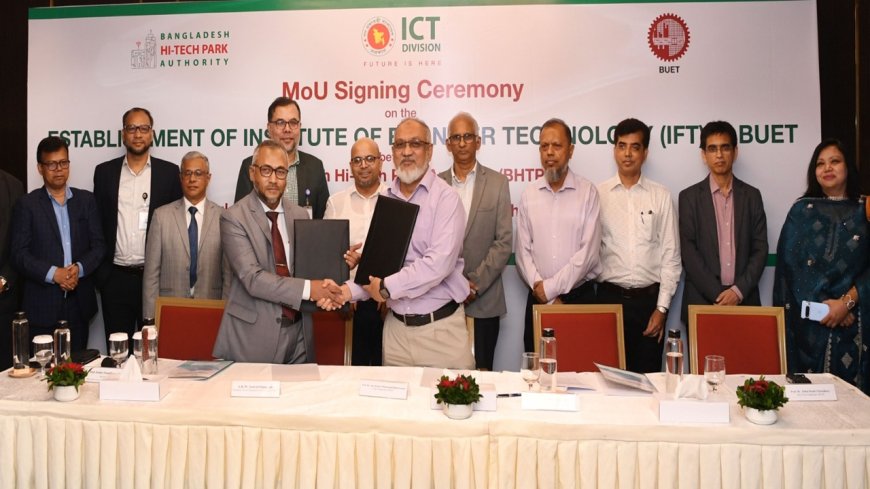
The memorandum of understanding (MoU) between the two institutions was signed on Wednesday, September 10, at the Intercontinental Hotel in Dhaka.
Present at the signing were Foyez Ahmad Taiyeb, Chief Adviser of the ICT Division and Special Assistant to the Ministry of Posts, Telecommunications and Information Technology, BUET Vice-Chancellor Professor Dr. Abu Borhan Mohammad Badruzzaman, and Bangladesh Hi-Tech Park Managing Director A.K.M. Amirul Islam, who signed on behalf of their respective organizations. The event was also attended by ICT Secretary Shish Haider Chowdhury, Project Director Dr. Md. Monsur Alam, and officials from both BUET and the Hi-Tech Park Authority.
In his address, Special Assistant Foyez Ahmad Taiyeb said, “The summary of our combined experience shows there is a significant gap between industry and academia in Bangladesh, and both face research gaps far behind international standards. The solution to this problem is the Institute of Frontier Technology.” He added, “Considering the history and success of university establishment in Bangladesh, and the economic and political factors involved, it becomes clear that universities cannot thrive where there is no sizeable economy. That is why we decided to relocate the Institute of Frontier Technology to BUET from the char areas, as mobilizing necessary students, faculty, and resources for cutting-edge technologies would be nearly impossible there.”
Referring to BUET’s capabilities, he noted, “BUET has eight institutes, with notable achievements in civil engineering and water management. BUET has successfully executed several important nationwide projects. From that experience, we believe placing the IFT under BUET’s supervision will ensure successful resource mobilization and skill gap bridging.”
He emphasized that no additional land acquisition or architectural expenditure would be necessary for establishing the institute. “We sincerely thank BUET for this support,” he said.
Foyez Ahmad Taiyeb added, “We will develop a model to reduce the distance between industry and academia, allowing foreign-returned faculty to conduct courses. Short-term, medium-term, and long-term curricula will be designed according to industry requirements and skills, which is not possible under conventional university regulations. We hope this will mark the start of Bangladesh’s journey to closing the skill gap.”
He further outlined a four-year roadmap: “We will complete the institute’s physical infrastructure within two years, and in the subsequent two years, focus on achieving excellence in courses and academic operations. The ICT Division and Bangladesh Hi-Tech Park Authority will be directly involved with BUET throughout this period. Based on this experience, a ‘course of action’ for the future will be determined.”
BUET Vice-Chancellor Professor Dr. Abu Borhan Mohammad Badruzzaman thanked the ICT Division for the opportunity to collaborate, noting that the initiative is timely, rational, and a major opportunity for the university. BUET Pro-Vice-Chancellor Professor Dr. Abdul Hasib Chowdhury added, “Frontier technologies are constantly evolving. What is considered frontier technology today may not remain so in five years. Therefore, a market-oriented, dynamic, and flexible institution is required to equip students with these skill sets.”









