


































Samsung Studies Active Liquid Cooling for Future Galaxy Ultra Smartphones
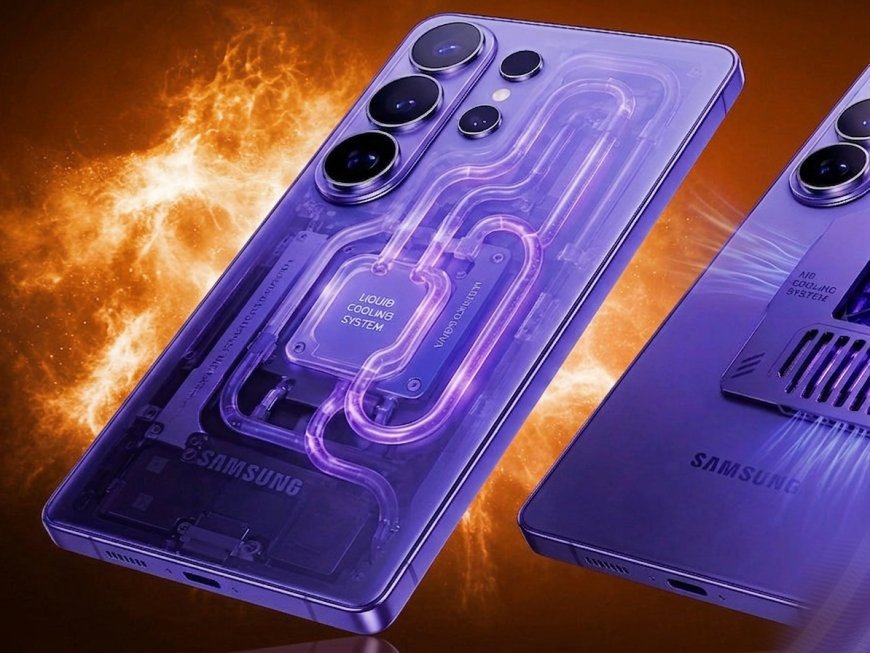



As on-device artificial intelligence continues to place increasing demands on smartphone processors, heat management is emerging as one of the biggest challenges for flagship devices. Excessive heat often leads to performance degradation, commonly known as thermal throttling, especially during intensive AI workloads and high-end gaming sessions.
To address this long-standing issue, South Korean technology giant Samsung is reportedly exploring a major breakthrough in smartphone cooling technology. According to sources familiar with the company's internal research efforts, Samsung is studying the integration of active liquid cooling systems—similar to those found in refrigerators and gaming PCs—into future flagship models such as the Galaxy S27 Ultra and Galaxy S28 Ultra.
The initiative is currently being pursued by a dedicated team within Samsung’s Production Technology Research Institute. Industry observers are now speculating whether the technology could debut as early as the Galaxy S27 series in 2027 or require additional years of development before reaching consumers.
Fan-Based Cooling vs. Liquid Cooling
According to Research Lab Director Park Min, Samsung engineers are evaluating two primary cooling approaches: fan-based air cooling and internal circulating liquid cooling.
Initial assessments reportedly favor liquid cooling technology. Engineers believe that incorporating a fan inside a smartphone could generate unwanted noise and significantly increase device weight. By contrast, a liquid cooling system would utilize a sealed internal loop containing a specialized coolant directly connected to the chipset.
This circulating liquid would absorb and dissipate excess heat efficiently while operating silently, helping maintain optimal processor temperatures without compromising user comfort.
Bringing Gaming-Grade Cooling to Mainstream Flagships
Advanced cooling technologies combining liquid and air-based thermal management are currently found mainly in dedicated gaming smartphones from manufacturers such as Nubia. Samsung’s goal is to bring similar high-performance cooling capabilities to mainstream flagship devices.
The company aims to ensure that future Galaxy S27 Ultra and Galaxy S28 Ultra users can sustain peak performance during prolonged AI processing, advanced computational tasks, and graphics-intensive gaming without experiencing significant thermal throttling.
Building on Existing Thermal Innovations
Samsung has already introduced a new thermal management solution called the “Heat Pass Block” in its latest Exynos 2600 processor. The technology, which debuted in the Galaxy S26 and Galaxy S26 Plus, utilizes a copper heatsink mounted directly on the chipset to improve heat dissipation.
According to industry sources, the solution has delivered encouraging results in current-generation devices.
However, Samsung reportedly recognizes that future on-device AI applications will demand exponentially greater computational and graphics-processing power. Engineers believe that passive cooling solutions alone may not be sufficient to handle the thermal requirements of next-generation AI workloads.
A New Era for Smartphone Cooling?
As smartphone manufacturers increasingly compete to deliver more powerful AI capabilities directly on devices, thermal management is becoming a critical factor in maintaining performance and user experience.
If Samsung successfully commercializes active liquid cooling technology in its future Galaxy Ultra lineup, it could mark a significant shift in smartphone engineering and set a new industry standard for flagship devices.
With speculation already surrounding the expected launch of the Galaxy S27 Ultra, many industry watchers believe Samsung may be preparing to usher in a new era of advanced smartphone cooling designed specifically for the AI-driven mobile computing age.
DBTech/BMT/OR