





































AI and the Airwaves: Radio’s Reinvention in a Conversational Age
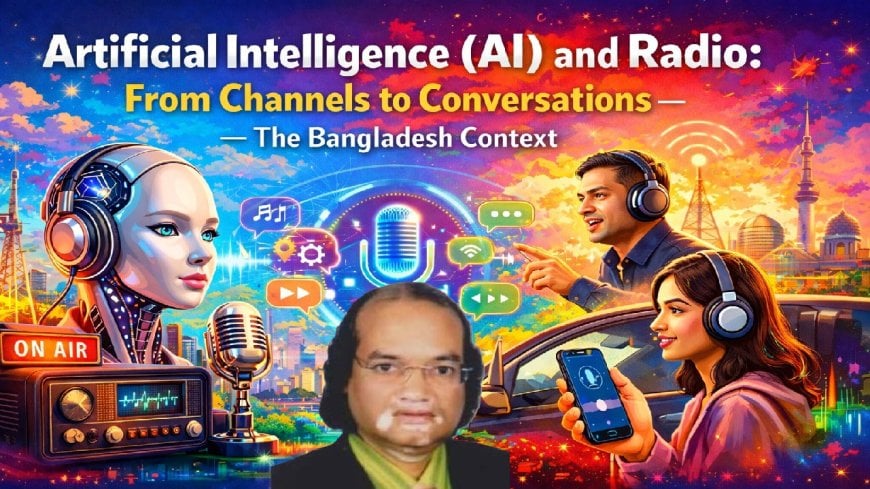


One of the world’s longest-standing and most popular mass media platforms—radio—is being reshaped by Artificial Intelligence (AI). The transformation is not confined to behind-the-scenes production techniques; it is also reshaping how listeners consume content, what they expect, how they search, and even how they ask questions.
Previously, radio was largely a “channel-driven” medium: stations decided what program aired and when, and listeners tuned in accordingly. Gradually, however, it is evolving into a “conversation-driven” experience: listeners ask questions, make requests, pull in topics of personal interest, and receive immediate answers or customized content.
Artificial Intelligence Behind the Scenes: Faster Production, Lower Costs, New Possibilities
Across the radio industry, AI’s impact on content creation is already evident. From ideation to final production, processes are becoming faster and more efficient. Many organizations are using AI at multiple stages, including:
-
Idea generation and scripting: Selecting topics, crafting headlines, developing questionnaires, structuring stories.
-
Editing and post-processing: Cleaning audio, reducing noise, segmenting clips, producing intros and outros.
-
Transcription and archiving: Converting speech into text and preserving it for searchability.
-
Metadata creation: Tagging programs by topic, region, guest, time relevance, and other contextual markers.
In Bangladesh, these advantages hold particular practical value. Many stations operate with limited staff, few trained audio editors, and significant time constraints. AI can serve as a powerful enabler—provided that human editorial control remains intact.
The Transformation Ahead: Both Enabling and Disruptive
AI is undoubtedly a powerful facilitator. Yet it is equally important to recognize its disruptive potential. It is not merely accelerating tasks; it is reshaping the nature of connection itself. The way producers build relationships with listeners—and the way audiences engage with content—is being fundamentally restructured.
A key misconception must be addressed: this shift does not mean that live or linear radio is disappearing. In Bangladesh, live broadcasting remains strong, particularly in areas such as:
-
Disaster and emergency information (cyclones, floods, storm surges, landslides, fires)
-
Power outages or mobile network disruptions
-
Local news and community life (village or sub-district updates, market prices, health advice)
Recent disaster experiences have repeatedly shown that when mobile networks collapse or the internet becomes slow or unusable, broadcast radio often becomes the last reliable source of information. Accessible, affordable, and trust-based, radio remains a dependable companion in modern life. What will change, however, is the language and structure of engagement with listeners.
The Active Listener: Asking, Choosing, Personalizing
Voice-based digital assistants and large language models (LLMs) now understand natural language, provide contextual answers, and respond conversationally. Earlier voice technologies were command-based—“Play this,” “Stop that.” Today’s systems are dialogue-based:
-
“What is the flood situation in my area today?”
-
“What precautions should pregnant mothers take?”
-
“Where is dengue testing available at local hospitals?”
-
“How can I reduce my child’s exam stress?”
Although connected cars are not yet widespread in Bangladesh as in Western countries, the use of smartphones, Bluetooth headsets, smart TVs, and increasingly smart speakers or in-car audio systems is rising. In this context, conversational interfaces allow listeners to “lean forward”: rather than passively accepting what a station broadcasts, they can actively pull content according to their time, context, preferences, and needs.
From Channel-Centric to Content-Centric: A New Branding Battle
Previously, the station was the primary gateway. Now, many users search directly for specific content:
-
“What advice is available for farmers this week?”
-
“Is there any program on migration or expatriate life?”
-
“Which discussion covers women’s digital safety?”
This shift benefits listeners—faster discovery, personalized listening, exposure to new topics. But it poses risks for stations: maintaining brand loyalty and recognition becomes more challenging if audiences forget the source of the content.
Attribution thus becomes a strategic issue:
-
Clear station identification at the beginning and end of content
-
Station branding in titles, descriptions, and tags
-
Visible or audible branding across platforms where content is accessed
Another pressing concern is data and recommendations. Platforms or device manufacturers may seek to convert content engagement into data assets, yet the immediate benefit to producers is not always clear. Negotiation is essential: Who owns the data? Who controls it? Who benefits?
Why This Time May Be Different: Five Converging Factors
This transformation may run deeper than previous technological shifts due to five converging trends:
-
Advanced conversational capability: LLM-based systems understand real dialogue rather than rigid commands.
-
Changing consumption habits: Short-form content, clips, and highlights align with AI-driven discovery.
-
Richer metadata: Better tagging enhances recommendation accuracy.
-
Platform power expansion: Device and app developers seek greater control over content journeys.
-
User expectations: Audiences now expect seamless, intelligent interaction—they prefer to “ask” rather than “search.”
Bangladesh’s Specific Challenges: Misinformation, Language Bias, Privacy
Alongside opportunities, several risks are particularly acute in Bangladesh:
-
Misinformation and deepfakes: Rumors spread rapidly during crises; AI can make false content appear more credible.
-
Language and accent bias: If systems fail to understand regional dialects or minority languages, conversational engagement becomes one-sided.
-
Privacy and security: Listener queries may contain sensitive personal information (health, family, violence, legal issues). Without clarity on data storage, access, and retention, trust will erode.
-
Editorial responsibility: Even if AI accelerates production, truth verification, fairness, context, and harm assessment remain human responsibilities.
A hard truth must be stated: the assumption that “having AI automatically modernizes radio” is dangerous. Technology alone does not guarantee quality. Misapplied AI can erode trust, increase confusion, and undermine news credibility.
Five Preparations for Broadcasters
To navigate this transition successfully, proactive preparation is essential:
-
Build a metadata culture: Tag each program by topic, region, audience, language/dialect, and time relevance.
-
Ensure attribution: Maintain clear station identity wherever content is consumed.
-
Adopt hybrid distribution strategies: Integrate FM/AM with online clips, podcasts, YouTube/Facebook audio, and messaging-based link sharing.
-
Maintain human editorial control: For news, health, legal, and disaster information, ensure mandatory human-in-the-loop oversight.
-
Develop data policies: Clarify listener data consent, retention periods, and third-party access rules.
These goals depend on collaboration with technology providers. Yet collaboration must not become dependency. Conditional partnerships are required—preserving transparency, data protection, and editorial independence.
International Directions: Responsible AI in Broadcasting
Globally, discussions and reviews are underway regarding AI’s potential use in broadcasting—from content aggregation and quality assessment to transmission efficiency improvements. Emerging use cases, technological maturity evaluations, and internationally aligned guidelines can help broadcasters adopt AI more responsibly.
For Bangladesh, this means not merely following trends, but embracing AI within standards-based frameworks.
Artificial Intelligence offers unprecedented opportunities to expand radio’s reach, accessibility, and relevance. Yet the fundamental strengths that have sustained radio for over a century remain unchanged: immediacy, intimacy, locality, and trust.
The question is not whether AI will change radio. The real question is whether we can guide this change toward trust, public interest, truthfulness, and inclusion—or drift toward a platform-controlled, opaque, rumor-prone ecosystem. If adopted thoughtfully and strategically, AI can help broadcast radio continue informing, entertaining, and connecting communities for generations to come.
Author: Founding Member (since 2012) of the International World Radio Day Celebration Committee; Chief Executive Officer of the Bangladesh NGOs Network for Radio and Communication (BNNRC); and Ambassador for Responsible Artificial Intelligence in Bangladesh.
Disclaimer: The views expressed in the Opinion section are solely those of the author. They do not reflect the position of the Digital Bangla Media authority. As a reflection of pluralism, this piece is published without policy-level editorial modification. Any offense or agitation arising from it is strictly the reader’s personal matter.









