






































Procurement Policy Priority: Promoting Participation of Local Players
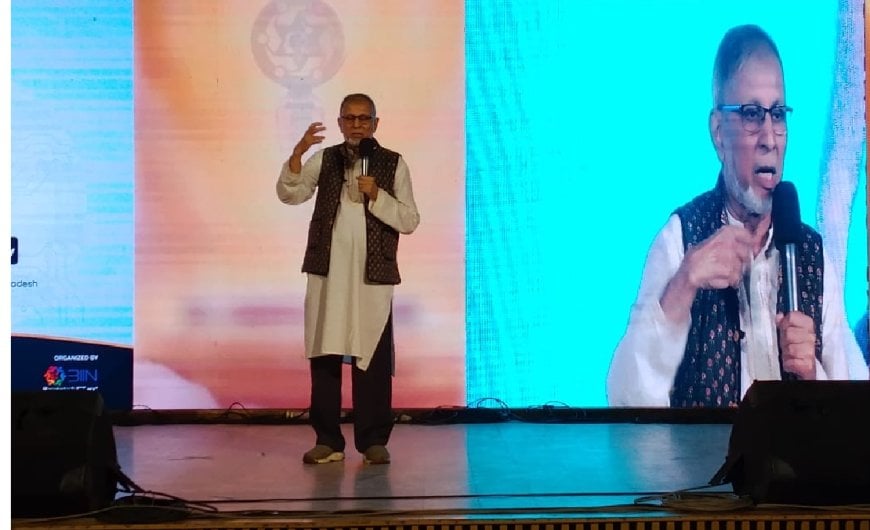



Special Assistant to the Chief Adviser in charge of the Ministry of Finance, Dr. Anisuzzaman Chowdhury, has emphasized the need to ensure opportunities for local firms in government procurement policies in the technology sector.
He said, “In many cases, 60 years of experience is required in procurement. But our country itself is not that old. As a result, these works go to foreign hands. This must come to an end. If we want to build our own capacity, local enterprises must be given the chance to participate in government purchases.”
Dr. Chowdhury made the remarks while addressing the first-ever Bangladesh ICT and Innovation Awards 2025 as the chief guest, held on Saturday at the Independent University, Bangladesh (IUB) campus in Dhaka.
Currently serving as a visiting professor at both the School of Social Sciences and Psychology, Western Sydney University, and the School of Business, University of New South Wales (Australian Defence Force Academy), Dr. Chowdhury returned to Bangladesh following the July uprising to join the interim government. In his speech, the veteran academic presented several candid observations.
Discouraging the country’s dependency on donor agencies, he said, “Dependency and inferiority complex have held us back. That is why we often move according to the prescriptions of donors. We cannot progress independently.”
He further noted, “Innovation is not merely technology-based; it is a thought process.”
Dr. Chowdhury urged for a transformation in national mindset, saying, “We must improve our thought and consciousness. For instance, we cannot pause an event for prayer time. We say ‘Allahu Akbar,’ yet prayer rooms in universities are located underground. Even in naming institutions, we place American, Dutch, or Lankan words before ‘Bangladesh.’ This reflects our inferiority complex and dependency. We must overcome this in thought and spirit to build the people of the future. Otherwise, no innovation or technology can bring true progress.”
He also stressed that “appointments of deans and vice-chancellors should be made based on merit, not election. Only then can citizens of an independent identity emerge. I have taught at many universities around the world, but nowhere have I seen faculty selection processes like ours.”









