





































Three Scientists Win 2025 Nobel Prize in Physics for Pioneering Quantum Circuit Discoveries
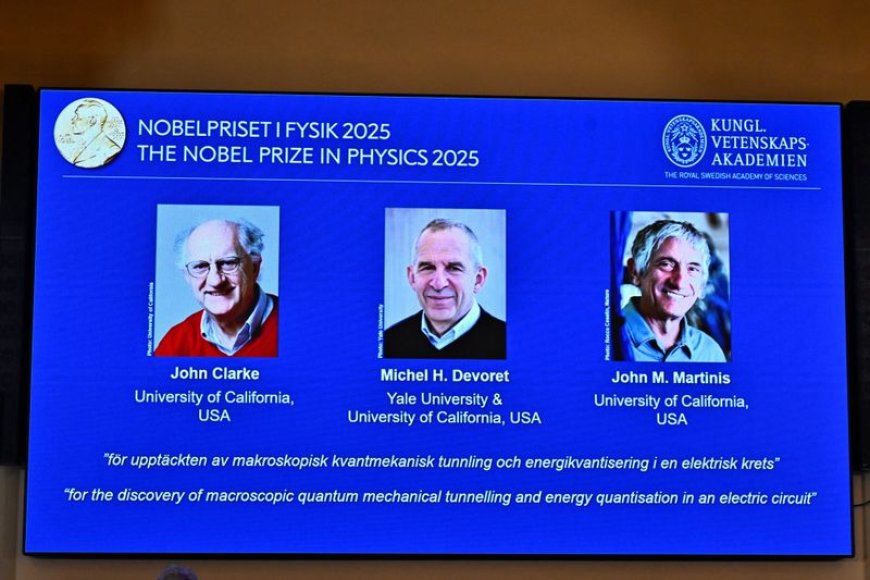



British physicist John Clarke, French physicist Michel H. Devoret, and American physicist John M. Martinis have jointly been awarded the Nobel Prize in Physics for 2025. The Royal Swedish Academy of Sciences announced the prestigious award on Tuesday, September 7, at 3:45 PM Bangladesh time, from Stockholm, Sweden.
The trio has been recognized "for the discovery of macroscopic quantum mechanical tunneling and quantized energy measurement in electrical circuits." Their groundbreaking work has opened the door to major advancements in quantum cryptography, quantum computing, and quantum sensors.
According to the Nobel Committee, the experiments conducted on chips by the three laureates have vividly demonstrated the workings of quantum physics.
One of the fundamental questions in physics is: "How large can a system be and still exhibit quantum mechanical effects?" The Nobel winners successfully addressed this by conducting experiments on an electrical circuit, demonstrating quantum mechanical tunneling and quantized energy levels.
The committee further noted that "this discovery has created new possibilities for the development of next-generation quantum technologies, including quantum cryptography, quantum computers, and quantum sensors."
John Clarke is a professor at the University of California, Berkeley. Michel H. Devoret and John M. Martinis are professors at the University of California, Santa Barbara.
This year's Nobel season, as usual, began with the announcement of the prize in medicine. Following the physics award, the chemistry Nobel is set to be announced on Wednesday, literature on Thursday, peace on Friday, and the economics prize on October 13.
Last year, the Nobel Prize in Physics went to American scientist John Hopfield and British-Canadian scientist Geoffrey Hinton for their pioneering contributions to machine learning and artificial intelligence.









