
































Experts Push for Demand-Driven Tech and Vocational Education in Bangladesh



Only 11 percent of students in Bangladesh are enrolled in degree pass programs, of which nearly half—around 4.5 percent—are unemployed. Highlighting this stark reality, education experts and stakeholders have stressed the need to align curricula with job market demands and improve the quality of education. They emphasized that making the education system modern, demand-driven, and future-ready requires special attention to technical, technological, and vocational education, as well as research collaboration, teacher training, and stronger industry-academia linkages.
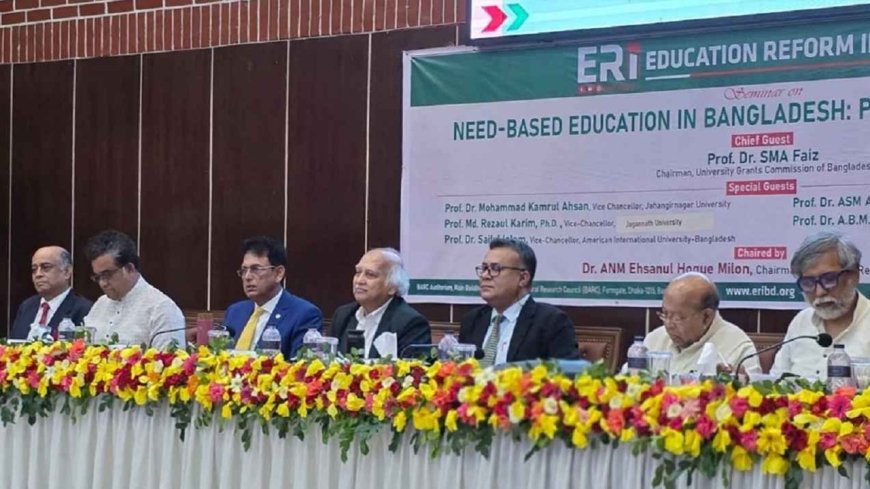
These observations came on Saturday, August 16, at a seminar titled “Demand-Based Education in Bangladesh: Challenges and Prospects” held at the BARC Auditorium in Khamarbari, Dhaka. The event was presided over by ERI Chairman and former State Minister for Education A N M Ehsanul Haque Milon, with Jahangirnagar University Vice Chancellor Professor Dr. Mohammad Kamrul Ahsan presenting the keynote paper.
Professor Ahsan noted, “The biggest problem in our education system is the lack of quality. Every year, 250,000 students score GPA-5 in SSC, but real improvement in education is not happening. About 1 million students sit for SSC exams, but where are those going who don’t achieve GPA-5?”
The paper highlighted that 11 percent of students pursue degree pass courses, with 4.5 percent unemployed, underscoring the need to educate the next generation in line with labor market requirements.
Calling for structural reform, National University Vice Chancellor Professor Dr. A S M Amanullah urged the government to form a modern education commission. Referring to the Fourth Industrial Revolution, he said, “Information technology, robotics, artificial intelligence, and automation are driving this revolution. Our education system must be redesigned to keep pace. The curriculum must be updated so students can work in harmony with modern technology and industry demands. The National University has already started revising its syllabus.”
Bangladesh Open University Pro-VC (Administration) Professor Dr. Saeed Ferdous stated, “Although we have millions of graduates with honors and master’s degrees, there is still a shortage of skilled manpower. In this context, BOU, in partnership with UNICEF, is launching new programs to develop young people into skilled citizens.”
The seminar was conducted by ERI Member Secretary Syed Rezwanul Kabir and attended by scholars, academics, policymakers, and researchers from various public and private universities.
Speaking as chief guest, University Grants Commission Chairman Professor Dr. S M A Faiz said, “Demand-based education is truly the need of the time. Specialized, work-oriented education can transform the country’s massive young generation into national assets. Therefore, any social disregard for vocational education is unacceptable. Be it jobs, research, engineering, medicine, or education—there is global competition. Our students must be prepared for that global stage.”
He also stressed bridging the gap between teachers and students, adding, “We saw how the debate over ‘quota versus merit’ became a major issue. During my tenure as PSC Chairman, I witnessed cases where many claimed to be freedom fighters without legitimacy. Even identifying genuine freedom fighters was difficult. Those benefitting from quotas continue to do so across generations, while those deprived remain excluded. I hope better days are coming soon, when these gaps will be bridged.”
In his presidential remarks, Ehsanul Haque Milon said that unemployed graduates without proper skills have become a “national headache.” He added, “Education must be connected to industry. Developed nations advanced by providing demand-based education. We must design curricula by identifying education that is timely and in demand globally.”
Referring to countries like Singapore and Malaysia, he noted their strategies in preventing brain drain and recommended incorporating such approaches into Bangladesh’s education policy.









