





































Rights, Reform, and Repeal: DSA Victims Call for Disbanding of Intelligence Agencies
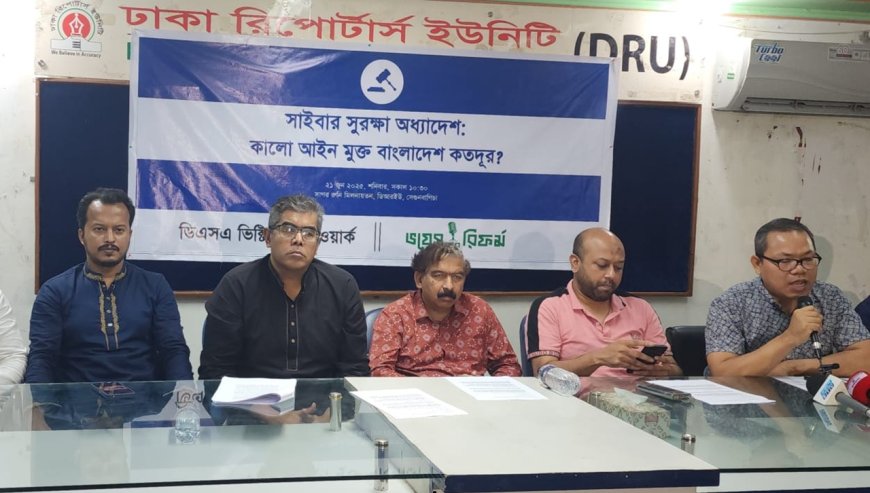



Victims of the controversial Digital Security Act (DSA) have demanded the disbanding of Bangladesh’s elite law enforcement and intelligence agencies—the Rapid Action Battalion (RAB), the Detective Branch (DB) of Dhaka Metropolitan Police, and the Directorate General of Forces Intelligence (DGFI). In the absence of such a move, they proposed nine reform demands, including institutional restructuring of these agencies.
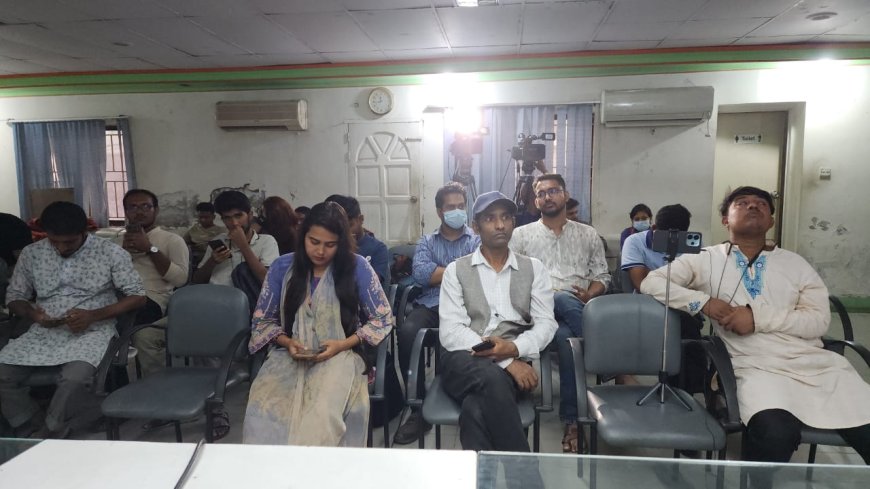
The concerns were voiced during a roundtable discussion titled “Cyber Security Ordinance: How Far is Bangladesh from a Law Free of Repression?” held on Saturday, June 21, at the Sagar-Runi Auditorium of Dhaka Reporters Unity in Segunbagicha. The event was jointly organized by the DSA Victim Network and Voice for Reform.
Fahim Mashroor, organizer of Voice for Reform, expressed suspicion that Israeli surveillance spyware Pegasus is still being deployed in the country. “Foreign surveillance tools, particularly Israeli products, are being used in Bangladesh. We suspect that such spyware is targeting the phones of our political leaders,” he said.
He further raised a pointed question to the interim government: “According to Bangladesh’s telecommunications law, state monitoring of phone conversations within legal bounds is permissible. But if surveillance is conducted through foreign malware like Pegasus—installed covertly on a person’s phone without consent—does that not constitute a criminal act?”
Chaired by Mashroor, the discussion featured prominent speakers including Hasnat Kaiyum, Chief Coordinator of the Rashtra Sangskar Andolon (Movement for State Reform), Asaduzzaman Fuad, General Secretary of Amar Bangladesh Party (AB Party), and Sakib Anwar, Organizing Secretary of Nagorik Oikya.
In a written statement on behalf of victims, Didarul Bhuiyan, Convener of the DSA Victim Network, described the new Cyber Security Ordinance 2025 as “a positive step forward despite some fundamental flaws.” He laid out a set of demands: the provision for instant online warrant issuance to prevent warrantless arrests, public disclosure of the full list of DSA victims, recognition of Mushtaq Ahmed—who died in prison—as a martyr, compensation for Mushtaq and others, a separate law for crimes like pornography, hacking, and gambling, and either the disbanding or restructuring of RAB, DB, and DGFI. He also called for an overhaul of the government’s unilateral legislative powers.
Hasnat Kaiyum added that the Law Ministry’s recent draft of the Cyber Security Act acknowledges, for the first time, “the misuse and repressive potential of the 2023 law, which contravened fundamental rights and freedom of expression.” He said, “This admission is important, and we commend the Law Ministry for it.” He also classified the Special Powers Act as another law being weaponized against citizens.
Barrister Asaduzzaman Fuad emphasized the need for fairness and rights protection in the new legal framework. “Each provision in the Cyber Security Act should ensure the establishment of justice. There must be a general clause that guarantees the law will not violate citizens’ fundamental rights or subject them to unlawful and unjust state actions,” he said. “Such a clause would serve as a key safeguard—something a citizen can invoke when wrongfully accused or detained.”









