






































Hsnat Abdullah Uses Digital Transparency to Counter Funding Allegations in Facebook Live



The rapid expansion of Bangladesh’s ICT infrastructure and widespread adoption of social media platforms are reshaping political accountability and public engagement. A recent example emerged when National Citizen Party (NCP) leader and Member of Parliament for Comilla-4, Hasnat Abdullah, responded to allegations regarding development fund allocations by presenting detailed financial records during a live online broadcast.
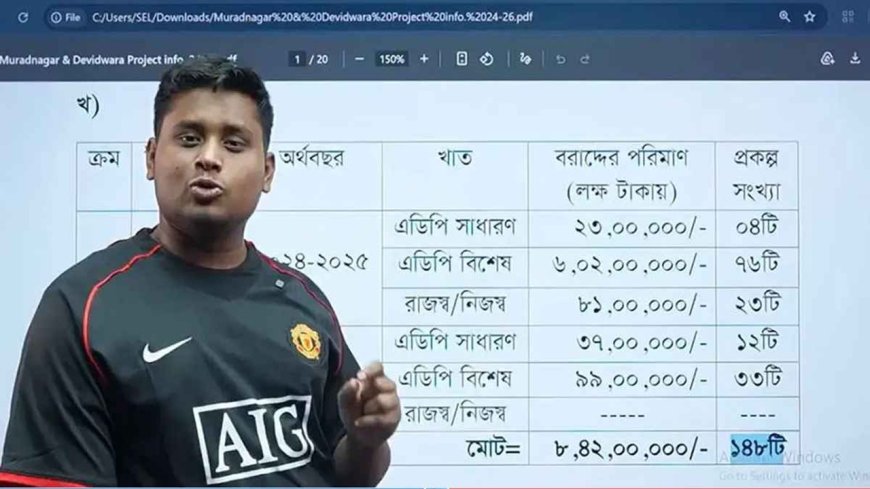
In a 43-minute Facebook Live session streamed from his official page shortly after midnight on May 31, the young political leader used a digital whiteboard to provide a detailed breakdown of development allocations in Debidwar Upazila. The broadcast was widely discussed among young audiences and highlighted the growing role of digital literacy and data-driven political communication in Bangladesh.
During the presentation, Hasnat Abdullah stated that a total of Tk 8.42 crore had been allocated to development projects in Debidwar under the Annual Development Programme (ADP), Special ADP, and revenue-funded initiatives during the 2024–25 fiscal year. According to the figures he presented, the funds were distributed across 148 approved development projects.
Using itemized calculations on the digital whiteboard, he argued that the allocation amount was precisely accounted for and challenged claims that suggested otherwise.
Allegations Spark Public Debate
The clarification came in response to remarks made by Comilla District Council Administrator Mostak Mia during an event at the Shilpakala Academy on May 30. According to the allegations, NCP leader Hasnat Abdullah and former adviser to the interim government, Asif Mahmud Shojib Bhuiyan, had received Tk 25 crore from district council revenue funds, with Tk 10 crore specifically linked to Hasnat Abdullah.
The claims quickly gained attention on social media and triggered extensive public discussion over the allocation and utilization of development funds.
Addressing the issue during the live broadcast, Hasnat Abdullah described the allegations as misinformation and argued that all development-related financial data are publicly accessible through government platforms. He emphasized that citizens now have unprecedented access to information through the internet and social media, making it easier than ever to verify government expenditures independently.
Emphasis on Digital Accountability
The NCP leader stated that budgetary updates and development-related information concerning his constituency are regularly published through his Facebook page, "Jobabdihita" (Accountability), as part of an effort to promote transparency and public oversight.
He further argued that the digital age has significantly reduced opportunities to conceal public information, noting that citizens can independently verify project allocations and expenditures through online sources.
According to the account presented in the broadcast, subsequent discussions with the district council administrator led to clarification that the funds in question were allocated for government-approved development activities rather than for any personal benefit. Hasnat Abdullah maintained that selective presentation of information had contributed to public misunderstanding surrounding the issue.
Digital Politics and Public Scrutiny
Political analysts observe that social media platforms are increasingly becoming tools for direct communication between elected representatives and citizens. Live broadcasts, digital documentation, and publicly accessible government data are enabling politicians to respond rapidly to allegations and engage with constituents without relying solely on traditional media channels.
The episode also reflects a broader trend in Bangladesh’s political landscape, where digital transparency, online fact-checking, and real-time public engagement are playing an increasingly important role in shaping public discourse and strengthening accountability.
DBTech/FBP/EK/OR









