








































Exclusive Interview with Fakir Mahbub Anam, Minister for Posts, Telecommunications, ICT, and Science & Technology
"We Want to Rebuild the ICT and Telecom Sector on the Foundations of Accountability, Transparency, and Integrity"



Elected as the Member of Parliament from Tangail-1 in the 2026 general election, Fakir Mahbub Anam is serving as Bangladesh's Minister for Science and Technology as well as Minister for Posts, Telecommunications and Information & Communication Technology. In Prime Minister Tarique Rahman's new cabinet, he oversees two of the country's most strategic sectors—technology and communications.
Within a short period of assuming office, Minister Anam has prioritized not only the sustainable development of Bangladesh's technology sector but also ensuring that no citizen is left behind in the country's digital transformation.
In an exclusive interview with SM Imdadul Haq, Executive Editor of DigiBangla, the minister discussed the key challenges identified during his first four months in office, the government's reform agenda, and its roadmap for the future.
Among the key highlights from the interview:
- The government aims to complete 70–80% of all ongoing projects by December 2026, while work is progressing on the development of a "One Citizen, One Portal" digital service platform.
- A comprehensive review has been initiated of the proposed Telecom Ordinance and the suspended National Telecom Policy, alongside efforts to make underutilized Hi-Tech Parks fully operational.
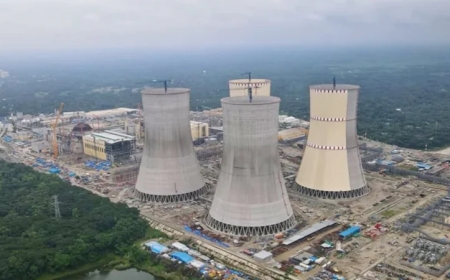
- A deadline has been set to commission the first unit of the Rooppur Nuclear Power Plant by August 2026, well ahead of the commencement of principal loan repayments scheduled for 2028.
Read the full interview in the Q&A below.
DBTech: What was your primary priority or foundational vision upon taking charge of these ministries? After four months, how do you evaluate the current progress?
Fakir Mahbub Anam: Look, the ICT sector is a highly technical domain—I mean, very, very technical. I am learning here every single day—I am learning every day. Over the last 17 years, we have heard the buzzword "ICT" repeated ad nauseam, but the real question is how much substantive work was actually achieved beneath the surface. The foundation of my work rests on three core pillars—Accountability, Transparency, and Integrity. These are the mottos guiding my administration of these ministries.
I have spent the past four months trying to grasp the entire ecosystem. Some might say four months is a long time, but given the massive scale of these operations, it is barely enough. My goal is to anchor the system onto a proper foundation. Our development agendas are aligned with and being implemented according to the current administration's 31-point manifesto. Our immediate priority is to complete 70% to 80% of all ongoing projects by this December. I believe in transparency. Future investments will focus strictly on practical public services that offer clear economic value; we will not entertain any projects lacking demonstrable economic worth.
DBTech: What were the key takeaways or achievements for Bangladesh from the ESCAP conference in Thailand and the Public Service Forum in Georgia? What is your vision for the 'One Citizen One Portal'?
Fakir Mahbub Anam: I recently attended the UN ESCAP conference in Thailand, which saw participation from 53 countries. Bangladesh was successfully elected as the Vice-Chairperson, securing 29 out of 32 votes. I personally chaired a session, and the Under-Secretary-General expressed great satisfaction with our performance, sharing a beautiful commendation letter. The core theme of the event was *"No One Left Behind."* This aligns with our primary objective: ensuring that individuals in remote regions or low-income brackets are not excluded from digital benefits. Delivering internet access to remote areas remains a high priority.
Following that, I attended the Public Service Forum in Tbilisi, Georgia, where discussions centered on delivering governance directly to citizens' doors. We are currently developing the *'One Citizen One Portal.'* Through this, a citizen will find their birth/death registrations, educational credentials, marriage records, employment history, and even legal case logs centralized under one digital roof. In Georgia, I held bilateral meetings with the ministers of Azerbaijan and Kazakhstan. They have advanced significantly in public service delivery, and we must match those global standards.
DBTech: The current ICT and telecom procurement system frequently faces criticism because strict "experience-based" criteria block new players. There are even allegations that tender conditions are altered arbitrarily to favor specific operators. Concurrently, why are these multi-million-dollar High-Tech Parks sitting completely empty?
Fakir Mahbub Anam: The professionals who boast 10 to 15 years of experience today also had to start from scratch at some point. I completely understand your point. While we cannot bypass the statutory rules, we will reform any restrictive requirements or bindings that act as barriers for newcomers to foster a truly competitive bidding environment.
Regarding the specific tender you mentioned—the 60 km fiber-optic laying project from Joydebpur to Jamtoli under the Bangladesh Railway, where criteria were allegedly altered from 5 years to 7 years—that does not fall directly under my ministry. However, if there are similar restrictive clauses or experience barriers within ICT or Telecom that are not business-friendly, I will review them. We will sit down with our officers to ensure the process remains transparent, inclusive, and within the scope of regulations.
As for the High-Tech parks—we have built many buildings... those are lying idle, we are not getting investors. Our High-Tech parks and innovation centers face a severe shortage of investors and skilled manpower; they failed to generate meaningful employment over the past years. We are actively formulating a practical strategy to steer these facilities into productive utilization.
DBTech: What is your current stance on mobile handset registration (NEIR) and the proposed BTRC Telecom Ordinance drafted by the previous interim administration? What is the status of the suspended Telecom Policy?
Fakir Mahbub Anam: The proposed Telecom Ordinance introduced by the previous interim administration has reached our desk, and we are reviewing it thoroughly to ensure it protects the long-term strategic interests of the country. Regarding the National Equipment Identity Register (NEIR), we haven't sat down for a detailed brief yet. I am aware of the stagnation surrounding it. The matter has been forwarded to us, and I am trying to isolate where the bottleneck lies. Our objective is to simplify the system as much as possible within legal boundaries to eliminate public hassle. Give us a little time; we are working to straighten everything out.
Additionally, the previous "Tiger Project" aimed at union-level internet connectivity is being restructured and re-listed as the *"Digital Star Project."* Our officials are currently evaluating whether underground or overhead fiber-optic infrastructure represents the most efficient, cost-effective solution.
We will also focus our attention on the broader Telecom Policy very soon with all stakeholders onboard. Please give us a moment. I am putting in 14 to 18 hours of work every day.
DBTech: There are strong market rumors circulating that the state-owned mobile operator 'Teletalk' is being sold off. How much truth is there to this?
Fakir Mahbub Anam: I want to clarify and reaffirm this unequivocally—the government has absolutely no intention of selling or privatizing the state-owned mobile operator, Teletalk. We need Teletalk in the market. If we abandon this market entirely to private operators, healthy market competition will be severely compromised. Our objective is not to sell Teletalk, but to modernize it and enhance its market competitiveness. Yes, several corporations approached us with outright acquisition or strategic partnership proposals for Teletalk, but as an administration, we have firmly ruled them out.
On the investment front, 'VEON'—the parent company of private mobile operator Banglalink—recently expressed keen interest in collaborating with Teletalk and BTCL. The Chairman of VEON, Augie K. Fabela, met with Prime Minister Tarique Rahman on June 29 and pledged to mobilize a *$1 billion USD* investment into Bangladesh’s digital economy. According to the proposal, VEON will participate as the lead investor by infusing *$250 million USD* directly, leveraging their international network to secure the remaining capital. This planned investment will be funneled into next-generation digital infrastructure, digital banking, mobile financial services (MFS), artificial intelligence, and advanced connectivity technologies.

DBTech: Extensive reports of financial irregularities involving 'Nagad' have surfaced, with audit and investigation figures pointing to liabilities ranging from 171 crore to 1,700 crore BDT. What measures are you taking, and what is your future plan for Nagad?
Fakir Mahbub Anam: The Nagad issue is currently sub judice (under judicial consideration) in court, making it difficult for me to comment directly. We will decide its future only after the ongoing legal proceedings conclude. However, there are multiple figures floating around—there is an investigation report highlighting 171 crore BDT, and another mentioning a 600 crore BDT liability that might have been liquid. The total liability could reportedly run up to 1,700 crore BDT. The primary issue here involved technical manipulation, specifically *"E-money creation"* or generating artificial digital balances. The Anti-Corruption Commission (ACC) has been investigating this since the tenure of the previous interim administration. Once money leaves people's pockets, it is very difficult to recover, yet we are exhausting all avenues.
But let me explain why I want to safeguard Nagad and protect its continued market presence: if Nagad ceases to exist, it will create a absolute monopoly for companies like bKash. They would then be free to hike prices and transaction charges at will, heavily penalizing ordinary citizens. Nagad is a public service; its role is crucial in preventing market dominance and sustaining competition. Therefore, we are holding off on any definitive actions until the court delivers its final verdict.
DBTech: Under the Ministry of Science and Technology, the Rooppur Nuclear Power Plant stands as one of the nation's largest mega-projects. Given the staggering loan burden of 1.13 lakh crore BDT and the pressure of principal repayments starting in 2028, what are your immediate technical and financial deadlines?
Fakir Mahbub Anam: The Rooppur Nuclear Power Plant presents an immense challenge. The project loan is staggering—a whopping *1.13 lakh crore BDT. We must begin paying off the **Principal Amount* starting in 2028; currently, we are only servicing the interest. Consequently, any delay in commissioning this project exponentially increases the financial burden on the state.
We view this as a *national necessity. Fuel loading has already commenced. We are collaborating very closely with Russian experts. If everything progresses according to plan, our target is to connect the first unit to the national grid by the end of **August 2026*, achieving a major milestone for the nation.
DBTech: Your recent official visits abroad have drawn substantial media coverage, with specific criticism directed at the choice of travel companions and delegation expenses. What is your explanation regarding this?
Fakir Mahbub Anam: Many have raised questions regarding my foreign travels, particularly concerning the composition of my delegations. I want to state clearly: to save public funds, I have personally financed these trips out of pocket in many instances. Look at my background—I hail from a political family associated with the BNP since its very inception; I am a third-generation politician. Furthermore, I hold a very solid footing in business and commerce. I have watched five World Cups live in my lifetime. I have nothing left to acquire or gain personally. I have come here solely to give back to my country.
The people voted to elect me as an MP, and the Prime Minister rewarded my constituents by entrusting me with three vital ministries. I am striving to work strictly for public service and national welfare. When I visited major countries like Mexico, I proudly stated, "I am from Bangladesh." We need global exposure. When we visit countries like Azerbaijan or Kazakhstan, they openly commend our public service models. When I chair a session at ESCAP or engage with the Director of the IAEA, the country’s global image rises. If we pull back from these international forums, we risk being erased from the global map. Furthermore, navigating multiple high-level international meetings requires support staff. Many of these expenses are borne by me personally, and where state funds are utilized, the itineraries and companions are selected strictly adhering to regulatory guidelines funded by donor agencies. I promise you, not a single taka of public money will be wasted unnecessarily; my focus remains solely on elevating Bangladesh's honor globally.
On the free flow of information—previously, journalists were often restricted from even entering the Secretariat. Often, we don't get timely responses from your media houses either. However, I prefer direct communication. I welcome you to conduct objective journalism—bring hard proof. When you publish truthful news, it gives us an opportunity to course-correct. But please, refrain from publishing untruths or rumors. For instance, the newspaper Kalbela recently ran a report claiming I had sold off 'Nagad' for 1,700 crore BDT! This is completely baseless and false. When stories like that run, damage control becomes incredibly difficult. While the newspaper's owner later expressed regret, nobody reads a rejoinder—the damage is already done. I believe in open collaboration with the press; you can text or call me directly anytime.
//DBTech/IH/MI//









