








































Policy Support Key to Scaling Bangladesh’s Startup Ecosystem



Despite having a lower startup failure rate compared to many other countries, young entrepreneurs in Bangladesh face their greatest challenges in the area of policy support while working to build and scale startups. Entrepreneurs believe that with the right government policies, Bangladesh’s startup ecosystem has the potential to grow into large, globally competitive companies.
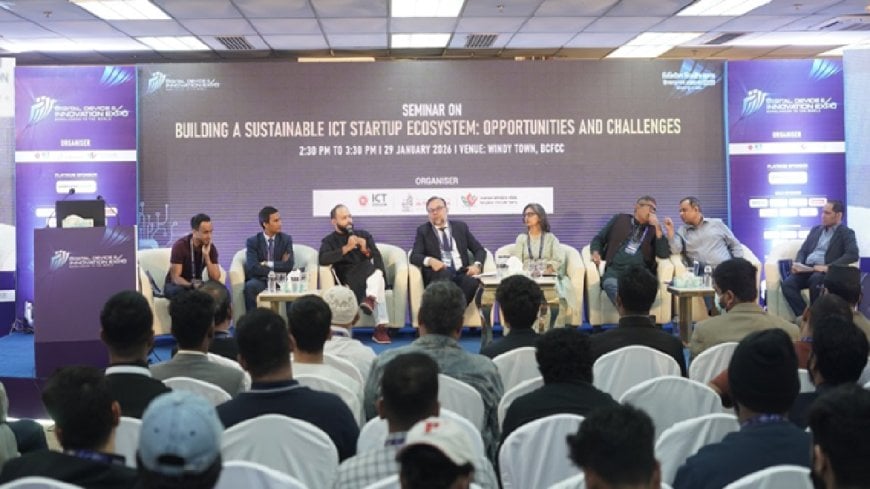
These observations were shared at a seminar held on Thursday, January 29, the second day of the Digital Device and Innovation Expo 2026, at the Bangabandhu Bangladesh–China Friendship Conference Center in Agargaon, Dhaka.
The seminar was organized under the initiative of the Information and Communication Technology (ICT) Division, jointly by the Bangladesh Hi-Tech Park Authority and the Bangladesh Computer Society (BCS). The session was chaired by ICT Secretary Shish Haider Chowdhury, while the keynote presentation was delivered by Nurul Hai, Managing Director and CEO of Startup Bangladesh.
The panel discussion featured Fahim Mashroor, Managing Director of Bdjobs.com; Sadia Haque, Co-founder and Chief Executive Officer (CEO) of ShareTrip; Shaheer Chowdhury, Co-founder and CEO of Shikho.com; Bijon Islam, CEO of LightCastle Partners; and Fahim Ahmed, CEO of Pathao Bangladesh.
In his keynote presentation, Nurul Hai outlined the current state of Bangladesh’s startup infrastructure, highlighting both existing challenges and emerging opportunities. He identified five key parameters critical to the growth of startups: talent conversion, capital depth, market access, trusted infrastructure, and exit pathways.
He also presented an overview of the country’s digital development landscape, noting that Bangladesh has approximately 187 million mobile phone users, 129.8 million internet users—more than 115 million of whom use mobile internet—and at least 239.3 million mobile financial service users.
Nurul Hai pointed out that the primary challenges facing Bangladeshi startups include access to capital and finance, market access, trust and compliance, and exit and repatriation mechanisms. He further highlighted various government policy supports and ICT Division initiatives aimed at strengthening the startup ecosystem, including startup investments, grants, funds of funds, and monitoring networks. Following his presentation, the speakers engaged in discussions based on these themes.
Speaking at the seminar, Bdjobs.com founder and CEO Fahim Mashroor said that there is a lack of credibility in data related to mobile, internet, and mobile financial service users in Bangladesh, describing such figures as “populist data.” He noted that when startups base their strategies on such data, it often fails to yield positive outcomes, increasing the risk of failure.
He further commented that Bangladesh Bank is planning to invest thousands of crores of taka in a startup company, but questioned whether any startup in the country currently has the capacity to effectively absorb such a large fund. According to him, securing funds is not the main issue; rather, ensuring proper utilization is the real challenge. He emphasized that effective policy support from the government is essential to deliver benefits to the public, adding that entrepreneurs have been raising these concerns for a long time and hope the elected government will address them.
Shikho.com Co-founder and CEO Shaheer Chowdhury said that if Bangladesh wants to establish its identity globally, startups must play a central role. He stressed that innovation and applying it to solve real-life problems are key, but current policy barriers are limiting access to users. He identified device taxation and high internet costs as two major policy-related obstacles preventing broader public benefit.
LightCastle Partners CEO Bijon Islam pointed out that one of the major structural problems is the absence of an independent institution dedicated to startups. He argued that establishing such an entity would make it easier to receive policy support.
Chaldal.com CEO Wasim Alim said that compared to other ministries, the ICT sector receives a relatively small budget. Despite ICT companies contributing significantly to GDP, the lack of sufficient budget prevents them from undertaking many important initiatives. He called for an increase in ICT sector funding.
Pathao Co-founder and CEO Fahim Ahmed emphasized that simplifying startup policies is the most critical step forward. While budgets do exist, he noted concerns about their effective utilization. He stressed the need for transparency and efficiency in spending, and added that government policies must be made more startup-friendly. He expressed optimism about Startup Bangladesh’s fund-of-funds initiative.
ShareTrip Co-founder and CEO Sadia Haque said that while the concept of a fund of funds is highly positive, it is also complex. She highlighted the lack of coordination among different ministries as a major challenge, noting that differences in mindset lead to execution problems. As a result, startups may fail to access funds when they need them most. Given the harsh realities faced by startups, she urged that the fund-of-funds initiative should not become entangled in bureaucratic complexities.
She also pointed out the difficulties of bringing all startups under a central framework, particularly due to confusion over which ministry oversees which startup. To overcome this, she suggested that the ICT Division take a leading role so that startups can be registered under a single authority, which would then provide all necessary policy support.
At the conclusion of the seminar, speakers collectively called on relevant government institutions to move forward with a more cooperative and supportive approach to strengthen Bangladesh’s startup ecosystem.
DBTech/FS/EK/OR









