


































NEIR Unmasks Massive Clone Phone Menace in Bangladesh
Nearly 40 Million Mobile Phones Under a Single IMEI Number!
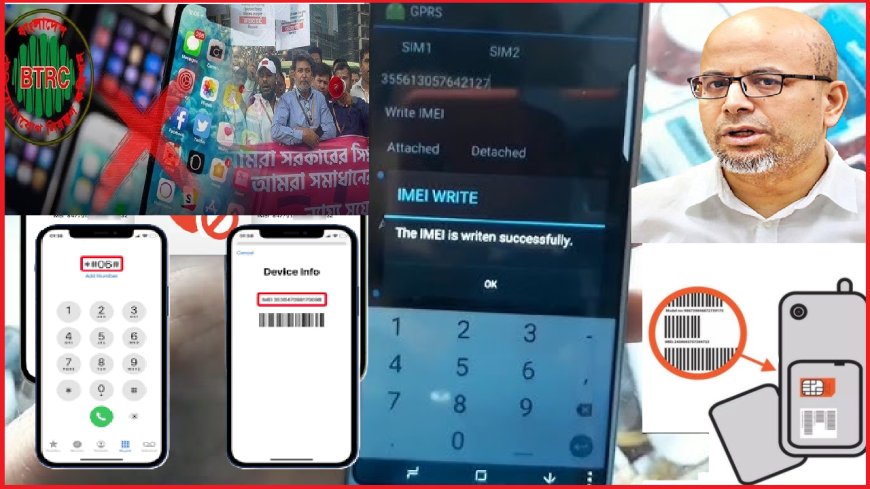



Shocking data has emerged following the rollout of the National Equipment Identity Register (NEIR) on January 1, revealing the staggering scale of cloned and fake mobile phones in Bangladesh. Analysis of top IMEI lists shows that as many as 1,949,088 devices were imported under a single IMEI number—440015202000. Another 1,758,848 devices were registered under IMEI 35227301738634, while 1,523,571 devices were linked to 35275101952326. Alarmingly, 586,331 handsets were found operating under a one-digit IMEI listed simply as “0”.
The Bangladesh Telecommunication Regulatory Commission (BTRC) has also identified millions of fake IMEI numbers operating on mobile networks, including repetitive patterns such as “1111111111111”, “0000000000000”, and “9999999999999”. According to NEIR software data covering the last decade, a staggering 39,122,534 devices were found registered under a single IMEI—99999999999999.
Despite the scale of the issue, the Chief Adviser’s Special Assistant for the Ministry of Posts, Telecommunications and Information Technology, Faiz Ahmad Taiyeb, has assured users that cloned, illegal or counterfeit phones will not be blocked immediately. Instead, such devices will be tagged as “grey” to avoid public inconvenience.
Explaining the complexity of the data, Faiz Ahmad Taiyeb said that various combinations of Document ID, MSISDN and IMEI exist, and that some IMEIs may also belong to Internet of Things (IoT) devices. “Operators cannot technically distinguish between mobile phones, SIM-connected devices and IoT devices. For instance, CCTV or similar devices may have been imported under the same IMEI. That is why we have started tagging legally imported IoT devices separately,” he said. He added that the sheer number of fake and duplicate IMEIs active on networks—often exceeding 100,000 per IMEI—was truly alarming.
He further noted that millions of citizens have unknowingly been using low-quality counterfeit phones that have never undergone radiation testing, Specific Absorption Rate (SAR) testing or other safety checks. These devices are widely active across all four mobile operators’ networks. “The government will not take any step that disrupts public life. These phones will not be shut down; they will be tagged as grey,” he reiterated.
According to BTRC data, at least 24 IMEIs have already been identified as fake or duplicate, each linked to hundreds of thousands of active handsets. For example, 539,648 phones were found under IMEI 3546480200025; 532,867 under 5868800000015; 463,107 under 86740002031661; 413,814 under 86740002031662; and 276,907 under 13579024681122. Several other IMEIs were also found to have between 120,000 and 210,000 active devices each.
“We knew there was a proliferation of clone and counterfeit phones, but we never imagined the depth of the problem,” Faiz Ahmad Taiyeb said. “Selling fake phones to Bangladeshi citizens under the guise of unofficial new handsets is an unprecedented and shocking fraud. This syndicate must be stopped.”
Contextual data further underscores the gravity of the issue. According to a Bangladesh Bank report published in 2024, 73 percent of digital fraud occurs through unregistered devices. Joint data from BTRC and mobile financial service providers show that 85 percent of e-KYC fraud cases in 2023 involved illegal or reprogrammed handsets. That year, 180,000 mobile phone thefts were officially reported, with many more believed to have gone unreported—most of which were never recovered.
Sources also revealed that of the 1.976 million iPhones currently active on mobile networks, around 1.955 million are not listed as legally imported—meaning they entered the country illegally. The number is now estimated to be close to 2.1 million. Similarly, of the 231.29 million Samsung phones in use, about 149.26 million are believed to be illegally imported, bypassing taxes and duties. In some cases, as many as five million phones have been found operating under just 10 IMEI numbers.
Analysts say the findings indicate that the majority of mobile phones used in Bangladesh entered the market through illegal channels, often smuggled in luggage to evade taxes. This is why a phone priced at Tk 30,000 in official showrooms is sold for Tk 20,000 at non-branded outlets in areas like Bashundhara and Eastern Plaza.
Efforts to curb this illicit trade through NEIR enforcement also triggered violent protests. On January 1, attackers vandalised the BTRC building demanding the suspension of NEIR. Protesters argued that government-imposed taxes of 35 to 61 percent on mobile phones forced them to rely on luggage imports and grey-market sales. However, authorities insist that such practices amount to large-scale tax evasion and consumer fraud.
DBTech/FA/JU/EK/OR









