




































Vaccine Vacillation: Study Finds Safety Fears and Hesitancy in Dhaka Schools and Madrasas



Concerns over vaccine side effects have emerged even in the capital city. Moreover, most Qawmi madrasas in Dhaka lack basic “First Aid Kits,” while English-medium schools—despite having kit boxes—often have no formal collaboration or partnership with nearby hospitals.
Researchers have identified similar patterns of hesitancy and inconsistency toward vaccination among teachers and parents in both English-medium schools and Qawmi madrasas. The findings come from a survey conducted under the strategic partnership of the World Health Organization (WHO) and the Health Protection Foundation, organized by the latter in Dhaka City Corporation areas.
The report, released for the first time, aims to strengthen the forthcoming Typhoid Conjugate Vaccine (TCV) campaign under the government’s EPI program, scheduled to begin on October 12.
At the dissemination event, speakers emphasized that the success of the government’s TCV initiative depends largely on the approval and cooperation of English-medium school and Qawmi madrasa management committees and parents. Following the research review, participants recommended identifying and addressing the specific concerns of teachers, students, and guardians regarding vaccination. They also advised measures to dispel rumors, ensure digital record-keeping of vaccination coverage, and maintain paper records for children lacking birth registration.
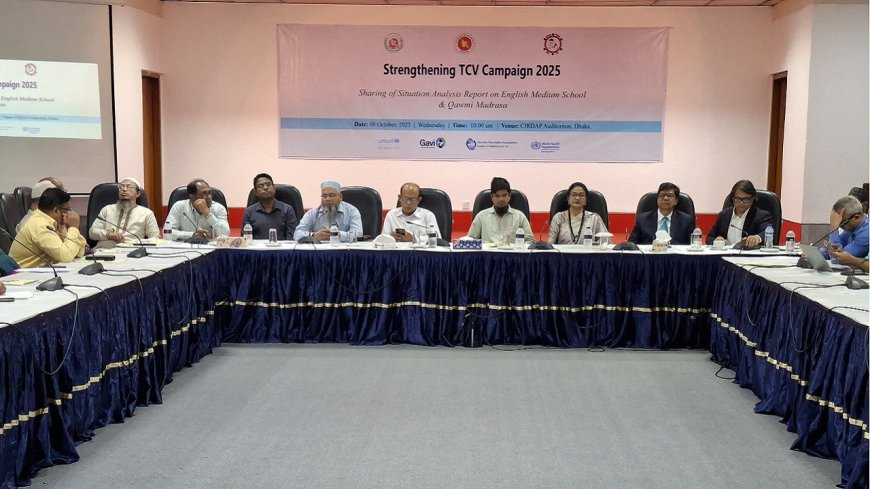
The research was unveiled at an event held at the CIRDAP Auditorium in Dhaka on Wednesday, October 8, organized by the Health Protection Foundation under the strategic partnership of WHO. The findings were presented by Dr. Nizam Uddin Ahmed, Executive Director of the Health Protection Foundation and Chair of Gavi CSO. Dr. Rajib Sarkar, EPI and Surveillance Medical Officer, presented an overview of the Typhoid Vaccination Campaign 2025.
Chief Guest A.T.M. Saiful Islam, Additional Secretary (Public Health Division), Ministry of Health and Family Welfare, attended the event. Other notable participants included Professor Dr. Sheikh Shaidul Haque, Additional Director General (Planning and Development), Directorate General of Health Services (DGHS); Dr. Abu Ahmad Al Mamun, Director (MIS); former Line Director (EPI) Dr. S.M. Abdullah Al Murad; former Program Manager (EPI) Dr. Abul Fazal Md. Shahabuddin Khan; WHO NPO Dr. Chiranjit Das; and Vice Chair of Bangladesh CSO Coalition for Health and Immunization & Executive Director of Aparajeyo Bangladesh, Wahida Banu. Representatives from English-medium schools, Qawmi madrasas, and NGOs were also present.
Chaired by the project’s Policy Adviser Professor Dr. Md. Rafiqul Islam, the study revealed that while most English-medium schools have first aid boxes and some have signed MOUs with nearby hospitals, vaccine hesitancy remains common among teachers and parents.
Many expressed concerns about vaccine safety, quality, and potential side effects, preferring private hospitals for vaccination. Additionally, the visibility of TCV campaign activities was low due to limited space, administrative hurdles, lack of awareness, and minimal promotion. Teachers and management committees had not received any training on TCV, and vaccinators from government or NGOs are not permitted to enter schools without authorization—a major challenge to implementation.
In English-medium institutions, the management committees play a key role in decisions related to education, health, and student welfare, but cannot approve vaccination drives without parental consent.
In contrast, the study found that Qawmi madrasas have very limited health and immunization activities. While students are taught physical cleanliness according to Shariah, vaccine awareness remains low. Most madrasas lack first aid kits, and sick students are usually taken to nearby pharmacies, clinics, or hospitals when necessary.
Occasional health camps are organized, but experience with vaccination campaigns—other than Covid-19 and HPV—is minimal. Implementing the TCV campaign in Qawmi madrasas requires prior approval from their management and teachers, yet awareness and publicity on vaccination are extremely limited.
Teachers and management committees expressed doubts about vaccine safety, quality, and side effects. In some instances, conspiracy theories about vaccines were also noted. Online registration for vaccination is limited, and gender-based restrictions exist—female vaccinators cannot operate in boys’ madrasas, and male vaccinators are not permitted in girls’ institutions.
Smaller madrasas often lack adequate space and facilities for immunization drives, face lengthy approval processes, and have limited communication with government authorities, making implementation more difficult. Moreover, as these institutions are independently run and parent-teacher communication is minimal—without regular parent meetings—the situation poses unique challenges for vaccination programs.
The study used a mixed-method approach combining both qualitative and quantitative tools. Data were collected from both English-medium schools and Qawmi madrasas through interviews with principals, teachers, parents, students, and management committees. Information was also gathered via Key Informant Interviews (KII), Focus Group Discussions (FGD), and participatory observation to ensure cross-verification.
Secondary data sources included institutional records, national EPI guidelines, WHO/Gavi (2025) reports, British Council and Qawmi Board documents, DGHS/BBS data, and school/madrasa archives. The study analyzed infrastructure, enrollment, social barriers (such as vaccine-related attitudes), administration, affiliations, facilities, and communication systems. Ethical standards were maintained through multi-source verification, informed consent, and adherence to scheduled data collection timelines.









