






































Bangladesh Bolsters Defense with U.S. Backing in Drone Development and Joint Exercises
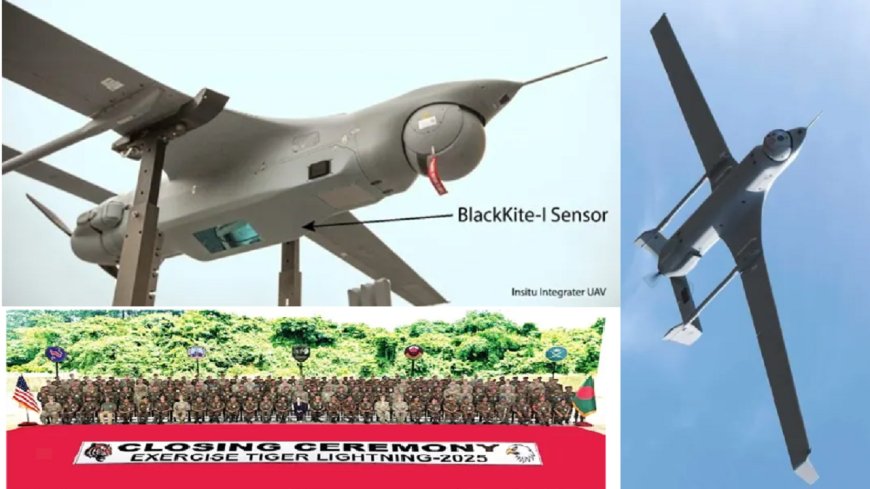



The United States is extending support to Bangladesh in developing an Unmanned Aircraft System (UAS), under which a joint regiment composed of army and navy personnel will produce and operate state-of-the-art drones. To this end, Bangladesh, utilizing Air Guard American funding, has procured Leonardo Falco EVO drones. Additionally, Roketsan has supplied Bangladesh with the TRG-300 Kaplan MLRS model drones, while the Bangladesh Army has taken delivery of six Bayraktar TB2 drones, according to GlobalDefenseCorp.com.
Official U.S. government documents confirm that the joint regiment will operate the new RQ-21 Blackjack system to monitor maritime areas, secure borders, and support peacekeeping operations. Since August, the Bangladesh Armed Forces and the U.S. military have already conducted three joint exercises with this objective in mind. The U.S. will now provide the RQ-21 system as part of its long-term partnership to strengthen shared security interests.
Bangladesh remains one of the key recipients of U.S. excess defense articles. Washington has previously supplied the Bangladesh Armed Forces with patrol ships, Hamilton-class cutters, surveillance drones, C-130 transport aircraft, and armored vehicles. U.S. assistance has also extended to equipping and training Bangladesh Navy’s Special Operations Forces and the Army’s Para Commandos at American facilities. In addition, Bangladeshi naval personnel frequently receive advanced training and scholarships at the U.S. Naval Academy.
Former U.S. Ambassador Peter Haas stated on July 30, 2023, that in 2022 the U.S. provided smaller UAS to SWADS and Para Commandos, along with modern weapons, ammunition, body armor, advanced radio systems, and medical kits. “By next year, we expect to deliver highly capable Blackjack UAS, 35-foot SAFE patrol boats, and additional Zodiac rigid-hull boats. These systems will help Bangladesh carry out UN missions and safeguard its sovereignty,” Haas said during a lecture at the Defence Services Command and Staff College in Dhaka.
The Trump administration was prepared to provide Bangladesh with more advanced capabilities through foreign military sales, contingent upon then-Prime Minister Sheikh Hasina signing the General Security of Military Information Agreement (GSOMIA). However, Hasina declined.
During the turbulent days of 2024, Hasina alleged that Washington sought to unseat her from power for rejecting proposals to establish an air base on St. Martin’s Island, sign a defense pact, allow the formation of a Christian state in the southeast, and award deep-sea oil blocks to an American firm without tender. The U.S., however, denied making such requests and instead emphasized its intent to provide advanced training and modern weaponry to Bangladesh in support of peace and democracy.
As the interim government has since argued, Hasina’s repeated exile in India (1975 and 2024) and her policies aligned with Delhi demonstrated her willingness to serve Indian interests while engaging in corruption and siphoning billions abroad. Her anti-American rhetoric, combined with repression of free speech, opposition politics, and attempts to appease senior military officials with privileges, eroded institutional trust. In contrast, Chief Adviser Muhammad Yunus is now seen as strengthening democratic institutions and freedom of expression.
The annual bilateral exercise Tiger Lightning 2025 (TL25) took place at Jalalabad Cantonment in Sylhet from July 20–31, 2025, involving the Bangladesh Army’s Para Commando Brigade and the Nevada National Guard. Held for the fourth consecutive year, TL25 focused on counterterrorism, peacekeeping, jungle operations, medical evacuation, and countering improvised explosive devices (IEDs). Around 80 U.S. personnel joined, including units from M Squadron, 221st Cavalry Regiment; 303rd Ordnance Battalion; 555th Engineer Brigade; 414th Contracting Support Brigade; and the 4th Military Police Brigade. The exercise supported USARPAC’s Theater Army Campaign Plan and broader security cooperation initiatives by enhancing readiness, interoperability, and professional ties.
Another key engagement, Exercise Tiger Shark 2025, part of the Flash Bengal series, was held in early August in Chattogram, where Bangladeshi and U.S. special forces conducted joint combat training. “This joint military exercise reaffirms our commitment to a safer, stronger, and more prosperous Indo-Pacific. It is also a symbol of the strong U.S.-Bangladesh partnership,” said U.S. Chargé d’Affaires Ambassador Traci Jacobson on August 2.
Since 2009, Tiger Shark has focused on enhancing the crisis-response capabilities of Bangladesh’s Special Warfare Diving and Salvage (SWADS) unit and the Para Commando Brigade, with both sides employing U.S. equipment. The exercise underscores the enduring commitment of both countries to regional peace, stability, and security.
Most recently, Exercise Pacific Angel 25-3, the fourth of its kind with Bangladesh, concluded on September 18 after seven days of Subject Matter Expert Exchanges (SMEEs). Highlighting disaster response capabilities, the exercise emphasized the critical role of the U.S. C-130 fleet in air-to-air refueling, transport, search-and-rescue, and aeromedical operations, further enhancing Bangladesh’s humanitarian readiness.
The exercise brought together about 92 U.S. personnel, 90 members of the Bangladesh Air Force, two Sri Lankan Air Force medics, and Oregon Air National Guard representatives, along with regional partners, to advance cooperation in medical readiness, aviation safety, engineering support, and disaster management. The Inter-Service Public Relations (ISPR) wing of Bangladesh noted that 150 Air Force officers had participated.
“Pacific Angel 25 underscores the enduring U.S.-Bangladesh commitment to defense cooperation and humanitarian preparedness, strengthening the ability to respond swiftly and effectively to future crises. By simulating real-world emergencies, it enhances partner nations’ capacity to confront natural disasters, build regional resilience, and reinforce long-term security cooperation across the Indo-Pacific,” the U.S. Embassy said in a statement.









