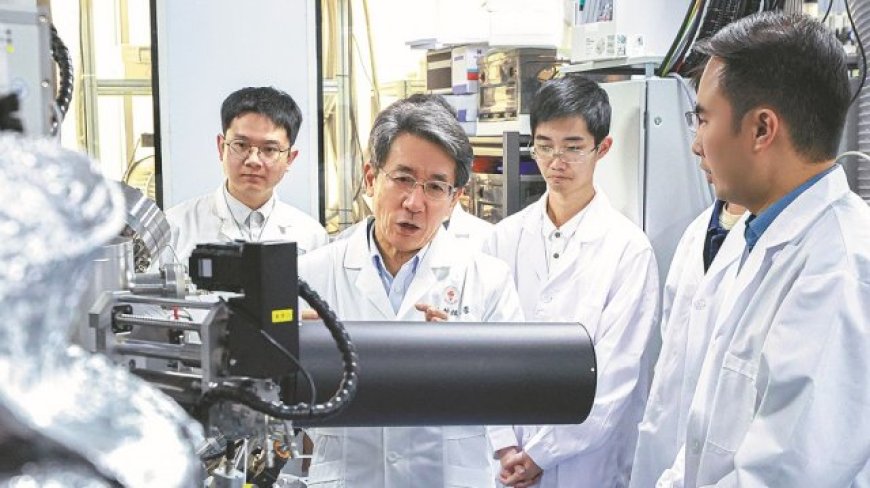
A team of Chinese researchers has made significant progress in understanding high-temperature superconductivity. They have, for the first time, observed a "nodeless superconducting gap" and "electron-boson coupling" in nickel oxide-based high-temperature superconducting thin films. This discovery opens new horizons for explaining the underlying mechanism of this complex process.
The research, a joint effort by researchers from the University of Science and Technology of China (USTC) and the Southern University of Science and Technology (SUSTech), was recently published online in the journal Science.
Jue Kikun, a member of the Chinese Academy of Sciences and a professor at SUSTech, stated that the symmetry of the superconducting gap and the electron pairing mechanism are among the most crucial aspects of high-temperature superconductivity research.
In superconductors, electrons move in pairs to avoid energy loss during electrical conduction. The characteristics of these pairs are determined by the superconducting gap. While this gap is typically uniform and "node-free" in conventional superconductors, it drops to zero in specific directions in copper-based superconductors.
However, the researchers identified a completely nodeless superconducting gap in the new nickel-based film. They suggest that this indicates nickel-based and copper-based superconductors may follow entirely different physics principles.
The research also revealed that electrons can pair through special "boson" particles, despite their mutual repulsion. Researchers identified a specific signal of this type of coupling in the energy data.
Nickel-based superconductivity research is currently a subject of great interest worldwide. However, significant technological challenges remain in preparing the necessary materials and developing experimental equipment.
DBTech/Xinhua/MUM