Will Bangladesh fall behind in the global artificial intelligence (AI) race, or will it leverage AI to boost its productivity tenfold? Seeking answers to this critical question—and aiming to develop one million citizens as “AI-native”—MillionX Bangladesh officially launched its initiative.
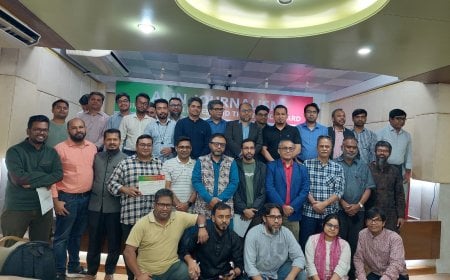
Marking the occasion, the National AI Buildathon was held on Friday, January 16, at Daffodil Plaza in the capital, followed by the Genesis AI Conference 2026 on Saturday, January 17, at the auditorium of the University of Asia Pacific (UAP). Organised by MillionX Bangladesh, the conference brought together top policymakers, academics, and global technology leaders on a single platform to discuss Bangladesh’s AI future and roadmap.
Summarising the outcomes of the concluding day, Dr Junayed Kazi Sara, Founding Council Member of MillionX Bangladesh, announced a commitment to draft a “Bangladesh AI Action Charter.”
Under this pledge, a draft of the AI Action Charter—covering AI policy, personal data protection, and the education sector—will be prepared within 30 days. Within 60 days, the formal implementation process of the charter will begin, and within 90 days, specific projects demonstrating real-world applications of AI technologies will be completed. Dr Kazi Sara further said that within one year, successful projects will be scaled nationwide to deliver benefits to the wider population.
“To move to the next stage of AI adoption, we need unprecedented coordination among policymakers, industry, and academia,” he said.
The day-long conference concluded with a collective commitment in the presence of MillionX Bangladesh Founding Council Members Anis Rahman, Mohammad Mahadi-Uz-Zaman, Munir Hasan, and M Manjur Mahmud, bringing the Genesis AI Conference 2026 to a close.
Opening Session: When the Goal Is a ‘10X Mindset’
The conference was formally inaugurated in the morning by Professor Abdul Hasib Chowdhury, Pro Vice-Chancellor of Bangladesh University of Engineering and Technology (BUET). He said technology and innovation are the primary forces needed to overcome major national development challenges, emphasising increased use of AI—particularly in agriculture—to enhance productivity.
In his address, Professor Dr Kamrul Ahsan, Vice-Chancellor of the University of Asia Pacific, described AI not as a replacement for humans but as a “supporting tool,” stressing the need to modernise the education system accordingly.
The session was moderated by US-based technologist Anis Rahman, Founding Council Member of MillionX Bangladesh, who highlighted the importance of building a sustainable ecosystem by combining expatriate experience with the talents of local youth. Joining virtually from the United States, Dr Yunus Shah advised young people to develop a knowledge-based “10X mindset.”

Session 1: In Search of a Knowledge-Based Future
In the first session, titled “Bangladesh’s Current AI Landscape,” BTRC Chairman Major General Md Emdad Ul Bari (Retd) said, “Inclusion increases revenue. High-level connectivity is the lifeblood of digital infrastructure.”
Silvana Qader Sinha, Founder of Prava Health, noted that AI’s goal should not be automation alone but maximising positive impact on human lives. Professor Dr Celia Shahnaz of BUET’s Department of Electrical and Electronic Engineering stressed the importance of research, while Abu Bakar Hanip, Chancellor of Washington University of Science and Technology, said that university degrees alone are no longer sufficient—short, skills-based programmes are now essential to succeed in today’s job market.
Session 2: AI’s Impact on Society and the Economy
In the second session, Mohammad Mahadi-Uz-Zaman, Founding Council Member of MillionX Bangladesh and Vice President of Cybage Software, said, “AI can empower people, but the responsibility to adapt lies with individuals themselves. No country has progressed by relying solely on government.”
From an industry perspective, Malik Mohammed Saeed, CEO of Square Toiletries, said, “AI may complete hours of a brand manager’s work in seconds, but it cannot replace human judgment. Remember—people who use AI will replace those who do not.”
Professor Khandaker A Mamun of United International University described AI as a powerful equaliser that can give rural students the same opportunities as their urban counterparts. Additional speakers included Mohammad Oli Ahad, Founder of Dhaka AI Lab, and Rakibul Hasan, CTO of Link-Three Technologies.
Session 3: Building AI Talent and Ecosystems
In the afternoon session on workforce development, M Manjur Mahmud, President of Datasoft, discussed strategies for building skilled human resources. Professor Dr Sadia Hamid Kazi, Head of the Department of Computer Science and Engineering at BRAC University, advocated a “problem-first” approach, urging industries to bring real problems directly to universities so students can learn by solving them.
Professor M Tamim, Vice-Chancellor of Independent International University, said, “AI is not only for CSE students—it is for everyone. Without original ideas, even ChatGPT cannot help you create something new.”
Session 4: Leadership Perspectives and the AI Action Charter
In the final segment, video messages were delivered by Asif Saleh, Executive Director of BRAC; Dr Arif Dowla, Managing Director of ACI Group; and Zafar Sobhan, Editor of the Dhaka Tribune. They shared strategic perspectives on Bangladesh’s AI future.
Dr Arif Dowla said, “For a country like Bangladesh, AI is a unique blessing. It enables us to achieve what once seemed impossible. By using small language models and edge computing in critical sectors like healthcare and agriculture, we can make life-impacting decisions more accurate for ordinary people.”
The event was supported by the University of Asia Pacific, Department of Innovation and Entrepreneurship at Daffodil International University, Bangladesh Open Source Network (BdOSN), and Billions for Bangladesh. Technical support was provided by Amazon Web Services, Career Canvas, and Vercel Visiro.
DBTech/MM/IH/OR