





































BTRC Deputy Director Amzad Hossain Nipu Permanently Dismissed for Proven Corruption
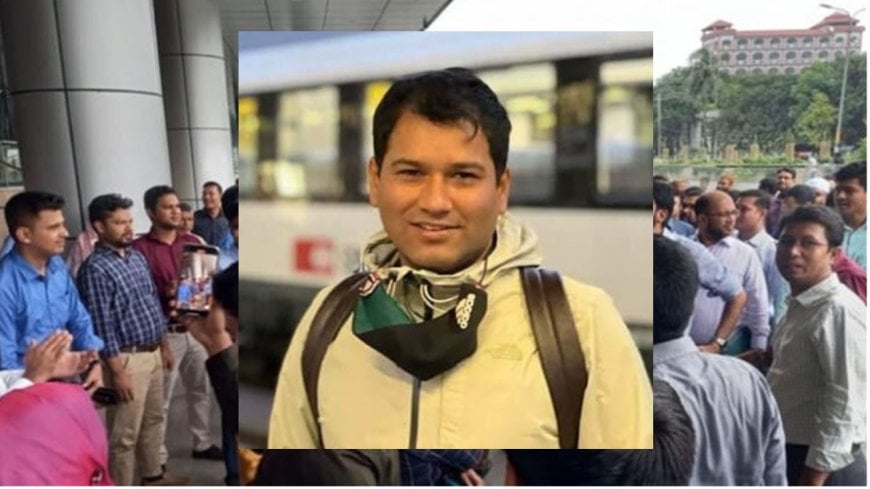



Deputy Director of the Administration Division of the Bangladesh Telecommunication Regulatory Commission (BTRC), Amzad Hossain Nipu, has been permanently dismissed following proven corruption allegations. This marks a new milestone in BTRC’s history, as this former personal secretary (PS) to ex-chairman Mohiuddin Ahmed has now been formally terminated. Through this permanent dismissal, current Chairman Major General Md. Emdad Ul Bari (Retd.) has taken a firm stance on administrative integrity ahead of BTRC’s silver jubilee.
Before this final action, the recently terminated official—who had been appointed to BTRC using his political identity as someone linked with the ruling party’s student wing, Chhatra League—remained under temporary suspension for nearly 15 months with the opportunity to prove his innocence. During the same period (11 August 2024), Mahdi Ahmed, Deputy Director of the Engineering & Operations (E&O) Division, was also temporarily suspended.
In BTRC’s 300th Commission Meeting, the decision to permanently dismiss Md. Amzad Hossain was finalized after serious allegations of misconduct and corruption were proven against him. On 11 November, the dismissal letter was promptly issued and sent to the convicted official’s address in Laksam, Cumilla.
The official dismissal order stated that on 11 August 2024, he was temporarily suspended based on multiple serious allegations, including reports in various national dailies and online media about his involvement in an “illegal syndicate” inside BTRC, harassment of officials and employees, and administrative discrimination.
Subsequently, a departmental case was filed against him under the Government Servants (Discipline and Appeal) Rules, 2018, and the BTRC Service Regulations. His written statement, personal hearing, and the comprehensive report submitted by a three-member investigation committee all confirmed the allegations of misconduct and corruption.
Based on the investigation report, BTRC decided in its 298th Commission Meeting to impose the highest penalty—dismissal from service. Even though he was given a second opportunity to show cause, the commission found his response unsatisfactory.
Finally, in the 300th Commission Meeting, the allegations were upheld, and he was permanently terminated under the Government Servants (Discipline and Appeal) Rules, 2018, and the BTRC Service Regulations, 2022.
The order signed by BTRC Chairman Major General Md. Emdad Ul Bari (Retd.) listed seven grounds for permanent dismissal and stated that the dismissal would take immediate effect in the public interest. The order was sent to all relevant departments, investigation records, and the accused officer’s home address, with instructions to publish it on the commission’s website.
Earlier, on 11 August last year, nearly a hundred BTRC officials and employees staged a protest in front of the BTRC office in Agargaon, stating that Amzad Hossain, who was involved in Chhatra League politics during his student life, used his political identity to secure recruitment in BTRC and later engaged in widespread politicization, irregularities, and corruption. They also alleged that Mahdi Ahmed, the Deputy Director of the E&O Division under the chairman’s supervision, was his trusted accomplice. Consequently, both officers were temporarily suspended that day through orders signed by Aftab Md. Rashedul Wadud, Director of the Administration Division. The orders cited their alleged involvement in an illegal syndicate, corruption reported by national and online newspapers, and repeated harassment and oppression of employees. These actions were taken under Sections 48 and 54 of the BTRC Employment Regulations 2022, and Sections 3(b), (gh), (i), and 12(1) of the Government Servants (Discipline and Appeal) Rules, 2018. While Amzad has now been permanently dismissed, Mahdi’s case remains unresolved.
Notably, the Bangladesh Telecommunication Regulatory Commission (BTRC) was established on 16 April 2001. Although it was formed as an independent commission under the Bangladesh Telecommunication Act, 2001 (Act No. 18 of 2001), it later became a subordinate agency under the Ministry. Within this structure, such a strict and unprecedented decision has been taken for the first time.
DBTech/IH/OR









