






































When the Ground Won’t Stop Shaking: A Wake-Up Call for Bangladesh
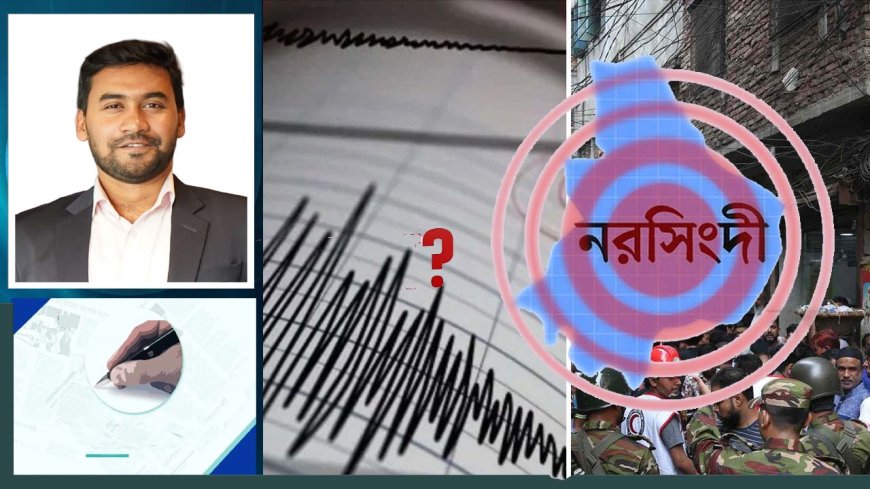


Bangladesh has been jolted repeatedly in recent days—at least five earthquakes in just three days—leaving a lingering sense of unease across the country. While these tremors caused no major damage, their frequency is unsettling. They signal a deeper truth that we can no longer afford to ignore: the threat of a major earthquake in Bangladesh is real, and our current level of preparedness is dangerously inadequate.
Sitting at the intersection of the Indian, Eurasian and Burmese tectonic plates, Bangladesh has always been seismically vulnerable. The catastrophic Assam Earthquake of 1897 and the 1950 Tibet-Assam quake loom large in the region’s history. Yet, despite repeated geological reminders, the country’s urban growth and infrastructural expansion have largely outpaced safety measures. Dhaka, in particular—one of the most densely populated megacities in the world—is perilously unprepared.
The recent tremors revealed how fragile our context truly is. Buildings lacking seismic resistance, haphazard construction, narrow exits, congested lanes, and aging lifeline infrastructure place millions at substantial risk. Experts have repeatedly warned that a major quake—especially one near or under Dhaka—could produce devastation surpassing what Haiti endured in 2010.
Having worked in journalism and public relations, covering issues ranging from urban risks to crisis communication, I’ve seen how information gaps and panic can worsen disaster outcomes. Earthquakes are, by nature, sudden. But the chaos that follows often stems from a communication failure, not the tremor itself.
This is where media—especially digital media—plays a decisive role. Today, Bangladeshis turn to Facebook, YouTube, WhatsApp and online portals faster than television or radio. During the recent tremors, social platforms overflowed with unverified predictions, recycled foreign disaster footage, and sensational claims about upcoming quakes. In the fog of confusion, misinformation thrived.
If the nation is to handle earthquakes responsibly, it must address the digital information sphere. Government agencies and scientific bodies need to adopt real-time communication strategies—not occasionally, but systematically. Public advisories must be concise, credible, and consistent across platforms. Every major digital channel, from social media pages to SMS alerts, should become a conduit for accurate information and practical guidance. Countries such as Japan, Turkey and Indonesia have demonstrated that timely, coordinated communication saves lives. Bangladesh should follow suit.
Yet communication alone is not enough. The physical infrastructure of the country demands urgent attention. Studies regularly highlight that a vast majority of buildings in Dhaka do not meet seismic standards. Many structures were built without proper supervision. Others have weakened over time, worsened by unauthorized vertical expansion and unchecked modifications. Retrofitting must become a national priority—not only for high-rises and commercial buildings but also for schools, hospitals and factories where large groups gather.
Public awareness must evolve from occasional concern to routine practice. When the last tremor struck, many people sprinted down staircases, used elevators or gathered under electric lines, actions that could have turned a mild quake into a deadly incident. Earthquake readiness must become part of daily civic culture. Drills should be conducted in offices, educational institutions and residential complexes. Communities can form volunteer teams trained to guide people during emergencies, following a model similar to the cyclone preparedness programmes that transformed coastal resilience.
Bangladesh must also invest in scientific capability. Institutions such as BUET, the Geological Survey of Bangladesh, and the Bangladesh Meteorological Department require modern equipment, hazard maps and expanded research infrastructure. Cross-border coordination with India and Myanmar is equally essential, as seismic activity in one region rapidly affects the others. Data-sharing and joint early-warning protocols would significantly improve detection and preparation.
The digital landscape deserves special mention. With more than 130 million internet users, Bangladesh’s online community is both a strength and a potential vulnerability. Instead of allowing rumours to spread unchecked, authorities and media houses can use short videos, infographics, livestreams and community-targeted content to strengthen public understanding. Clear guidance—how to “Drop, Cover, Hold On,” how to inspect a building after a tremor, where local emergency assembly points are located—must circulate widely and regularly.
Earthquakes are unpredictable, but preparedness is not. Bangladesh has already shown its capacity for resilience. Cyclone-related deaths have declined dramatically over the decades due to early warning systems, community awareness, and improved shelters. A similar national commitment can prevent large-scale tragedy when the ground moves again.
The tremors felt very recently were nature’s reminder, not nature’s wrath. They are an early signal urging the nation to reassess its priorities. The next quake could strike tomorrow or years later—but the question is whether Bangladesh will be ready.
Preparedness is not merely a responsibility of scientists, engineers or government agencies. It is a collective duty—one owed to every family in a crowded apartment block, every student in a classroom, every worker in a factory, and every patient in a hospital. The ground will shake again. Our readiness must not.
H. M. Imam Hasan :









