






































Banglalink Links Tax Trap on Telecom: High Mobile Taxes Hindering Digital Growth




The high tax rate imposed on Bangladesh’s mobile sector is significantly higher than global and regional averages, and is severely hampering the country’s overall digital transformation and economic growth.
This information was presented through a research report titled “Launching White Paper on Tax Reform,” unveiled at a special event held on Thursday night, May 21, at the Meghna Hall of Pan Pacific Sonargaon Hotel in the capital.
The report made three key policy recommendations to the government aimed at achieving economic growth through enhanced digital connectivity. It suggested restructuring the high supplementary duty and usage-based direct taxes on mobile services to reduce consumer costs; eliminating all entry-level charges and barriers such as SIM tax to include marginal and low-income populations in the digital economy; and formulating a long-term, integrated tax reform strategy aligned with the goals of “Smart Bangladesh 2041” and the ICT Master Plan, instead of focusing narrowly on short-term revenue losses.
Speakers at the event, attended by senior journalists, expressed hope that the government would seriously consider these timely policy reforms to accelerate the sustainable digital transformation of Bangladesh.
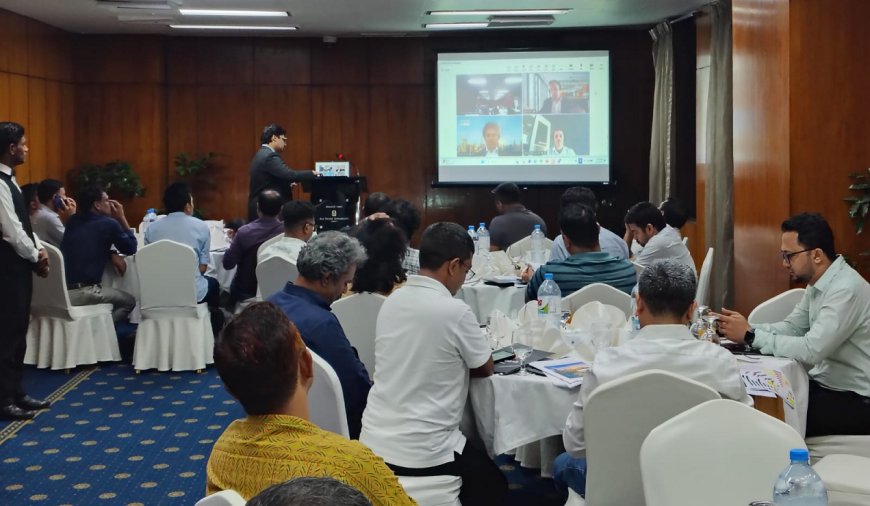
The report was prepared by international research firm Frontier Economics Limited for global telecom giant VEON. The detailed presentation of the paper was delivered before senior media professionals covering the telecom sector by Taimur Rahman, Chief Corporate and Regulatory Affairs Officer of Banglalink.
The study noted that although Bangladesh is a “mobile-first” country, both consumers and mobile operators face a significantly higher tax burden compared to other Asian countries. Citing GSMA (Global System for Mobile Communications Association), it stated that approximately 55 percent of total revenue in the mobile sector is collected by the government through various taxes and fees. In other words, for every dollar earned from mobile services, consumers and operators pay an average of 55 cents in taxes.
In contrast, while the overall tax-to-GDP ratio in the Asia-Pacific region averages 20 percent, Bangladesh’s figure stands at 7.6 percent. However, despite the lower overall tax ratio, the tax burden on mobile services is disproportionately high. Currently, VAT, a 20 percent supplementary duty, and a 1 percent surcharge together push the total tax on mobile usage to 47 percent. In addition, a Tk 300 tax is imposed on each new SIM card, while corporate tax rates range from 40 to 45 percent, significantly higher than the standard 22.5 to 27.5 percent in other sectors.
Taimur Rahman of Frontier Economics, presenting the mathematical model and future scenarios, said that rationalizing the tax structure in the mobile sector would have a strong positive long-term impact on both the economy and government revenue. According to the proposed reform model in the report, reducing the combined tax burden on mobile usage from 47 percent to 23 percent, removing the Tk 300 SIM tax, and lowering corporate tax to 30 percent would significantly increase mobile usage and service penetration.
The report projected that such reforms would increase per capita data usage by 4 percent and overall mobile service penetration by 5 percent. This would also positively impact the macroeconomy, potentially increasing annual per capita real GDP growth from an estimated 6.6 percent to 7.2 percent.
In the first year of tax reduction, government revenue from the mobile sector may fall by approximately USD 761 million or 2.5 percent of total tax collection. However, due to the expansion of the digital economy, formal business activity and overall economic engagement would grow substantially, strengthening other sources of government revenue. According to projections, by 2030, the government could generate significantly higher annual tax revenue from the broader economy and achieve a fiscal break-even position within a few years.
DBTech/IH/MUM/OR









