





































Samsung Strike Suspended, Semiconductor Shock Averted
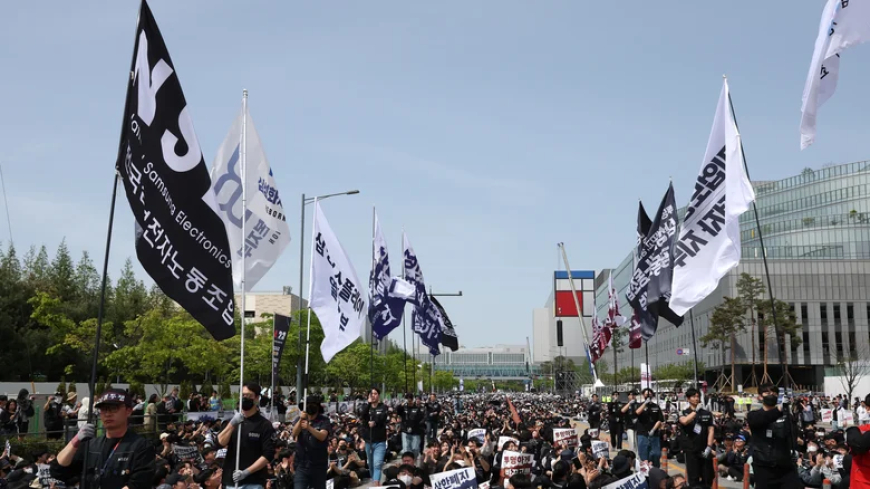



A major crisis threatening South Korea’s economy and the global semiconductor market has, for now, been avoided. Samsung’s largest labour union has suspended its previously announced 18-day mega strike after reaching a tentative agreement with the company over bonus and profit-sharing issues. As a result, the work stoppage that was scheduled to begin today (May 21) has been called off.
Around 48,000 Samsung workers were expected to participate in the strike, most of whom are employed in the company’s highly profitable memory chip production division. Analysts feared that if the strike had gone ahead successfully, it could have triggered a major disruption not only for Samsung but also for the broader South Korean economy.
Final Decision to Be Determined Through Voting
Union leader Choi Seung-ho said workers will vote on the draft agreement reached with management between May 22 and May 27. The agreement will be finalised after the voting results are announced.
In a statement, Samsung management said, “With an extremely flexible and sincere attitude, we will build a mature and constructive foundation for labour-management relations so that such a situation never occurs again in the future.”
Bonus Dispute and Competition With SK Hynix
The strike movement was primarily launched over demands to remove the cap on annual bonuses and allocate 15 percent of the company’s annual operating profit to a bonus fund.
Samsung’s main rival, SK Hynix, had already removed the bonus cap for its employees. Samsung workers alleged that last year SK Hynix employees received bonuses three times larger than those paid by Samsung, resulting in many skilled employees leaving Samsung to join competing firms.
According to Reuters, under the new agreement Samsung has agreed to completely abolish the existing 50 percent ceiling on bonuses and proposed allocating 10.5 percent of annual operating profit as employee bonuses.
Yonhap News reported that 40 percent of the bonus fund will go exclusively to employees in the memory chip division, while the remaining 60 percent will be distributed among workers in other divisions.
However, a condition has been attached to the bonus scheme. Between 2026 and 2028, the memory division must generate at least 200 trillion won (approximately USD 13.3 billion) in profit. In addition, a portion of the bonuses will be provided in the form of company shares over the next 10 years.
Government Intervention as Samsung Drives 12.5% of GDP
Immediately after the announcement of the 18-day strike, the South Korean government moved swiftly to mediate the dispute. Samsung alone accounts for nearly 12.5 percent of South Korea’s gross domestic product (GDP).
The global memory chip giant recorded 53.7 trillion won in operating profit during the first quarter (January–March) of 2026 alone.
Earlier, Prime Minister Kim Min-seuk had warned that the 18-day strike could directly cause losses of nearly 1 trillion won. However, if chips on the production lines had been damaged, the indirect and broader economic losses could have exceeded 100 trillion won (approximately USD 66 billion), a scenario the global market has now narrowly avoided.
DBTech/BMT/OR









