






































Data, Discipline, and Digital Duty: Taiyeb's Technical Observations on Biman’s Ticketing System
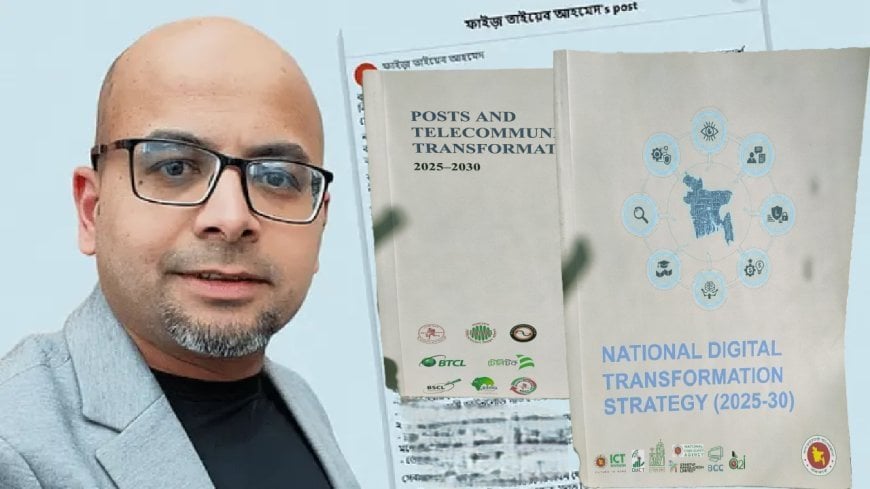



Technical observations and recommendations have been presented to ensure data integration, transparency, and accountability in the ticketing system of Biman Bangladesh Airlines by recently outgoing Assistant to the Chief Adviser assigned to the Ministry of Posts, Telecommunications and Information Technology, Faiz Ahmad Taiyeb. On Friday, 20 February, he shared a detailed post on Facebook regarding the ticketing system.
At the outset of his post, he clarified that although his name had been proposed as a Director of Biman Bangladesh Airlines, he did not sign the joining letter. He also did not attend any office or board meetings.
However, to prevent fraud in Biman’s ticketing system—including group and block booking-cancellation-booking renewal processes, agent ID usage and reuse procedures, as well as system administration, log recording, audit, and data analytics concerning GDS/NDC>PSS>RAPD/RMS—he submitted a short technical report. The report identified a lack of coordination between Biman’s Sales/Marketing and IT teams, absence of proper log records in GDS and PSS systems, discrepancies between payment settlements and group/block bookings, revenue mapping gaps in Amadeus/Galileo/Sabre systems, limited data sharing from software suppliers, restricted access to booking/payment/group blocking/blocking renewal data, and a lack of data analytics capabilities.
According to his post, it was on the basis of that report that his name was eventually included as a Director of Biman toward the end of the tenure.
In his words, “It is often observed that Sales team heads later become the Managing Director of Biman; we have also become aware of this nexus related to group booking/blocking. Group and block bookings are made using fake passenger information and passport data, and later passenger and passport information are changed—this appears to be a major issue. At the inter-ministerial consultation stage, we provided policy inputs regarding ticketing technical processes, data/log access, and data analytics. Biman’s top management may have proposed my name after being satisfied with our work, and I expressed verbal gratitude for that.”
He further stated, “Our recommendation was that at least once a week, real-time agent login data with timestamps must be provided. This should include: (a) Group and block booking information, volume, booking value, booking ID, and booking and payment timestamp data; (b) Group and block booking expiry data, renewal data, and re-entry data; (c) Passenger information—initial entry and modified entry—including at minimum name, date of birth, and passport details. Passport information should be validated in real time via API from the passport database to prevent fake number entries; (d) Booking data against real-time payment settlements and re-booking data against real-time payments; (e) Conditions for initiating bookings from one booking block (alphabetic class or ticketing category) to another. Collectively, agents should not be allowed to hold 50% or more of any block without real-time payment.”
He then highlighted notable aspects of his report (technical matters, not confidential financial details).
Bangladesh Biman’s ticket booking, reservation, fare determination, passenger information management, and all related activities are conducted through a digital operational framework. Specific software is used for each stage, and these are entirely subscription-based—Biman has no in-house system of its own. Through Biman’s Revenue Management System (RMS), fare determination and strategic capacity assessment are conducted based on Revenue Booking Designator (RBD) classes—A/B/C/D/E/Y. The same vendor’s RAPD system generates tariffs based on specific blocks.
Travel agencies make bookings via GDS platforms, particularly Sabre and Amadeus. Primarily, the Sabre platform is used as the booking gateway for Biman Bangladesh Airlines, through which bulk booking, blocking, and cancellation are executed.
Conversely, NDC, developed by IATA, is also an open platform. While widely used by international airlines, it is applied by a limited number of airlines in domestic operations. Biman Bangladesh Airlines has not adopted NDC.
The Passenger Service System (PSS), operated by Sabre, is the most critical component of the ecosystem. It integrates booking navigation, ticket management, tariff data exchange, and coordination with RAPD and RMS. Although passengers can purchase and cancel tickets via web or mobile apps, this accounts for less than 5% of total sales. To verify revenue integrity of travel agency-based bookings, a Revenue Integrity (RI) system operated by Accelya exists.
However, despite the presence of all these systems, effective data integration among them is lacking. In the absence of a centralized, real-time Analytics Platform, audit logs from the systems are either not received on time or, in many cases, not active at all. For example, ASR or Ticketed Sales Files from PSS are sent to RAPD only once daily, which completely hampers real-time visibility. While logs are sent from GDS to the RI system, they do not include agent IP addresses. Although PSS is capable of generating audit logs, there is no platform to analyze them. The RMS system also does not have active audit logs.
As a result, proper oversight of travel agents’ block bookings, reservations, ticket purchases, seat management, and internal tariff planning or RBD configuration is not possible, severely affecting transparency and accountability.
In this situation, to ensure risk management and good governance, the following data must be regularly collected from source systems and rapidly analyzed:
-
All RBD-related settings must be regularly collected in Definition File (JSON/XML/CSV) format in EDR format according to prescribed classifications.
-
Daily Agent-wise Block/Reservation Logs must mandatorily include Agent ID (IATA), Timestamp, IP Address, and related RBD-Class information.
-
Weekly Agent-wise logs of Expiry, Cancellation, and Rebooking must be supplied with proper Agent ID and IP Address.
-
Price Change Logs at the time of booking—any price modification made by agents—must provide audit logs; system features should be activated if necessary.
-
Passenger Information Consistency Check: To verify whether passenger information (PI) provided at booking and ticket purchase stages is identical, daily logs from GDS and PSS must include Passenger ID, Agent ID, IP Address, RBD ID, and Ticket Price for comparative analytics.
-
Transactional ID: To link data across different systems, each log must include inbound and outbound Transactional IDs, enabling clear identification of the source and destination of API-based data exchange.
-
Real-Time Analytical Engine: A robust Real-Time Analytical Engine is required to conduct fast and accurate analysis of collected data, enabling immediate audit activities related to booking, cancellation, blocking, and compliance.
If the above data is supplied regularly and an integrated Analytics Engine is developed to analyze it, Biman Bangladesh Airlines’ operations, compliance, and revenue management can be elevated to a modern, transparent, and accountable level. At the same time, citizen suffering, ticket-related irregularities, and black-market activities would be significantly reduced.
DBTech/FBPO/EK/OR









