











Coordinated Click-Campaign: Facebook ‘Review Bombing’ Targets Media, Analysts and Activists



A newly launched online news outlet came under heavy attack on Facebook after publishing a report about former prime minister Sheikh Hasina, who was ousted in the July mass uprising. Immediately after the report was released, negative “reviews” began flooding the outlet’s Facebook page, sharply reducing its rating. More than a thousand Facebook accounts—run by supporters of the Awami League—worked in a coordinated effort to execute this “review bombing.” Whenever content displeased them, these accounts targeted online news outlets, analysts, political parties, state institutions, public figures, and various organizations to collectively downgrade their Facebook ratings.
Similarly, after fact-checking an online harassment incident involving Tasnim Jara, Senior Joint Member Secretary of the National Citizen’s Party (NCP), the Facebook page of DismissLab—an information verification initiative of Digitally Right—became a victim of such review bombing. What began with one negative review from a single account was repeated by others within minutes. In just two hours, 48 negative reviews appeared, accusing DismissLab of spreading propaganda.
DismissLab’s investigative team launched a probe into the matter. Reviewing 62,592 posts from 1,118 Facebook pages between January and October this year, researchers Partha Pratim Das and Towhidul Islam Raso identified nearly identical review patterns. Multiple pages received the same text, posted within seconds or minutes of each other. They identified 23 recurring review templates, which were reused 1,473 times across another 315 pages.
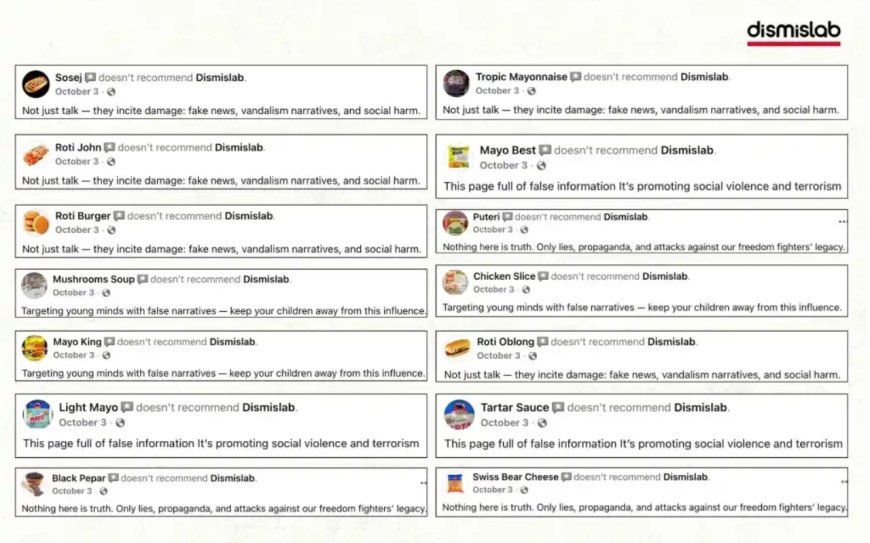
Analysis of the review bombing pattern revealed 23 distinct comment “scripts,” supported by a network of 278 core accounts, more than 600 high-activity accounts, and a total of around 1,019 accounts. Between January and October, this network targeted at least 721 pages. The accusations typically included phrases like “spreading false news,” “promoting terrorism,” and “engaging in wrongdoing.”
DismissLab’s findings also show that the accounts were operated by supporters of the Awami League, a party currently banned from political activity. The review bombing began on 2 October 2025. The network has posted over 13,000 reviews so far, roughly 94% of which promote pro-Awami League narratives.
Among the victims was Drik, an independent media organization, whose Facebook page was attacked after it posted photos from its July–August protest photography exhibition. Pages belonging to BNP Media Cell, Jamaat-e-Islami, and Rastrya Sangskar Andolon were also targeted. Political figures including NDM’s Bobby Hajjaj, Ganadhikar Parishad’s Rashed Khan and Faruk Hasan, and Information Adviser Mahfuz Alam faced similar attacks. Academics and journalists—such as writer and professor Salimullah Khan, journalist Khaled Muhiuddin, Mostofa Firoz, and analyst Zahed Ur Rahman—were not spared. Even Mayer Dak, an organization representing families of the forcibly disappeared, was attacked.
Explaining how the accounts were identified as Awami League–aligned, Raso said their review texts, expressed ideology, and recent posts were cross-examined. He also noted that 24 counter-accounts were found, though their political affiliation was unclear. The pro-Awami accounts had posted positive reviews on Awami League pages, several Indian news media pages, and even the profile of a Bharatiya Janata Party (BJP) politician. Some accounts also gave positive reviews to Kolkata-based ABP Ananda, Republic Bangla, and ZEE 24 Ghanta.
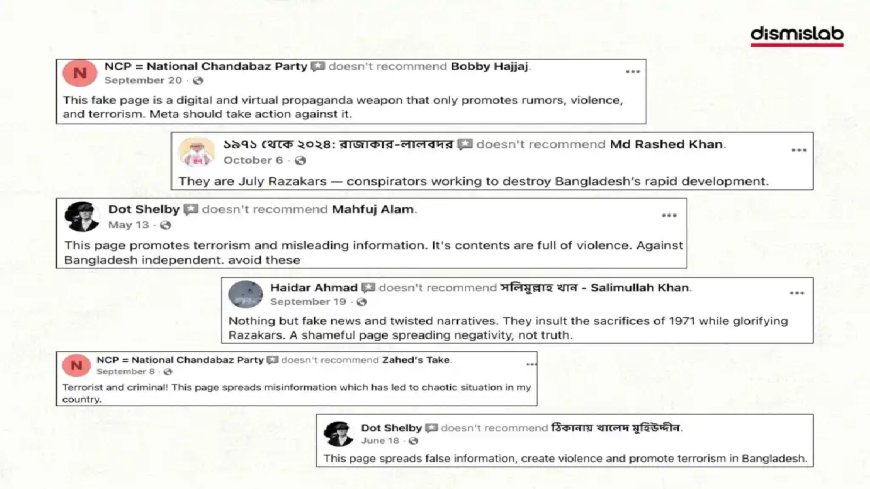
The Awami-aligned network mainly targeted Facebook pages belonging to media houses, political rivals, and cultural institutions. Government agencies, online bookstores, and publishing houses were not spared either. Even the Facebook pages of the US Embassy in Dhaka and the Pakistan High Commission came under attack.
Professor B. M. Moinul Hossain, Director of the Institute of Information Technology at Dhaka University, urged the European Union, Australia, and other stakeholders to increase pressure on Meta—the parent company of Facebook—to tackle such fake reviews.
Asked whether any action had been taken, Digitally Right’s Managing Director Miraz Ahmed Chowdhury said no formal complaint had yet been filed with Facebook, though necessary documentation was being prepared. He added that when a page’s rating drops, new visitors often lose trust and become confused. He stressed the need for greater public awareness and discussion on the issue.
On Facebook, users can review an organization’s page—essentially indicating how strongly they recommend it. Coordinated review attacks can significantly lower a page’s rating, enabling online political influence and manipulation.
DismissLab researcher Towhidul Islam Raso advised that under Meta’s community guidelines, users should report fake reviews by clicking the three-dot menu in the Review section and submitting a complaint.
DBTech/DL/IH/OR